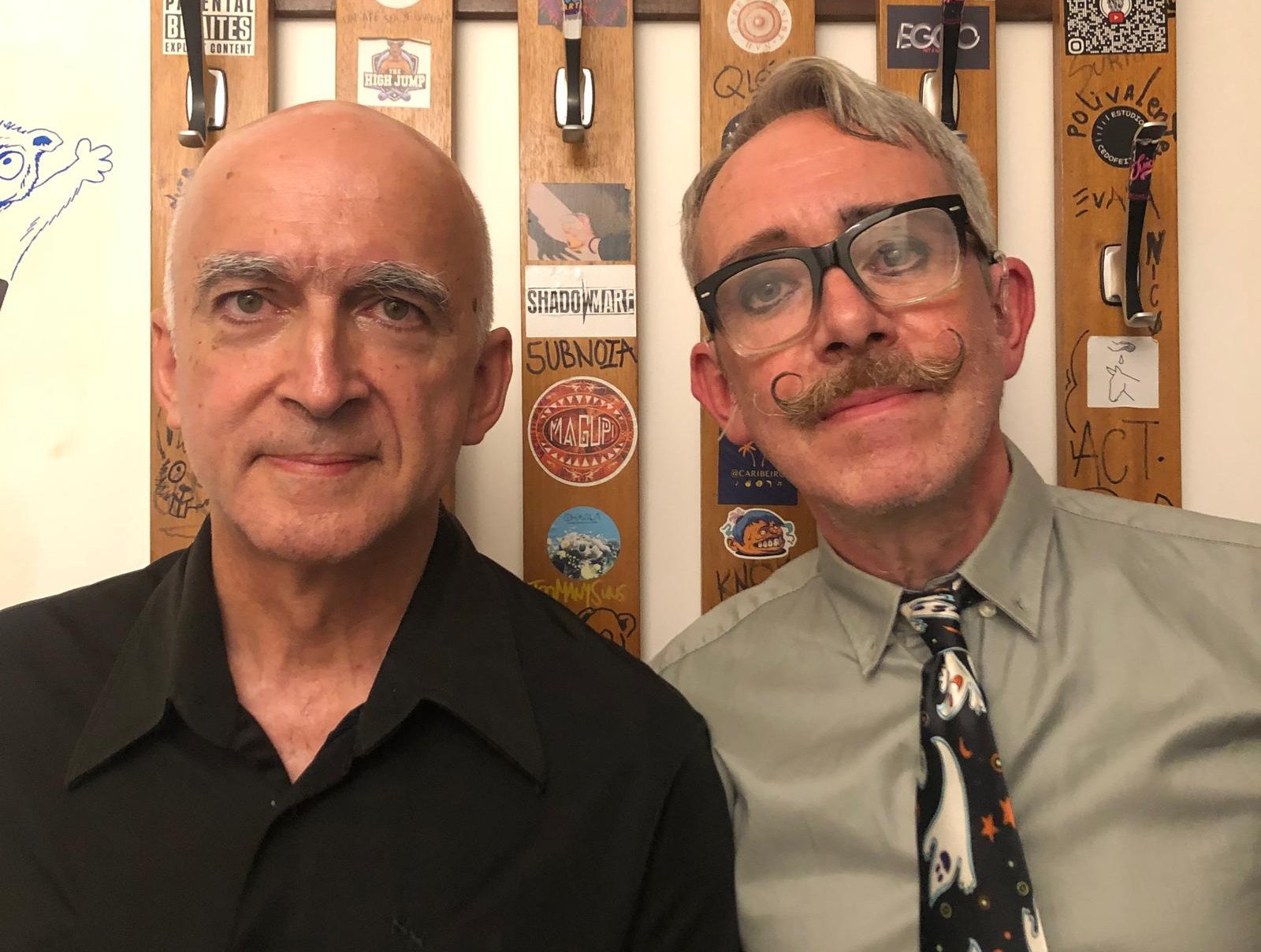
When Portuguese visual artist and academic António Olaio came to London to perform in a play in 2024, he ended up having a pint with Mikey Georgeson, the frontman behind cult British art-pop outfit David Devant & His Spirit Wife. Within months they had a band name, a debut single and a shared philosophy. Since then, The Middle People have released three albums, a Christmas record and are now putting out a Best Of compilation, Can You Feel The Moment, in May.
The name is not an admission of defeat. “Middle,” Georgeson is quick to point out, is not a synonym for average. It refers, with characteristic obliqueness, to the children in John Wyndham’s The Midwich Cuckoos, entities that control without leading. Both men hold doctorates and bring the intellectual confidence to match, yet the music is warm and genuinely fun. They talk to Jason Barnard about working together, plasticity, and the pleasure of finishing what you start.
António, you were already an established figure in Portuguese visual art and had navigated music with Repórter Estrábico back in the eighties. Mikey, you’d built a whole mythology around David Devant. When you met through a mutual friend, was there an immediate sense of creative kinship, or did it take time to click?
António Olaio: I don’t quite remember how but I remember Mikey came to see a play I did with Richard Strange at The Courtyard Theatre in London, and for some reason we ended up meeting again for a pint. I guess we already felt we should do something together sooner or later. We started by exchanging drawings and ended up starting a band!
Mikey Georgeson: I’m often thinking about how rapport works through aesthetic experience (music for instance) and we both seem to unconditionally submit to that. When we meet to discuss ideas the post-rational brain can try and disrupt the rapport but it fails because we both serve the pleasure of the sonic atmosphere.
Mikey, you sent a drawing called ‘Losing My Virginity to Time Itself’ and that it ‘sort of set the tone’. António, what was your reaction when it arrived? And Mikey, was that a considered choice or pure instinct?
António Olaio: From the many drawings Mikey was posting online, I chose that one. When it arrived I was really glad it was finally mine! I loved the title and the drawing is brilliant. There is no grander way to lose your virginity!
Mikey Georgeson: António chose this drawing from my daily morning drawings. These are a conference between the somatic self and the cognitive mind. They are drawn in trance ritual and each one is an entity that speaks back. I feel like we are happy to sing about almost anything so in that sense this drawing sets the tone.
Your first song ‘Hello John’ was about twin brothers who hate each other. That’s a striking way to say hello to a new collaborator. Was that darkness a release valve, or a deliberate signal to each other about the kind of territory you were both willing to explore?
António Olaio: In retrospect, it really helped set the tone for what we did afterwards. After that, we even allowed ourselves to be kind. Actually, as Middle People, we’re essentially kind. Or wicked people in disguise… like those guys who go undercover for too long, we will never know. Actually, we are able to do so many different things and still be coherent. Maybe it’s one of the advantages of being what we are.
Mikey Georgeson: I’m often bewildered that people fail to engage with songs as fictional abundance rather than messages. So I loved the drama and the encounter with something unsettling but powerfully imaginative.
You’re insistent that ‘middle’ doesn’t mean ‘average’. But Mikey, your original reference point was the children in Wyndham’s Midwich Cuckoos, entities that control rather than lead. How does that unsettling source sit alongside the ‘joyful darkness’ and ‘elegant ambition’ you also describe?
António Olaio: Maybe we said that so people could have the word average in mind, even when we were denying being it. It’s really exciting how with music you can turn anything into something else that is so much better! Doing wonderful songs as if you don’t care.
Mikey Georgeson: One of my most resonant memories is the climax of the above film where the protagonist hides the bomb in his mind with an imagined brick wall. The simplest way to explain our identity is Blake’s marriage of heaven and hell. We’re not really about good or bad, we’re about Jouissance in the refrain. I think there’s also a part of me feels like we have allowed a worship of efficiency to steer us. The funny thing is the name of a band is like a book or film title so the main aim is to be alluring (in the way a good horror film is!) rather than giving a clue to the nature of our true selves.
Mikey, David Devant became the house band on Edgar Wright’s Asylum in 1996, alongside people like Simon Pegg and Julian Barratt before any of them were well known. What are your key memories of that period?
Mikey Georgeson: It was a delightful shoot over a couple of weeks in an abandoned children’s hospital. A decidedly sad and spooky place when it came to sleeping there at night. My main take away was how much I loved the work of Julian Barrett. Edgar was a genius too. I loved his recent film Last Night in Soho and Edgar chatted to me about how that is a particularly personal film. It really interested me that making such an explicitly genre film enabled the personal to emerge. Maybe we are slightly Horror as a way of being more personal.
António, Repórter Estrábico came out of the CAPC in Coimbra, a post-revolutionary art scene with performances at the Pompidou. That’s a world away from the Britpop vortex Mikey was navigating. Did your different national art-world contexts create productive friction in The Middle People, or did you find you were speaking the same language from the start?
António Olaio: Me willing to start a band with some friends in the 80’s came from all that. Also from pretending I wanted to be a dancer in my early performances to start to sing wasn’t a big step. And many things, many musical projects happened after that. Things in The Middle People seem easy and we always end the songs we start, and do it very quickly! Thanks to Mikey, of course, the guy in the band who can actually put everything together.
Mikey Georgeson: My relationship with Britpop made sense to me with Michael Bracewell’s book England is Mine. This is steeped in the joy and woe of a peculiar form of English Neo Romanticism so it’s not hard to weave that with Antonio’s love of materially vital dada. That book helped me reconcile my love of painters like Cecil Collins and the songs of Roxy Music as my strange Englishness.
You both have doctorates and are practising academics as well as artists. Does the theoretical framework ever threaten to strangle the instinct when you’re making music together?
António Olaio: Never! And I care more for what comes from other artists than any theoretical frame work. I made my Phd about Duchamp and any theoretical framework seems really boring after him… I believe he gives you confidence to be anything, even to be more concerned in writing lyrics than papers, and feeling so much clever for doing so. And so working with Mikey is pure joy!
Mikey Georgeson: The Deleuzian orbiting theory really saved me and gave me the courage to go further into using aesthetic experience as a vital technology. The Body knows.
‘Can You Feel The Moment?’ was inspired after reading Colin Wilson’s The Outsider, a book about people who feel fundamentally alienated from ordinary experience. How does that theme map onto being ‘middle’, which implies belonging to neither extreme? ‘Things Change’ features The Professor on drums. Mikey, what does it mean to bring a David Devant collaborator into a Middle People record? Do those creative worlds feel continuous to you, or does it feel like different universes colliding?
Mikey Georgeson: Reading The Outsider I was struck by the feeling that thoughts, feelings, and doing are separated in the nausea of the outsider. The meaning inside the feeling of song is what gave Sartre brief relief but personally I militantly believe in song or the lyric voice as the shift into non-oppositional living rather than just relief. Pop has allowed me to live in an emerging real fiction and Graham (the Professor) was the first person there when I discovered this experience. Graham maintained this rapport through music. With Antonio we both step into the space of trust without hesitation.
‘Love Is Plasticity’ features a child playing with a genetics kit and creating new beings. António, plasticity is a word that clearly matters to you, and in Portuguese the artes plásticas carries wider connotations than it does in English. Is the song also about the plasticity of identity itself, how creativity or parenthood remakes who you are?
António Olaio: The importance we give to plasticity is probably what me and Mikey have most in common. For Mikey, the awareness that ‘Love Is Plasticity’ is of great importance! In this song, I liked this idea of a small child playing with genetics as though facing the possibility artistic creations actually existing in the real world. Picasso’s Demoiselles D’Avignon is a beautiful work of art, but wouldn’t it be interesting to have breakfast with one of them if she actually existed as a person? I believe The Middle People celebrate the plasticity of art and of life itself.
Mikey Georgeson: I was delighted when António told me the university wanted to use my lyric “love is plasticity” as a title for a year long international exhibition. The verses are Antonio’s – more ambiguous and dark but about the same thing. I guess love is often seen as this diamond of a perfection. ‘Love Is Plasticity’ was a conscious repost to that insidious myth. It’s meant to be hopeful. The capacity for actual transformation and reconciliation. On a more esoteric level I became enthused by Catherine Malabou’s ideas in One Life Only because they offer ideas of radical change via bio-synaptic engagement with life. She makes the simple point that habitually DNA is presented like a fixed code but is shaped by experience. In the same way that words on a page only have meaning once read and in the specific context of the reader. Here’s a mix of ‘Love Is Plasticity’ featuring some theory read in a computer voice.
‘Dancing My Way to the Sky’ imagines Jesus Christ pulling the nails from his hands to start dancing, and António, you cite living in baroque, Catholic Coimbra as the context. Mikey, you grew up in a very different spiritual landscape. How do you negotiate a song like that? Is one of you more invested in the transgression and the other in the beauty of the image?
António Olaio: Coimbra is where the Portuguese Holy Queen’s body is, the one who turned bread into roses. And she did it in 13th Century. Baroque made all these old stories shine with gold and the most iconic image we have of her is the statue that was made in the nineteenth century! But I guess I would find the context for writing those lyrics anywhere and never feel blasphemous. Actually it helps a lot with choreography in our live concerts.
Mikey Georgeson: The play I met António at had various Catholic elements and I think this played a part in drawing me to collaborating. When we recently toured I loved the baroque quality to Coimbra and this feels like an uplifting part of being Catholic. Growing up Catholic for me remains a complex experience but I think its pure aesthetic experience can be abundantly engaging. I am not such a fan of the guilt and shame it seems to generate though. ’21’ by David Devant and His Spirit Wife playfully looks at this.
‘Half A Step From Heaven’ is described as your saddest song and it comes from a Christmas album. Was placing your most melancholy material in a festive context deliberate? Does the seasonal frame make the sadness more bearable, or more exposed?
António Olaio: It is sad and it is happy like all Christmases are. Being half a step from home or from Heaven, as the song’s title turned out to be is being really close to happiness, and that’s good. That’s a good feeling. But unfortunately half a step is impossible, you can take smallers steps, but there isn’t such a thing as half a step. Not possible, sorry.
Mikey Georgeson: As someone who recently reaffirmed his Neo Romantic faith I’m all for the joie de Vivre in melancholy.
You both navigated a pre-internet media landscape and now you’re operating in a different one, releasing three albums and a Christmas record in roughly a year. Do you feel liberated by that, or does part of you miss the friction and the gatekeeping?
António Olaio: I like to think we feel liberated by that. I really think we do. I believe we live in wonderful times. It depends in what times you chose to live in when you’re making songs. But at the same time maybe optimism is the new Dada…
Mikey Georgeson: I personally don’t miss them because they still feel like they’re there. The Revenge of The Killjoys is a title that turns this back on them. Call it detournement if you like. The gate keepers are usually killjoys and releasing records as The Middle People feels like we’re on a label that finally gets us.
And finally, is A Best Of a statement that The Middle People exists fully formed, with a body of work worth surveying already? Or is it more about introducing yourselves to people who missed the first wave?
António Olaio: The truth is introducing ourselves to people who missed the first wave gives us the opportunity to show we’ve been here forever. That year started way back, long before we even met.
Mikey Georgeson: I think it’s also about reintroducing ourselves to the music. The second LP Dogmatists In Disguise got a bit overlooked due to timing. There’s also an aspect of us both really enjoying the frameworks and tropes of the record industry. There are those who may feel we are exploiting out fans! A Best Of is a version of those dinosaur record company mechanisms but rather than flogging a dead horse it’s created new enthusiasm from us as artists. It also meant we could include three new tracks! I do feel like The Middle People emerged fully formed. The intro performance film to our recent Portuguese tour showed our arrival from a dark corner of the cosmos as spores that germinated into live pop stars on stage.
Further information
Can You Feel The Moment: Best Of The Middle People is released on Real Records on 1 May 2026