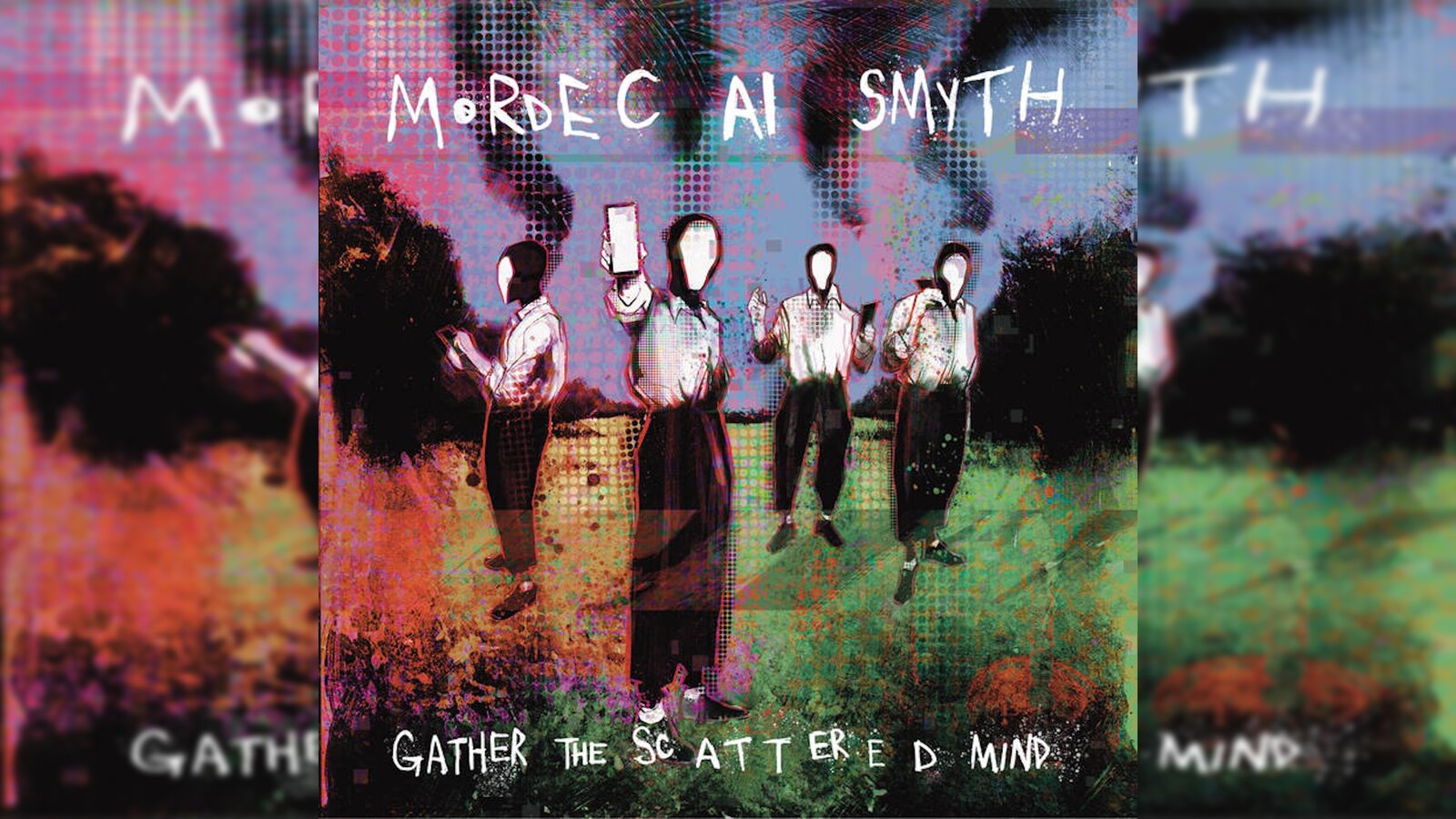
There is a songwriter who acts as a chronicler of the age. He has opinions. He has themes. He has been watching the news and doesn’t like what he sees. Mordecai Smyth is that man, and on Gather The Scattered Mind he has been observing. The premise is that we are all zombies, shuffling through atomised lives with faces pressed against glass, too besotted with our machines to distrust them. Smyth has been saying things like this for years and Jason Barnard listens.
Gather The Scattered Mind is an album that scrutinises social media, AI, and the pressures facing young adults today. What sparked this shift toward tackling these contemporary issues, and did any particular experience or observation drive the lyrical direction?
Observing what is going on. Talking to people both young and old and listening to their experiences. Tackling contemporary issues is not a new thing for me. For example, the last album dealt with climate change: “That Late Autumn Sun” and “High Once More”. Feelings of isolation; “In Your Dark Space’ and “The Upholsterer’s Wife”. “Fear of Flying” is about not achieving your potential. Maybe, this time the themes are a little more obvious to people – “On A Daily basis” is clearly about bullying that people experience at different stages in life.
The group lineup has changed with Luxagen and Steve Thompson joining the fold. How did their arrival influence the LP, and were there moments in the studio where their contributions pushed the music in directions you hadn’t anticipated?
With this album, I wanted to get a band together that could play live. So, it made sense to get friends who live locally on board. Both Lux and Steve have their own home studios and are both very capable sound engineers as well as musicians. Luxagen mixed this new album!
Like everyone in the band, they wrote their own parts and that freshened the sound up in a very wonderful way. With this album I think we have created a lot of positive energy which comes through in the recordings.
You mention the album tips its hat to 1970s art rock and new wave. Can you talk about walking that line between homage and innovation, especially on a track like “Armalites And Disco Lights”?
There is / was never any intention of paying homage to music which has gone before. However, when you get a body of work together, it gives you a certain vibe. This vibe made me think of the art rock and new wave genres. For example, the way Tabitha plays sax gives us a bit of a Roxy Music feel. I’m quite happy to embrace that and to me, it is a musical ace up our sleeve.
There’s a tradition in British art rock that deals with alienation through theatricality and dystopia. Were you interested in leaning into these themes with the album?
Funny you mention dystopia – turn on the news and there it is: weirder and wilder every day. I don’t think this album creates a dystopic vision – certainly not like Bowie’s “Diamond Dogs.” As for alienation – look around. I think there are a lot of disenfranchised people out there. Modern life seems to breed alienation: people are “connected” but insular/isolated. Society was very different in the 1970’s, but these themes seem to remain a constant.
Your previous work has often been more in the pop-psych and prog rock style, but this album seems to be moving into different territory. Was that a conscious shift or the way things have naturally evolved?
Yes, it was a conscious decision. I deliberately steered the ship towards some uncharted waters.
In our 2022 interview, you mentioned wanting to record acoustic guitar-based songs for your own music. Looking at where Gather The Scattered Mind ended up, did those ambitions feed into this album at all, or are they still waiting in the wings?
No, not at all. I think I discarded the idea not long after. I think there is acoustic guitar on only two songs on this album and Darren Medland played those.
You’ve built up a network of collaborators over the years, from Terry Bickers to Icarus Peel to Jon Camp. What do these musical relationships give you that working on your own couldn’t?
I worked with Terry for two years in the 1990’s. He got me to play guitar in DADGAD tuning. That was a sharp learning curve! I used that tuning on two of our older songs, “Mercy” and “River of Sleep.” Icarus is a very different type of musician to me, so it is fruitful when we compare notes. As well as being a tremendous guitarist, he is also a great bass player – that was his first instrument. He did most of the bass on “Toytown” and side one of “Stranger”. He is also a very good lyricist and writes in a completely different way to me. He wrote the lyrics to the aforementioned tracks, as well as helping me arrange the ideas I had which became “Mercy.” Both Jon Camp and Dave Lambert played for me in a session musician capacity. It was flattering to have such fine musicians willing to play for me.
And finally, what’s the first thing you want to explore musically now that this album is finished?
The ideas have been flowing and I am very happy with the band I have. The plan is to get us all to move forward together and see what happens!
Further information
Mordecai Smyth, Gather The Scattered Mind, is released on 1 May 2026 on Mega Dodo