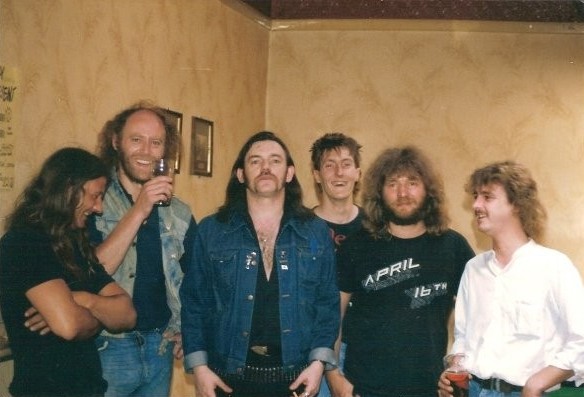
APRIL 16TH and Lemmy
By Jason Barnard
APRIL 16TH formed in the summer of 1985 in South London, late to the New Wave of British Heavy Metal. By then the scene they were joining was already shifting; keyboards creeping in, an eye turning toward America, a more commercial polish settling over everything. APRIL 16TH went the other way.
They gigged relentlessly across the South East and then further afield, recorded a cassette demo at Cherry Studios in Croydon they called Cherry Jam, and eventually signed with High Dragon Records. The Sleepwalking album came out in January 1989. Radio One invited them to record a session for Tommy Vance’s Friday Rock Show. London Weekend Television followed. They played the Marquee on a Saturday night as headliners. They drove to Lyon at their own expense, camped in tents, got pulled over by the police, played to a thin crowd, and considered it a good trip. In 1991 the money ran out.
In more recent years, Chris Harris compiled Epitaph, to collect their material. Dave Russell wrote a memoir, The Ghosts of April. The conversations that follow are with four of the five original members. They don’t always remember things the same way, and they don’t always agree on what they do remember.
First, Chris, the moment Lawrence played the opening notes of ‘Illusion’ and blew your face off, as you put it, was that the moment you knew the band existed, or did it take longer to be sure?
Chris – At this point we were miles away from becoming an up and running band. But the initial vibe from this first meet was overwhelmingly positive, as indeed were all the subsequent sessions. We still had to recruit a singer, bass player and drummer, however, and it was also possible — as a novice performer — that I might succumb to stage fright (i.e. lose my bottle).
Lawrence, you and Chris had been out of touch since school, yet ended up in the same band through a chance conversation at a Comet warehouse. Did it feel like picking up where you’d left off, or did you have to get to know each other again?
Lawrence – I didn’t really know him that much in school, so yeah I think we had to work a bit on getting to know each other again. How we met is as follows from what I can remember: A bloke I used to work with, John Hickman, knew I played Guitar; he lived in the same cul-de-sac as Chris Harris in Buckhurst Avenue in Carshalton Surrey. He put me in touch with Chris and organised a meet up between me and him and, as they say, the rest is History.
Chris, what’s your perspective on reconnecting with Lawrence? Does that feel like luck in retrospect, or just the way things happened?
Chris – There were many occurrences that seemed to just slot into place with APRIL 16TH. At times it felt as though we were simply re enacting a play that we’d performed before somehow, and that we would perform again and again. There was a very odd déjà vu / time loop feeling to it all.
Black Sabbath gave you the dirty guitar sound you’d always dreamt of. Were there specific records rather than just bands that pointed you towards what APRIL 16TH should actually sound like?
Chris – Black Sabbath was the first band that I’d listened to that had the sound I really wanted. But there were other influences that also played a significant part in how our sound evolved. Each new member of the band came with their own ideas and influences, of course, but there was also a lot of common ground. After making an early decision to avoid covering other bands’ material, and being fortunate enough to have “enabled creativity genes” in our toolbox, we were set to go.
Dave – I don’t think we were trying to emulate Black Sabbath’s or anyone else’s guitar sound, much as we admired it. We had our own personal influences of course, for example I loved Robert Plant and Paul Rodgers, but couldn’t touch them vocally. We literally turned up, plugged and what came out was real and honest. Made with our own hands, so to speak.
John – No specific records, we all came to the table with our heroes i.e. for me Kenny Jones and Ian Paice. I tried to sound like a cross over of them.
Lawrence –
- * Cream – Crossroads Live
- * Jimi Hendrix – Voodoo Chile
- * Led Zeppelin – Black Dog
- * Thin Lizzy – Suicide
- * Wishbone Ash – Throw Down the Sword
Lawrence, Your influences run from Cream and Led Zeppelin through to Pink Floyd and King Crimson, a broader and more progressive palette than most people would associate with APRIL 16TH. How much of that side of you made it into the band’s sound?
Lawrence – As there were no keyboards, hardly any of it made it into the band, however, the actual rock riffs I tried to incorporate as much of it as I could, adding my own twist to it all. I never stole riffs but they were definitely an influence, for example, listen to Thin Lizzy’s Suicide Riff and you will hear a similarity to perhaps She’s Mean track. Also listen to Throw Down the Sword by Wishbone Ash and you’ll hear a similarity in the structure to Clapham Wood – obviously not all the way through just in bits and pieces and only an influence
John, you answered an ad in Sounds to get the drumming position. What was the audition like, and did you have any sense of what kind of band you were walking into?
John’s reply – Never had an audition like it …. I went to someone’s house to hear 2 guitars play. I loved what I was hearing and tapped my legs in time to what they were playing. Somehow I was in. The next time we met was a rehearsal!
The group was gigging from 1985 but Sleepwalking didn’t come out until January 1989. What happened in those four years that shaped who APRIL 16TH were?
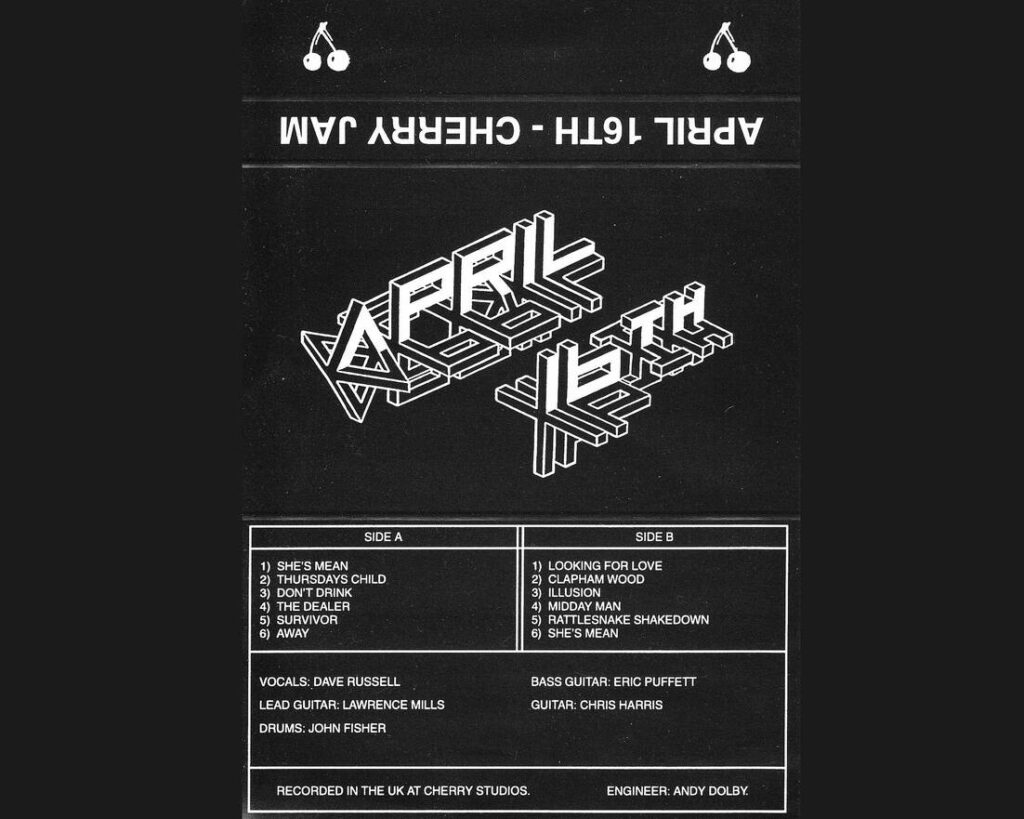
Chris – Actually, our first proper stint in a recording studio came some years before the Sleepwalking session and resulted in a C60 cassette that we used as a “gig getting” demo. We called this tape the Cherry Jam after the name of the place where it was recorded – Cherry Studios in Croydon. In 1985 the band was new, and many lessons would be learned as the months and years unfurled. To survive emotionally and financially, all bands need fans. To attract and keep fans, the music needs to be the real deal in both content and presentation. PA systems must be at least twice the size required for any given space, with light rigs similarly OTT. Two smoke machines aligned at 45 degrees left and right of centre stage are essential. They should be located beneath the drum riser to enhance the lighting rig and further ensure that punter disorientation is complete. In the first four years the band’s songwriting and performance skills had improved dramatically. Our presentation and promotion of shows had also matured significantly – what could possibly go wrong.
Dave – Those four years galvanized us as a unit. We had played some prestigious gigs by then, including festivals and supporting name bands, so we gained a little self-belief. We had some studio experience with the recording of Cherry Jam, but nothing radical had shaped us, or affected our love and respect for one another. We were in essence just five working class lads who loved being in our band and making music.
John – We already had the Cherry Jam out, so that gave us an idea for what we wanted to sound like.
Lawrence – We were gigging and rehearsing, developing the tracks in Cherry Jam Studios.
Cherry Jam sounds wilder and more natural than Sleepwalking. Was some of that wildness lost once you were recording for a commercial release?
Chris – The name Cherry Jam was chosen because the music was essentially a jam session of a few of our songs recorded at a place called Cherry Studios in Croydon. We used this tape primarily as a demo to secure many of our early gigs in London and the South East.
This tape was also used to try to secure a record deal, and it was finally successful in doing so circa 1988 with High Dragon Records of Paris.
Having secured a record deal, we naturally wanted our best tracks to appear on the album, and in the three years since recording the Cherry Jam session, some new tracks had emerged that we needed to record for the Sleepwalking album with High Dragon. Many of the tracks planned for the album had appeared on the Cherry Jam demo, but we decided to re record all the older songs in an attempt to iron out any imperfections.
During the recording of Sleepwalking, we were all very conscious of the need for perfection. This LP would be our showcase to the world, and it needed to be good — very good. Sadly, our overly cautious playing on that day resulted in a somewhat robotic performance that I feel is not truly representative of APRIL 16TH on stage.
Dave – An interesting observation, Jason. I think with Cherry Jam we just wanted to get something laid down to give to pubs, clubs and local press to potentially get some gigs and get us out there, get us noticed. We were quietly impressed with just how well it (Cherry Jam) turned out. It was all done in pretty much one take, raw and unfiltered, essentially like a live recording. But of course at that stage we were yet to play live! It captured that almost punk-like spirit some have mentioned about our early sound. A few years had passed before we went on to record Sleepwalking, with a different engineer for a start. Maybe that was a factor.
John – Yes I think so, Nerves play a big part when trying to get the playing right.
Lawrence – Yeah, maybe something to do with the engineer and the way it was recorded.
At what point did you realise the spending on oversized PAs and light rigs was going to kill APRIL 16TH rather than help it?
Chris – It was a balancing act, really, as a band will not succeed by putting on under financed shows. All shows must be full of music that is top notch, extremely loud, and wrapped in clouds of multi coloured smoke. Fans are attracted to this environment and expect it. By supplying the above home comforts of your average headbanging nutter, you go some way to retaining their interest. But the costs of such OTT shows must be offset by attendance figures that generate enough revenue to cover the expenses incurred in putting them on. I’d hoped that at some point “breaking even” would become a regular occurrence that would lead to eventual surpluses. I think I realised from day one that money versus success were the rules of the early game. Without promotion and presentation, even the best bands fail. Morale rapidly dwindles when playing an ill equipped show to three drunks in the corner. Without investment the band would have lost interest and folded; with investment, the race was on to start breaking even before the money ran out.
Chris, the backstage story at the Marquee, placing the setlists and hearing the crowd cheer thinking you’d walked on. What was the gig itself like after that?
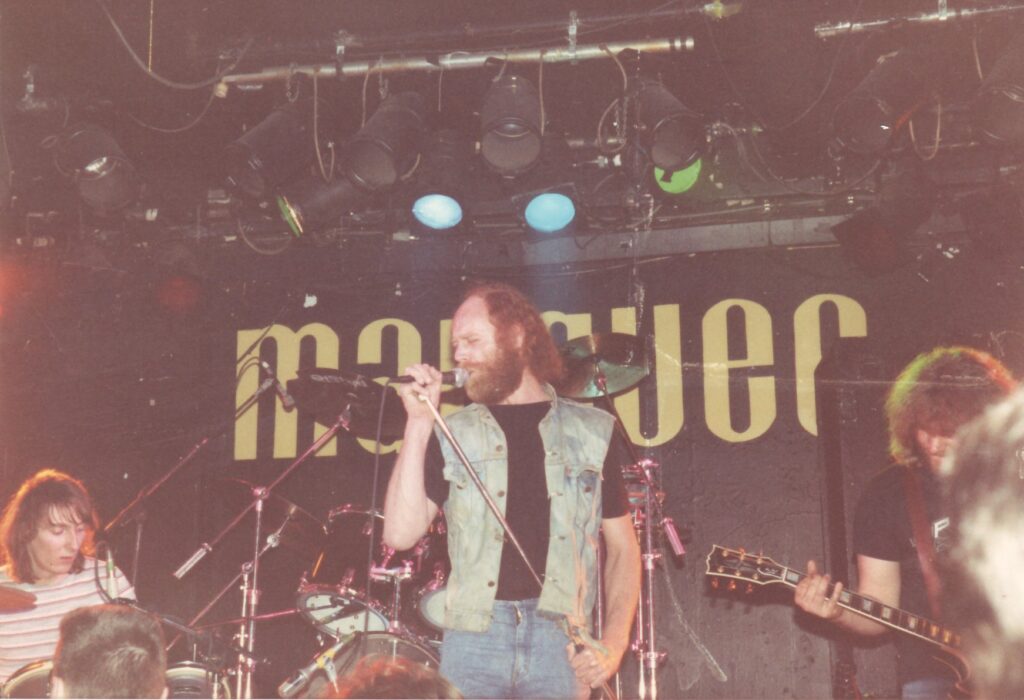
Chris’s reply – This gig was magnificent. We were not only playing the Marquee – we were the headliners on a Saturday night. We’d done the usual promotional overkill required to attract a good sized crowd, but this time the crowd was bigger than expected and contained so many new faces. There was something else afoot here that could only be indicative of a step change in the band’s fortunes.
Were there ever conversations about halting live shows and focusing on recording instead, or was splitting up the only option anyone could see at the time?
Chris – In hindsight this should have been the choice that was taken. But I was so sad to have to face the reality of halting live shows, that this option was not really a choice that I gave enough consideration.
Dave – No, not as I recall. However, recording a second album was definitely on the cards, if we had been given the opportunity. We were starting to develop some good ideas for more new songs, and in fact had a sprinkling of new material we had started to incorporate into our live set. At least four previously unrecorded songs, if memory serves.
For me, splitting up, or stopping to be more precise, had been simmering. No ill-feeling, no animosity or such like, we had become good mates. It became clear we were haemorrhaging money. We reduced our gig schedule to try and cut costs, but it was becoming a very expensive venture. And, as previously mentioned, we all had modest regular day jobs, no record company or such like to take us onto that elusive next step, with bigger gigs and a second album.
John – We had conversations about money – i.e. putting money into the band but I had a mortgage to pay so didn’t add anything. The split came suddenly.
Lawrence – Not really. I was working full time, then the rest of my time was taken up with rehearsing and gigging for the most part with no financial reward at the end of it.
Dave, ‘Madagascar’ was a personal favourite to perform live and was never recorded. Is there any regret about that?
Dave Yes, I’d say some regret over ‘Madagascar,’ but almost equally with a handful of other later songs which didn’t get recorded.
APRIL 16TH held a stable lineup for six years in a scene where most bands were constantly reshuffling. What held the five of you together through that?
Chris – It was a bit of a bumpy ride at times, but major successes like being invited to record a Tommy Vance “In Session” at Maida Vale helped us keep the faith. Other morale boosting moments included securing a record deal, appearing on London Weekend Television, sell out dates at Bogiez Rock Club in Cardiff, and an ongoing, growing, and loyal fan base.
Dave – We just rubbed along together really well. We socialised, our partners got on with each other too. We were all quite introvert, but as a collective we had developed something of a siege mentality. We had a lot of barriers to overcome just to get past the judgemental attitude of promoters and gig-goers. We weren’t flashy wannabees, we fell into the dark abyss of post NWOBHM and pre hair metal, when it had become trendy to pigeon-hole bands in order to fit the narrative. For example, we played with glam bands like Wrathchild and Tygertailz one week, then at a Hell’s Angel rally with the likes of Dumpy’s Rusty Nuts or The Groundhogs the following week! Every gig was an adventure, something we would chat about when we met up for beer nights between gigs; we just got on really well together.
John – Simply – we were all mates and enjoyed each other’s company.
Lawrence – I left the band and fully intended to stay left, but Chris and I met up and chatted and he convinced me to rejoin, so we did have our ups and downs before the official split.
The group were playing raw, unadorned rock while glam metal was crowding the market. Was that a principled stance, or did the other approach simply never appeal to you?
Chris – I think we found the sheer transparency of the pretence so often associated with many glam metal bands extremely nauseating. The predictable verse–chorus–verse–chorus formula also reeked of commercial motivation rather than any sincere passion for music.
Dave – We ran into a bit of trouble with this. Chris and I were interviewed by a glam metal goddess of a journalist at the height of glam metal’s popularity.
We met in a pub at lunch time somewhere in London mid-80s, me and Chris in our denims, smoking roll-ups, drinking pints at lunch time, like a couple of old homeless dudes, when in breezed this back combed satin clad chick, black lip stick and sparkles on her cheeks, who couldn’t have been less sympathetic to our cause during the interview. She also slated Sleepwalking when she reviewed it in a very well-known music rag at the time. She was quite rude and unprofessional, I felt.
But she did admit to having seen us live and gave her approval. So there in a nutshell was our dilemma. We didn’t fit the glam metal scene at all, and didn’t want to, but our no bullshit live shows gave us some street cred with gig-goers.
John – No appeal to change our style. We didn’t even dress up to go on stage – straight from work mostly.
Lawrence – Glam Rock never really appealed to me on a grand scale, I preferred Motorhead, Deep Purple, Led Zeppelin and the Thin Lizzy Look.
The France trip gets a mention as the moment the group could claim to be international. What was the reality of that trip?
Chris – This gig was arranged by our Paris based record company and therefore didn’t receive any of our usual feasibility checks before the booking was confirmed. We were all very keen to go, of course, as the kudos of playing abroad was intoxicating. The venue, Le Truc in Lyon — about 120 miles north of Marseille — was a large concert hall, and I was hoping that, as the support act, the headliners would fill the place.
The “promoters” had laid on masses of booze and food for us as a rider, so when we arrived everything looked set for a memorable evening. As our stage time approached, however, I became increasingly anxious about what the turnout might be, and no amount of pacing around outside seemed capable of manifesting any actual punters. Sadly, things didn’t improve, and the headcount remained disappointing.
Both bands played great sets, though, so those who were there definitely got their money’s worth. And as a bonus, we ran into a radio station broadcasting from the venue and were interviewed on the spot.
Dave – We would play anywhere, and this was seen as a potential promo opportunity which we grabbed with both hands. Don’t forget, we PAID our own expenses! Petrol, ferries, camp sites, the whole lot. All I can say is I had a whale of a time. The gig itself was a disappointment attendance wise, but a huge success for our endeavour and commitment to each other! It also served as a reminder that we still had a way to go to achieve a modicum of recognition as a band.
I just wish we had a video recorder at the time. That trip was one of the many highlights of our career and it’s such a crime that it was never recorded! Although it does fill an entire chapter in the book, and was another remarkable achievement by Chris and his resourceful management of getting us gigs.
John – Some of us stayed in a hotel while Dave , Eric and I slept in our tents. Had just the best time. The funny story here is while at school I hated learning French. When I left school what did I do ? – went to evening classes to learn it. When the police stopped the band, who were looking for drugs, I could talk to them. We had no drugs, we were a drinking band.
Lawrence – It was the dream to become internationally recognised, but given France was a one-off gig, I’d say being recognised internationally from it was a long way off. We played more in Wales than France.
Hiring National Express coaches to ferry fans to Cardiff sounds funny now. Did it feel funny at the time?
Dave – Your shout Chris??
Chris – We hired coaches to a number of different venues over the years. It might sound daft to take your fans with you instead of focusing on making new ones elsewhere, but their presence at unfamiliar venues had a real purpose. Our plan was that bringing 25–40 head banging, front row nutters with us would act as a catalyst — something to ignite contributions from similarly minded locals. And it worked.
John – I thought it strange sitting with some people I didn’t know, knowing that they were coming all this way to watch me and the lads.
Lawrence – It was a good way to get local support from Croydon to Cardiff and back again. I wouldn’t have called it fun because if memory serves it was one of hottest days of the year and also had to get back to work for a stock check at my work after only a couple of hours sleep.
Dave, writing The Ghosts of April meant going back over ground that didn’t always end well. Was there anything you found harder to put on the page than you expected?
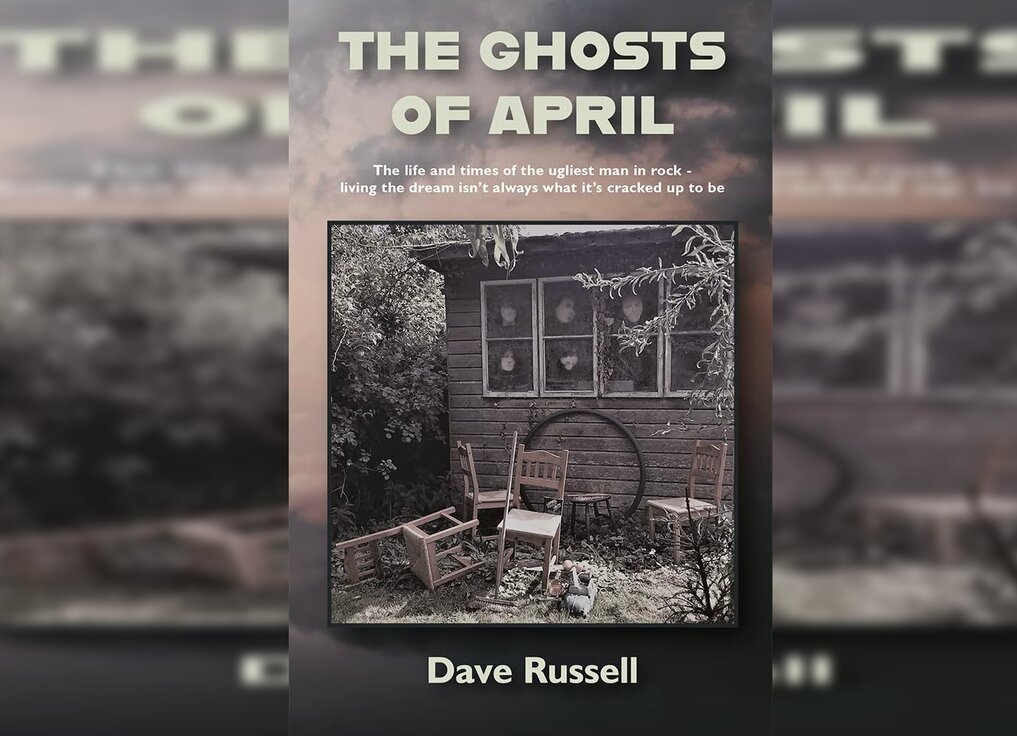
Dave – Writing The Ghosts of April was a wonderful experience, especially when the rest of the guys and girls jogged my addled memory with things I’d forgotten about. It was a joy getting those stories down. Toughest part, and I’m not looking for sympathy, was writing about the loss of my mum when I was a teenager, in the first chapter. Yet it was so cathartic. My personal story weaves in and out of the band’s story, which gives some context to how they bounced off, and affected each other.
A reviewer of Dave’s book singles out the backdrop story as the band’s great Spinal Tap moment, suggesting it makes the Stonehenge debacle look minor. What happened?
Chris – We loved our backdrop and were enormously proud of our logo. As a support act at the Corn Exchange in a new town, it was vital that people knew who we were. But when I looked over my shoulder to admire — and quietly gloat over — our magnificent (but unfortunately back to front) stage banner, I was mortified.
Dave – We had this massive backdrop procured from a local theatre. It had our logo on it. It was rolled up and ready to drop when we hit the stage at the beginning of our support slot at a big venue. We went to the pub after our sound check. We came back, went on stage, ties were released and the backdrop was the wrong way round! Oh how we laughed….
John – Didn’t notice it – too drunk.
Lawrence – Sorry, mate, no idea what you’re talking about on either the backdrop incident or the Stonehenge debacle. Been a while I imagine since both incidences.
Dave’s book has been described as making you laugh and then making you a little sad. Reading it, did he get the story right from where you were standing?
Chris – There are several moments in Dave’s book where his account of events has genuinely enlightened my own recollections. Dave is also a people person — far more capable and sensitive than I am when it comes to recounting subtleties. So yes, Dave most definitely got the story right.
Dave – Guys.
John – Yes, mostly you have to remember he wrote it from his angle. We all saw and remember some parts differently.
Lawrence – Yeah, I think he was pretty much spot on with his remembrances.
What is it like to have the years documented by someone else, knowing their version of events is now the public record?
Chris – Everyone’s perspective on events is different, but Dave’s knack for seeing the wider picture is evident throughout his book. It ensures that the viewpoints and considerations of others are always part of the mix.
John – I loved his book. When I read it, it was like did that really happen – Yes it did.
Lawrence – No problem at all. Learned some things I didn’t know about in Dave’s private life at the time.
John, getting press coverage felt like banging your head against a brick wall. Was there a moment that sums that frustration up more than any other?
John – I would sit at home and send 5 letters a night to various papers and mags, never getting any replies. That was frustrating.
Compiling Epitaph meant going back to the original 1986/87 master tapes and releasing them untouched. What did you hear in those recordings after thirty years away?
Chris – There wasn’t really a 30 year gap since we’d listened to those old recordings, as we had mass produced a demo tape and a vinyl album from them. We have therefore all remained fairly familiar with our original sound. That said, when we decided to scrutinise this material for release on the EPITAPH CD, many subtleties began to resurface.
Dave – Oh I like Epitaph. I heard potential. I also heard room for improvement in some areas but the downright honest grit and love in those songs is something I’m proud of.
Would do it again in a heartbeat.
John – Once I got my copy of Epitaph, I sat down, pressed play and thought. Crikey – were we really that good.
Lawrence – Some really good stuff to be honest.
Chris, after your group Matrix wound down, did you reach a point where you made peace with not being in a band, or has that never fully gone away?
Chris – As pathetic as it sounds, I’ve always wanted to be a globally admired intellectual giant. The main thrust of my campaign has always been through music and words. APRIL 16TH’s demise was catastrophic for me, and the fall of MATRIX was a significant aftershock. But APRIL 16TH are now partially active again and trying — with some success — to present a darker, more menacing side to the world. Fingers crossed.
Dave’s book tagline talks about living the dream not always being what it’s cracked up to be. How close do you think APRIL 16TH actually got?
Chris – April 16th were right there on the front line. I never intended the band to be an amusing hobby or pastime — in my mind we were on a mission that had to succeed. And I’m still on that mission.
Dave’s reply – We’ll never know. That second album could’ve been the breakthrough though, that I believe. But we gave it a good shot. Our Appreciation Society continues to grow, and the interest being generated by Chris’s efforts is also encouraging, even after nearly 40 years. Perhaps some financial backing might have helped, who knows?
John – Close, very close. But you also have to have luck, the right person at the show to say “This band will go far”. And that didn’t happen. But hey – album out, 2 sessions on BBC Radio One, played big festivals and have a book out. Not bad.
Lawrence – I think the closest we got was the BBC Session which I cannot find anywhere, which would be great if I could find it, and an Interview with Danny Baker, and feedback from Lemmy (of Motorhead) on the 6 O’Clock TV Show with Michael Aspel.