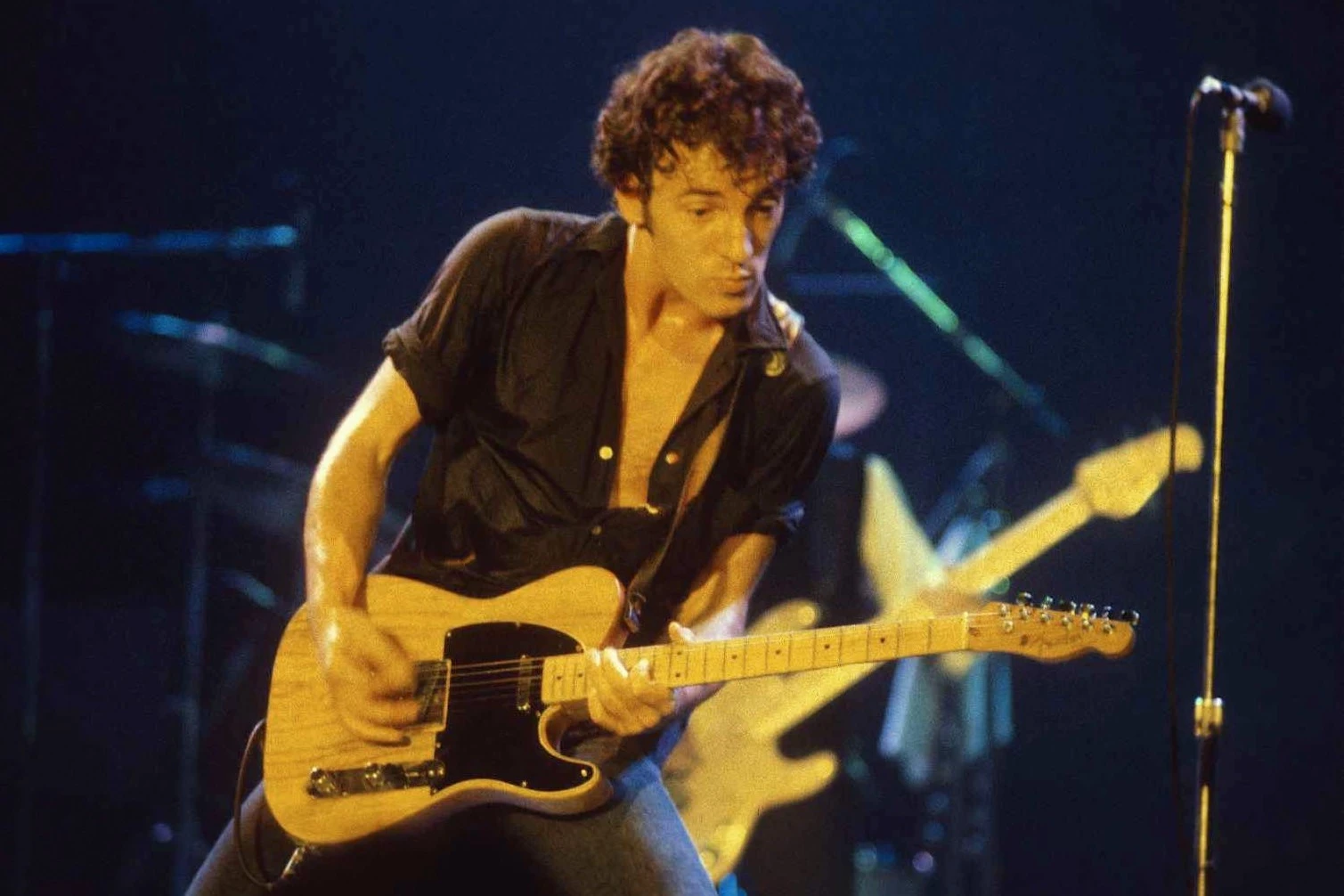
By Carl Lender - Bruce Springsteen at the New Haven Coliseum, CC BY 2.0, https://commons.wikimedia.org/w/index.php?curid=137161168
By Scott Shea
June 9th marked the 54th anniversary of Bruce Springsteen signing with Columbia Records, which is rarified air for recording artists, and there are only a select few who can make the same claim. And they all seem to be at Columbia Records. The only two still living who can make the same claim are Bob Dylan and Barbra Streisand, both of whom have been there longer than Bruce. Nearly every artist with a legacy-level of success has hopped labels at least once. But not Bruce. Columbia has kept a tight grip on him, keeping him happy and unwilling to go elsewhere. But it wasn’t always like that.
It’s often said that 1975’s “Born to Run” was Bruce Springsteen’s make-or-break album, and there’s a lot of truth to it. His first two albums had sold fewer than 50,000 copies, and Columbia was preparing to drop him if the third didn’t show a notable sales uptick. Signing Bruce Springsteen three years earlier was a roll of the dice on an absolute unknown, which we now know paid huge dividends. With the benefit of hindsight, those pre-Born to Run days were incredibly romantic, perhaps the most unique period of Bruce’s whole career. It’s a place he still revisits, but only in limited doses and never too deeply. Let’s take a trip back.
SAINT IN THE CITY
Not much ever came out of South Jersey, let alone the Jersey Shore. That’s where New Yorkers went to escape the thick city air, take a dip in the Atlantic Ocean, or hang out poolside at any of the hundreds of motels that dotted the shoreline. The locals called them Bennys (people from Bayonne, Elizabeth, Newark, New York). Rarely did someone from that area blossom, spread their wings, and make a profound mark. To the Bennys, the Jersey Shore may as well have been Mule Ditch, Arkansas; Smut Eye, Alabama; or Spread Eagle, Wisconsin, and, in many ways, it sure seemed like it.
For the sake of brevity, I’ll give you the pre-E Street history of Bruce Springsteen in a nutshell. He was born and raised in Freehold, New Jersey, with a doting mother, a bipolar and difficult father, and two younger sisters. There is a large body of writing about his early life, including his autobiography, if you want to check it out. In late 1971, he was 22, staying at his friend Tom Cotter’s hippie pad, completely wrapped up in the late-60s/early-70s zeitgeist and living a starving artist’s lifestyle. He wrestled with a sense of abandonment by his parents, who had moved to San Mateo, California, two years earlier. He pushed that youthful bravado down, and it would wreak havoc on him emotionally years later. He’d been playing in bands since 1965 and turned professional, more or less, with the Castilles, who lasted from 1966 to 1968. From there, he formed Earth, which became Child after some personnel changes. Child featured future E Street Band members Vini Lopez and Danny Federici, and they changed their name to Steel Mill. Steve Van Zandt would join them in February 1970, but the group broke up 11 months later. Next up was the Bruce Springsteen Band, which lasted from July 1971 to July 1972 and sucked up just about every other young, talented Asbury Park musician, including more future E Streeters in Garry Tallent and David Sancious.
Though Bruce was building his musical acumen, success proved elusive, and playing in democratic bands was starting to wear him down. He also knew that among the musicians he played with, he was far and away the most talented, and that his ambitions needed to be front and center. Something big lay on the horizon. He just didn’t know what it was. Then it all changed quickly. His manager and friend Carl “Tinker” West knew a guy and took Bruce along on a trip to New York City on a crisp autumn Thursday in early November 1971 to audition for him. His name was Mike Appel, a struggling songwriter and manager who worked for a slick veteran songwriting huckster named Wes Farrell.
Farrell had written hits for Jay & the Americans, Every Mother’s Son, and Ronnie Dove, but his biggest claim to fame was co-writing the monster hit “Hang on Sloopy” with Bert Berns. But times had changed. It was the era of James Taylor, Carole King, and Van Morrison, and Appel was looking for artists in that vein. Farrell had been a good teacher since Mike first joined him in 1967, mostly by example, particularly in the art of cutting yourself in on the deal. Though a staff writer, he took a straight salary instead of royalties and got the biggest exposure of his songwriting career when Farrell landed the music contract for ABC’s new sitcom, “The Partridge Family.” Mike even notched his second hit, their sophomore single, “Doesn’t Somebody Want to Be Wanted.” His first had been “A Question of Temperature” with his group Balloon Farm in 1968.
The day Bruce and Tinker walked into Mike’s Midtown office, just four blocks south of the southeast entrance to Central Park, Mike was moving away from the Partridge Family experience and into artist management with his longtime writing partner, Jim Cretecos. After missing out of Sir Lord Baltimore, a fledgling hard rock group, they took on a CSN&Y wannabe group called Montana Flintlock, whose soundman was none other than Tinker West. When Bruce walked in, Mike was all ears but not particularly impressed by what he saw. Bruce looked more like just another hippie, in torn jeans and a T-shirt, than a singer trying to get a record deal, underscoring the disparity between where each was in 1971.
“I’m tired of being a big fish in a little pond,” he told the skeptical manager.
The truth was, Bruce’s style was still raw and unrefined, but his dedication and self-discipline were sharpening his skills and honing his style at a rapid pace. Steel Mill had been a proto-heavy-metal band with a beat, in which he shared lead vocals and served as the principal songwriter. Their songs were wild escapades, often undisciplined lyrically and stylistically, yet well-suited to the time. Still, neither the band nor any of their songs ever really broke out, and there were no strong indicators of what lay ahead, even though they received good local press. At this stage, he was fronting the Bruce Springsteen Band, and his songs were becoming increasingly streamlined, bearing hallmarks of his first two albums, but still mostly restricted to the Jersey Shore.
He sat down at Mike’s work piano and broke into two originals, “Baby Doll” and “Song for Orphans.” They were slow, and Bruce’s choice of them betrayed his naivety, yet they also reflected his pride in his songwriting maturity. Compared to the Partridge Family’s bubblegum pop, they were real snoozers. One can only imagine what Mike was thinking when he heard lyrics like, “But times grew thin, and the axis grew somehow incomplete/Where instead of child lions/We found aging junkie sheep” or “The confederacy’s in my name now/The hounds are held at bay.” What the hell does any of that even mean? Still, there was something there. A seed was planted in Mike’s brain by one line from “Baby Doll,” a lament about a man in love with a deaf mute that held a modicum of charm. “Oh baby doll/They had to see by touching hands/We had to dance to a silent band/And you surprised me, being so graceful.”
That’s deep, especially for a 22-year-old from Freehold, but it wasn’t enough for Mike to run and grab a contract and a pen, and insist that Bruce sign on the dotted line. They chatted afterward, with Mike imparting practical advice, telling him to write more songs if he wanted an album deal and to write ones that weren’t boring. To his surprise, Bruce took it all in. Though it surely must’ve cut deep, he didn’t let on. He knew he still had work to do. What nobody knew then was that Bruce is one of the most tireless workhorses in rock and roll history, constantly working on self-improvement. He wrote down his phone number and told the youngster that the door to his office was always open. Bruce said he’d come see him after visiting his parents in California over the holidays.
Nearly three-and-a-half months later, he did just that. His time away had done him some good. From December through all of January, he stepped away from performing with a band, cleared his head, and wrote lots of songs. He even dabbled in making a go of it at some clubs in San Francisco as a solo performer, but his heart just wasn’t in it. He reconvened with his band, which had been tended to by close friends Steve Van Zandt and Southside Johnny Lyon in his stead. But deep down, Bruce knew he had to go it alone if he was ever going to make it as a recording artist. He loved all these guys, and maybe there was a place for them, but for now, it was all about getting on a label. The one man who could help him was Mike Appel. He called him and set up an appointment.
It was Valentine’s Day 1972 when he sat down with Mike, Jim, and Bob Spitz in New York City, fresh off a nine-show residency with the Bruce Springsteen Band at the Back Door in Richmond, Virginia, where he’d been hot since the Steel Mill days. He brought a new batch of songs, sculpted and trimmed to meet his mentor-in-waiting’s expectations. His opening number, “No Need,” was long and slow but far more cohesive than the two songs he’d played months earlier. Bruce’s ace in the hole was his third song, “It’s Hard to Be a Saint in the City.” It was action-packed and compelling, with a melody that moved and provocative lyrics about a young city boy trying to stay on the straight and narrow, not always succeeding. It was Bruce’s finest hour yet and one that made Mike fully realize the potential of what stood in front of him. In fact, he and Jim were downright dazzled. How could they have been so blessed to have such a talent drop in their laps? The line, “Silver stars studs on my duds like a Harley in heat,” echoed in Mike’s mind so much that he asked Bruce to play it again. He obliged and followed it up with four more songs, including an embryonic version of “For You,” which would later grace side two of his debut LP in its complete form. After the dust settled, they agreed to talk business the next day.
The shoe was on the other foot that mid-February day. Although he probably didn’t know it, Bruce had leverage. This time, Mike didn’t want the young singer walking out of his office without an agreement, so he laid it on the line, pitching his ability to get him signed to a major label and arguing that nobody would advocate harder.
“You’ve seen both sides of me,” he told Bruce. “When you played songs I didn’t like, I told you they sucked…when you came back, I told you they were great, so you have to know I’m being straight with you.”
He had a point there. Not only that, but he also agreed to see him again despite not being initially impressed. That doesn’t happen very often, especially on your first go-round. Mike also promised to work his ass off to get him signed and make him a superstar. Bruce took the recording contract home and, after a few weeks of hemming and hawing, brought it back signed. It was a life-changing moment for both. By March, Mike quit his job with the Wes Farrell Organization, launched Laurel Canyon Ltd. with Jimmy Cretecos, and signed Bruce to additional publishing and management contracts. With those in place, he got Bruce into Media Sound Studios in Midtown Manhattan to begin work on roughly 60 publishing demos to copyright his work and pitch songs to other artists. Even “Baby Doll” and “Song For Orphans” made the cut. During the first recording session, Mike tiptoed through the building and barely left Studio C because Wes Farrell was recording an artist in Studio B. Shopping songs proved difficult. Hollies lead singer Allan Clarke cut “If I Was the Priest” for his 1974 solo debut, and, to everybody’s eventual surprise, David Bowie, at the height of his wildly popular Ziggy Stardust phase, recorded “It’s Hard to Be a Saint in the City” and “Growin’ Up,” both of which were shelved for 15 years. But that was it. At this point, it seemed only Bruce Springsteen could effectively sing a Bruce Springsteen song.
BLINDED BY THE LIGHT
True to his word, Mike secured a meeting with a major record label for his client, fast. In fact, it was Columbia Records, the home of Bob Dylan, Paul Simon, and Johnny Cash, and arguably the biggest of the six major record labels. It was also run by Clive Davis, perhaps the hippest, most artist-friendly label president of them all. And nobody was more surprised at wrangling that audition than Mike Appel. It was the first label he called, and he started right at the top with a cold call to Davis. He got brushed off. The only other name he knew at Columbia was John Hammond, and he managed to reach his secretary. Hammond was a legend to anyone in the business. He introduced Fletcher Henderson to Benny Goodman, was the first to record Billie Holiday and Count Basie, signed Pete Seeger as a solo artist, and, perhaps most interesting to Bruce, discovered Bob Dylan and Aretha Franklin. Mike pressed his assistant in a way that was a notch below outright obnoxious, which was countered a little by charm and confidence. Normally, this would lead to an excuse and a hang-up, but something about the urgency in Mike’s voice struck a chord, and she scheduled an appointment for him and Bruce to meet with Hammond on May 2nd at 10:30 am.
They showed up promptly, with Bruce carrying former Castilles bandmate Vinny Manniello’s acoustic guitar, caseless and with a crack in the neck, and sat in the 12th-floor waiting room. In his five-plus years of performing, he’d never bought one of his own. When Hammond emerged, crew cut, horn-rimmed glasses atop his head, he didn’t seem too pleased to see two nobodies off the street waiting to talk to him. Always artist-friendly, Hammond lunged at the manager first, giving him about five seconds to let this guy try to win him over.
“OK, what do you have to say?” he asked Mike bluntly.
Nervous but ready for the moment, the new manager launched into his elevator pitch, no doubt rehearsed, beginning with the struggle every songwriter faces, namely writing quality songs and writing a lot of them. With nearly four decades of auditioning, recording, and producing to his name, Hammond surely could empathize, right? If he did, he didn’t show it. Mike pressed on, telling the famous executive about the speed and efficacy of his client’s songwriting. Still nothing. He wasn’t very moved by Mike’s pitch so far, and he made it obvious. Mike called an audible and took a personal stab at the legendary executive, practically daring him to listen to Bruce.
“If you’re the guy who discovered Dylan for all the right reasons, you won’t miss this,” he said.
That did it. Hammond told Mike to shut up and motioned for them to follow him into his office, giving them about 30 seconds to impress him. Bruce always kept his cool when performing, but this was different, immediately hostile. Deep down, he was thrilled to be in this spot, but now the pressure was on. Hammond sat behind his big wooden desk, quietly ready to hate this young upstart. He folded his hands behind his head and, with a smile, simply said, “Play.”
In the now-legendary audition, Bruce rose to the occasion and played his heart out, almost as if he were playing for the last time, and this could be the only way he’d ever be remembered. And why not? He had nothing to lose.
“He just sat right in his little seat there and blasted Hammond right in the face with all his God-given talent,” Mike said in Marc Eliot’s 1992 biography “Down Thunder Road.”
Bruce cranked out several of his best songs, leading off with “It’s Hard to Be a Saint in the City,” the gem that won Mike over. Looking over his glasses at Mike, Hammond remarked, “You’re absolutely right. He’s great. You’ve got to be on Columbia Records,” he told the young singer.
The ice had completely melted. Bruce had won over a legend in the business and was close to signing with the country’s premier record label. What was he going to tell everybody back in Asbury Park? Bruce, always a band guy, went into Columbia Records and charmed the guy who signed Dylan by doing what Dylan had done 10 years earlier. It almost seemed like a secret side. When they wrapped up, Hammond told them that Clive Davis had the final say on signing an artist to the label and asked Mike to arrange for Bruce to play somewhere in Greenwich Village that evening to see how he performed in front of a crowd. It took some doing. Everywhere they went, the answer was a firm no, except for the Gaslight Au Go Go on Bleecker Street, which had an opening at 8:00 pm. Hammond walked in a few minutes before showtime and joyously watched Bruce perform effortlessly in front of almost nobody. Things were moving.
The following day, the three, along with Jimmy Cretecos, met at Columbia Recording Studio E on 52nd Street at 2:00 pm and laid down 14 cuts for Clive Davis’ listening. A little less than five weeks later, Bruce sat down in the mogul’s office with his manager and a few attorneys, walked out Columbia Records’ newest artist, sealed with Clive Davis’ blessing, and began thinking about what would come next. Surely a single and an album, but what would be on them? How would they go about it? Who would play on them? These perfectly natural questions would be answered in ways that would shape Bruce Springsteen’s career and send him down a memorable road of peaks and valleys, curves and straightaways, and a future he could never have fathomed that June morning in John Hammond’s office. For now, Bruce Springsteen Mk. 1 was in the planning stages, and the sky was the limit.

Scott excels at sharing origin stories and providing valuable context about how and why things began. His insights into young Bruce’s early years and the genesis of the legend are particularly compelling.
Scott has a talent for uncovering the deeper layers of every story—going beyond the surface to reveal what others might miss. His thorough approach brings dimension and richness to the narrative.
Excellent work!