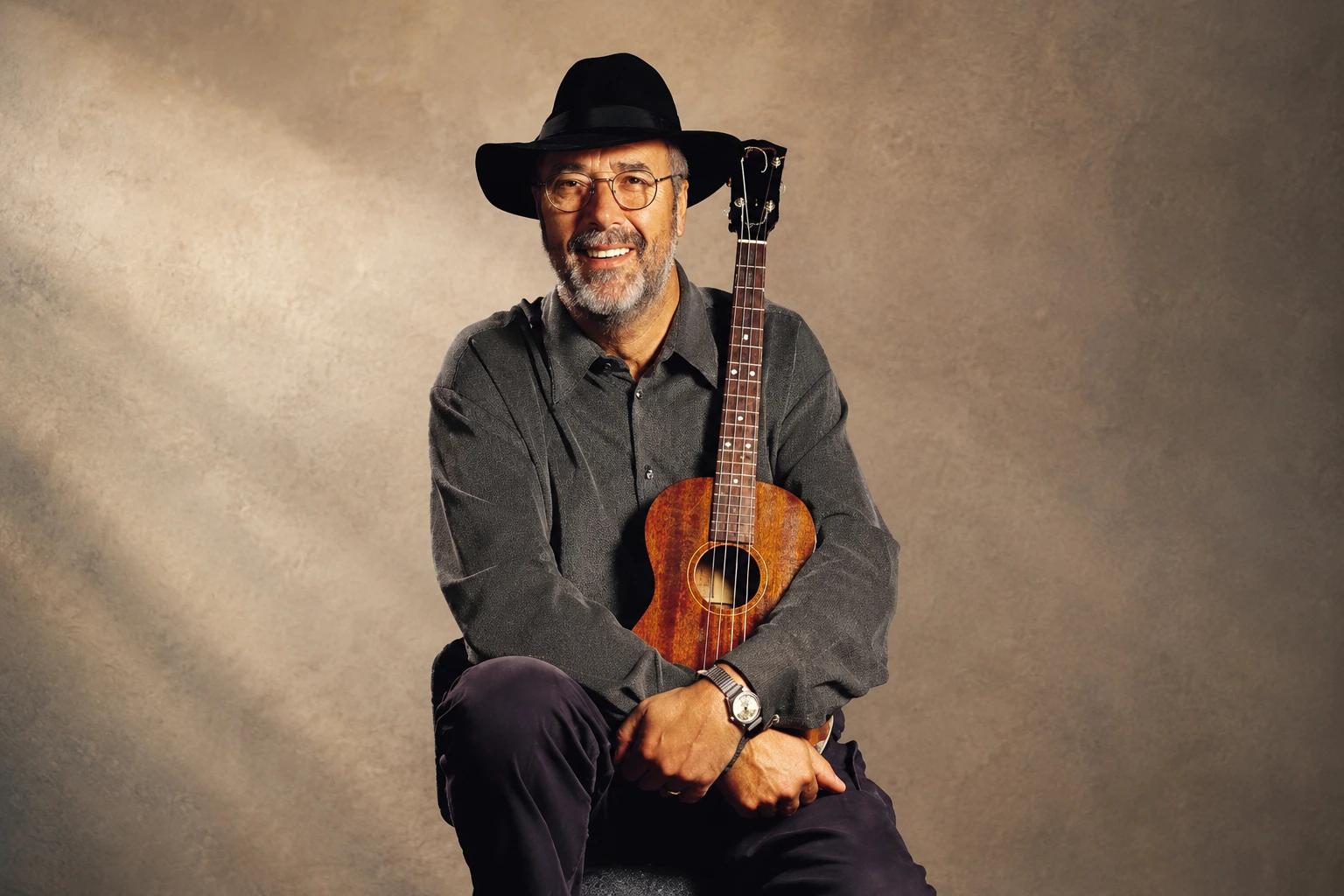
Roger Cook (upscaled photo with added background - used with permission)
From a ukulele in a dressing room in Lincoln to the Songwriters Hall of Fame, Roger Cook’s story is one of pop’s great hidden histories. In this article drawn from a previous Strange Brew Podcast interview, Jason Barnard spoke to him by telephone as he sat in his Tennessee home.
It is October 2017 in Nashville, Tennessee, and Roger Cook is in a good mood. He has a round of golf lined up later and, before that, he is happy to talk. The phone line is clear. He is, he says, still writing two or three songs a week. He reckons he is closing in on 6,000 songs in total and, though he pauses to do the arithmetic out loud, he does not seem especially surprised by the number.
Cook was 77 when we spoke, born in Fishponds, Bristol, England. He has spent more than half a century as one of the most consistently successful songwriters Britain has produced, the sort of career that tends to stay invisible even as the songs themselves are everywhere. You will have heard his work this week without realising it. The Fortunes, Gene Pitney, Deep Purple, The Hollies, Crystal Gayle, Don Williams, John Prine: the songs keep turning up on radio stations and in supermarkets and streaming with the same familiarity they have always had.
His great partnership was with fellow Bristolian, Roger Greenaway. The two were first named Britain’s Songwriters of the Year at the Ivor Novello Awards, and then won the same prize again the following year. In 1997, the duo became the first British songwriters inducted into the American Songwriters Hall of Fame. He and Greenaway once had five dozen hits between them. On one particular Christmas morning, sometime around 1969 or 1970, he woke up to discover his songs sitting at numbers one, two, four and thirty-three in the UK singles chart simultaneously.
‘We had a run of about two and a half years where we were never out of the charts,’ he says. ‘When I look back on it, it was totally amazing.’
A ukulele in a dressing room in Lincoln
The Kestrels were a British vocal harmony group, the type that were thick on the ground in the early 1960s, and both Roger Cook and Roger Greenaway were members. By the time they found themselves playing a two-set gig in Lincoln, the group was on its way out.
‘The Kestrels were just about to fold,’ Cook recalls. ‘I think we were in Lincoln as one of our last dates. Roger and I had never written together, but we’d threatened to. We both knew. And I had my ukulele, and he had his ukulele. During the break between sets, he said, what do you think of this? And he had this little progression, from the C to the D chord.’
It took about an hour. The song was ‘You’ve Got Your Troubles’, and the Fortunes took it to number two in the UK and number seven on the Billboard Hot 100 in 1965. Their very first collaboration.
George Martin heard the song before the Fortunes got hold of it. He called Cook and Greenaway into his office and told them he loved it, loved the way Cook sang, and wanted to produce a record with them himself. The only problem was that Martin was occupied at the time.
‘He had at least a couple of months’ work still to do on it,’ says Cook. ‘Meanwhile, the Fortunes got hold of it somehow, and they went in and cut it. As soon as I heard their record I thought, well, I think we’re going to have a hit as writers anyway. But it would have been very nice for Roger and I to have had a hit with our own song straight off the bat.’
That ‘little thing’ Martin was producing was Rubber Soul.
Michelle, and the Beatles connection
Martin did not forget Cook and Greenaway. When it became clear that the Beatles were not going to release ‘Michelle’ as a single, Martin offered it to the pair as a form of compensation, and produced the recording himself. Under the name David and Jonathan, they had a hit on both sides of the Atlantic in 1966 which gave Cook his first trip to New York City.
‘George said the boys aren’t going to put it out, but he thought it was a hit song. He asked if Roger and I could work up a version, which we did. Of course we had a big top-ten hit with it in America. For the first time in my life I got to come to New York City in 1965. That was a thrill.’
The David and Jonathan recordings were not all covers. ‘Lovers of the World Unite’ was their own song, and it benefited from what was then the relatively new luxury of four-track recording. They stacked their voices and produced something that sounded, Cook says, like a choir. It was a sizeable hit in the UK, and it caught something real about 1966: the creed, as Cook puts it, of ‘love thy brother, we’re all in this together’.
Then there was ‘Softly Whispering I Love You’, their penultimate David and Jonathan single in 1967. It did not do much at the time, but great songs have a tendancy to be covered. The Congregation, produced by their friend John Burgess, took it to the top five in the UK over Christmas 1971. Years later, Paul Young did his own version.
‘Yeah, he had a hit with it,’ says Cook. ‘I like his version.’ He leaves it there.
Gene Pitney, a great demo, and one note too high
By 1967, Cook was writing songs that went to people he had not written them for. ‘Something’s Gotten Hold of My Heart’, which he and Greenaway composed, ended up with Gene Pitney in a roundabout and rather pleasing way.
Pitney’s team tried recording the song in New York but could not get the feel right. Cook had made a demo, and it was good enough that they decided simply to use it as the backing track, building strings and other parts on top. The only catch was that Cook had a high voice, and Pitney had to sing in Cook’s key. There was one note, Cook recalls, that Pitney simply could not reach; someone else had to come in and sing a harmony over the top to cover it.
Pitney’s version reached number five in the UK chart in December 1967. More than twenty years later, it became something considerably bigger. Marc Almond had recorded the song alone for his 1988 album The Stars We Are. When Pitney heard the cover, he offered to re-record it as a duet. The result hit number one in the UK in January 1989 and stayed there for four weeks.
‘I think it was number one for about five weeks or something,’ Cook says. ‘Yeah, it was immense. There’s a nice little copyright for you.’
Hallelujah: Deep Purple and a song that found its own way
Cook is modest about how ‘Hallelujah’ got to Deep Purple. He had cut it with a singer called Tony Kingston, who had earlier recorded the original version of ‘Red Red Wine’, but nothing came of that version. Somehow the group picked it up.
‘I didn’t plug it, that’s for sure,’ he says. ‘But I was very pleased to have a Deep Purple cut, because they were one of the seminal rock bands of that era.’
The recording was more significant than Cook knew at the time: Deep Purple in their original line-up were, by mid-1969, on the verge of a wholesale change. Guitarist Ritchie Blackmore and keyboardist Jon Lord had been looking for a new singer, and had settled on Ian Gillan of Episode Six. Gillan’s session recording of ‘Hallelujah’, with bassist Roger Glover alongside him, became one of the first recordings by the emerging Mark II line-up. That configuration went on to make Machine Head and ‘Smoke on the Water’. The Cook-Greenaway song sits right at the centre.
Blue Mink: a group that needed a song
Blue Mink came together through the practicalities of London’s session circuit. A group of top players, including bassist Herbie Flowers, had put together a loosely jazzy little outfit and needed singers. Madeline Bell was asked and agreed. Roger Greenaway was asked to stand alongside her but turned it down and said to try Roger Cook instead. Cook went in, put his vocals on the group’s existing material, and the results were not hits. Their manager suggested they get Cook to write something for them.
Cook sat down with the brief and came up with ‘Melting Pot’.
The song’s message is anti-racist in the plainest possible terms: it imagines a world in which all human difference is thrown together and stirred until something new comes out. Which is why it particularly irritated Cook when a BBC DJ pulled the record off the air halfway through, declaring it racist.
‘He missed the point of the song completely,’ Cook says. ‘If he’d let it play all the way through, he’d have realised that basically I was making fun of people who made racist remarks. But there you go.’
‘Melting Pot’ reached number three in the UK in 1969 and has been in rotation, in one form or another, ever since. Cook and Flowers went on to write more Blue Mink material together. ‘The Banner Man’ (1971) came from Cook’s childhood in Bristol, watching the Salvation Army march through his neighbourhood on Sunday mornings. There was one particular man who used to carry the banner out front, Cook remembers, hunched, possibly not entirely well, but proud.
‘He was out in front, clutching his banner, holding it up high. That was the point of the song: the Salvation Army on a Sunday morning, marching around the streets, up to the top of the hill and then back down again.’
It is a more personal image than the song might suggest if you have never thought about where it came from.
White Plains, and an incredible run of hits
‘My Baby Loves Lovin” came from the same crowded period. White Plains were, effectively, the same pool of musicians and contacts. The lead singer was a young man Cook recalls as having come from South Africa, whose name he cannot quite place. Tony Burrows, a prolific English session singer who would front any number of hit-making studio outfits in those years, sang in the background alongside Greenaway. Cook came in partway through the writing when Greenaway needed a bridge and some additional work. The song went top ten on both sides of the Atlantic in 1970.
Those years between roughly 1969 and 1972 were a kind of industrial-scale run in British pop songwriting. Cook and Greenaway were named Songwriters of the Year at the Ivor Novellos in both 1971 and 1972. Their songs were on the radio constantly, covered by artists across virtually every genre, and they were writing for Cilla Black (‘Something Tells Me (Something’s Gonna Happen Tonight)’, composed specifically for her television show), The Hollies, Andy Williams, and many others. Cook recalls it as a blur of productivity.
The most famous jingle in advertising history
In the early 1970s, Cook and Greenaway were also writing jingles. It was, Cook notes, very lucrative. You got paid on the spot. He did not especially distinguish between jingles and songs; the craft was the same, and a good tune was a good tune.
‘I’d Like to Teach the World to Sing’ began as a sixty-second Coca-Cola commercial. Cook and Greenaway had already written the melody, which had existed as a song called ‘True Love and Apple Pie’. The advertising executive Bill Backer had the idea of reframing it around the line ‘I’d like to buy the world a Coke’, and worked with songwriter Billy Davis to reshape it for the campaign. The resulting commercial, featuring a crowd of young people singing together on a hilltop, became one of the most recognisable television advertisements ever made; the finale of AMC’s Mad Men used it as the image of a creative man whose best idea was to sell something.
What nobody anticipated was the public’s response. Hundreds of thousands of letters arrived at Coca-Cola from people asking where they could buy the song. Davis decided to release it as a record. Extra lyrics were added quickly, and two versions went out: one by the American Hillside Singers and one by the New Seekers. The New Seekers’ recording reached number one in Britain and went on to sell millions worldwide.
‘That was number one for six weeks over Christmas,’ Cook says. ‘An unexpected gift.’
Long Cool Woman: writing in an afternoon
‘Long Cool Woman in a Black Dress’ has the distinction of being the song Cook seems most cheerfully unbothered about having written while slightly drunk. He and Allan Clarke, The Hollies’ lead singer, met up one afternoon, had rather too much wine over lunch, brought a bottle back to the office, and wrote the song in about two hours at the piano.
‘It seemed like a good song, but I had no idea they were going to cut such a great record on it,’ he says. ‘I hear that song is still a cult hit, gets played to death on the radio forty years later. Forty-five years later. So that was nice.’
The song, co-credited to Greenaway under their standing arrangement that each would share publishing with the other on solo compositions, reached number two on the Billboard Hot 100 in September 1972 and sold two million copies worldwide. It remains The Hollies’ biggest American hit, a piece of swamp rock that sounds nothing like their usual work and nothing like something written by two men who had spent the previous half-decade writing harmony pop. Clarke had in fact left The Hollies by the time the single became a hit and rejoined the group largely because of its success.
‘Gasoline Alley Bred’ is the other Cook-era Hollies song that rewards closer attention. Co-written with Tony Macaulay, it is a more reflective than ‘Long Cool Woman’, a song about getting away from where you live and making a better life. Blue Mink also recorded it and The Hollies, Cook says, did a lovely version.
Today I Killed a Man, a number one in Sweden, and Elton John
Cook has also recorded under his own name. ‘Today I Killed a Man I Didn’t Know’, released under the name Roger James Cooke, reached number one in Sweden, which meant a tour there. Cook liked the song and had heard strong versions by other singers over the years, but his was the one that charted.
He also had a brief but productive connection with a young Elton John, then still going by Reg Dwight.
Dwight/John played Cook ‘Skyline Pigeon’, and Cook thought it was good enough to take around and try to get placed with other artists. In exchange for that effort, it was arranged that Cook and Greenaway would take half the publishing on the song. Cook eventually recorded it himself, using just a couple of pianos.
‘It was before they’d had any hits of any kind, Elton and Bernie,’ Cook says, referring to John’s lyricist Bernie Taupin. ‘I think they were thrilled at trying to get a cut.’
John Paul Jones is another name that turns up in the margins of Cook’s story from this period. Jones used to arrange and play on Cook’s demos for a couple of years. Then one day he came in and said he was sorry but he had to pull out: he was going into rehearsals for six months with a new group.
‘I was really disappointed,’ Cook says. ‘John was great in the studio, terrific. So I called a musicians’ booker called Charlie Katz. He said a lot of people seemed to like this Herbie Flowers, maybe you should try him. And that’s how I met Herbie.’
Flowers became Blue Mink’s bass player and one of Cook’s most productive writing partners. The path from John Paul Jones leaving to Blue Mink existing, in Cook’s telling, was essentially a straight line.
Nashville: starting again
In 1975, Cook moved to Nashville. He had a stack of UK hits behind him and a body of work that most songwriters could not match across three careers. None of it counted.
‘I’d been living in Nashville for two years and I still hadn’t had a country hit,’ he says. ‘I thought, well, this isn’t going to be as easy as I thought. The country thing, it’s what you leave out sometimes that makes it important. I just had to leave all my little English bits out and write a straightforward song that country artists could cut.’
The breakthrough came with ‘Talking in Your Sleep’, written with Nashville musician Bobby Wood. Crystal Gayle’s version, produced by Allen Reynolds, came out in 1978 as the lead single from her album When I Dream. It reached number one on the US country chart, crossed over into the pop top twenty, and won the BMI Song of the Year.
Gayle was not convinced about the song at first. Reynolds kept pushing. ‘Crystal didn’t really like the song,’ Cook says. ‘She didn’t think it was right for her. But her producer, my friend Alan Reynolds, he thought it was perfect for her. He kept pushing her, and in the end they cut it. She was following a huge hit with ‘Don’t It Make My Brown Eyes Blue’. So we were guaranteed a lot of radio play. And it did become the song of the year. A lovely way of coming to Nashville.’
Don Williams: the song that felt like it had been written for him
Don Williams was one of the reasons Cook had come to Nashville in the first place. He admired Williams enormously, and when the moment arrived to play Williams’ producer Garth Fundis a new song called ‘I Believe in You’, the reaction was physical and immediate.
‘About halfway through, Garth held up his arm and all the hairs were standing up on end. He said, Don would kill that. He said that’d be a big hit for Don. I said, go for it.’
Williams recorded it in 1980. More than that, Williams later told Cook that he agreed with every single line in the song, that it felt as though it had been written specifically for him.
‘He said, I just about agree with every line of that song. I felt like it was for me. And I did that unknowingly, really. I wasn’t trying to write for him. I just did the demo and sang it in a Don Williams fashion because I liked Don Williams so much. I guess that helped.’
Waiting fourteen years: John Prine and George Strait
Not all songs arrive on time. ‘I Just Want to Dance with You’, which Cook co-wrote with John Prine, waited more than a decade to find its moment.
Prine recorded the song for his 1986 album German Afternoons. It did not come out as a single. Years passed. In 1992, Daniel O’Donnell had a modest UK hit with it. In 1998, George Strait released it as the lead single from his album One Step at a Time. Strait’s version, produced by Tony Brown, topped the US country chart for three weeks and became his thirty-fourth number-one single. Cook remembers it going to number one for five weeks, though that figure likely belongs to another Strait single; the chart record shows three weeks on top for this one.
‘That sometimes happens to the songwriter,’ Cook says. ‘You just don’t get a hit straight away. You have to wait until somebody goes: that’s my song, that’s what I want.’
He wrote a number of other songs with Prine over the years and mentions them with some affection. He still has some he feels the world has not properly heard.
Bing Crosby, a father’s verdict, and 6,000 songs
At some point during the mid-1970s, Bing Crosby recorded a Cook song called ‘Beautiful Memories’. Cook’s father, hearing about this, was unambiguous: ‘You can’t get any bigger than that, son. Because for my father’s generation, Bing was Elvis.’
Crosby cut another Cook song after that, ‘Where the Rainbow Ends’. Cook saw him perform it live. It is, he says, a moment he will not forget.
The Bristol kid who watched the Salvation Army march through his neighbourhood ended up with Bing Crosby whistling his tune, Led Zeppelin’s future arranger playing his demos and George Strait taking his songs to the top of the American country chart. It’s incredible to think that it all connects to Cook.
He has also, more recently, had a song called ‘Sleepyhead,’ written with American singer Galen Crew, become a major hit in China. Cook says he saw little royalty income from the song’s popularity, but it is still nice, he says, to have a hit in a foreign country. Crew had to learn enough Mandarin to speak to his audience.
When asked to sum up his output, Cook estimates around 6,000 songs in total, at least a hundred a year for every year of his career. At the time of the interview, in October 2017, he was still writing two or three a week. He mentioned a solo album idea he has been sitting on: just himself and his ukulele, minimal accompaniment, called The Naked Uke. He has thought about the cover art already: a ukulele with a fig leaf over the sound hole.
‘I’ve got a bunch of songs I could go in and record like that. Songs I wrote with John Prine. Some really good songs I’d like the world to hear.’
He has a round of golf to get to and ends the call in good spirits.
Jason Barnard interviewed Roger Cook in October 2017 for The Strange Brew Podcast. This article is based on that recording.