“It took us a long time to finish the songs on this album,” Jon Fine admits of Minako, the debut release from We Contain Multitudes. That’s an understatement. The band, a transatlantic trio comprising Fine (formerly of Bitch Magnet), his long-time collaborator Orestes Morfin, and London-based bassist Simon Kobayashi, formed in 2017. Eight years and one pandemic later, they’ve finally emerged with a double LP that’s intricate, muscular, and weirdly euphoric.
Fine is best known for his memoir Your Band Sucks, a bracingly honest account of life in America’s post-hardcore underground. In it, he detailed the thrill and futility of chasing glory in a van with a busted axle and a crowd that might include one disinterested dog. A decade on, his new project trades burnout for clarity and cynicism for something resembling joy, even as it digs deeper into labyrinthine riff structures.
Speaking from New York, Fine reflects on the long road to Minako, the musical fluency of his bandmates, and what it means to make uncompromising music in an age of algorithmic ease.
We Contain Multitudes formed in 2017, and it’s now 2025. Was the long wait for Minako part of the plan, or just what happens when your band spans three time zones and several adult lives?
Mostly the latter. We didn’t feel any rush to put anything out, but the brute fact is that the members of We Contain Multitudes are really geographically spread out. Simon lives in London, Orestes lives in Tucson, Arizona, and I am (somewhat) at the midpoint, in New York City. We can each work on individual bits on our own, but we do need to get together and play to really hammer stuff out, and some songs only happen when we’re all in the same room. Until the pandemic, we were in a nice rhythm of getting together two or three times a year for four or five days of intensive rehearsals. The pandemic, obviously, completely fucked that for quite a while. And I went through a spell during said pandemic–which lasted longer than I’d have liked—of not really being able to play guitar and write.
All that said: I really like how Minako turned out. We were able to really hone what we do, and to get really deep into the songs and the process of the songs, and we’re all insanely proud of the record. That feeling is, personally speaking, very unusual for me. Generally, after I finish recording an album, I want to throw it, or myself, or both, off a bridge. I don’t feel that with this one! (Progress, I guess.) Also, I’ve wanted to do a double album forever.
You’ve spoken about the “terroir” of Cleveland and the Midwestern underground. Do you see We Contain Multitudes as born of geography in the same way, or are we in more rootless times now?
I’m sure that today there are still geographic commonalities of some bands from specific areas. For good or ill, I’m no longer encyclopedically on top of the current musical scene to know from firsthand experience.
But this question raises a really interesting point. We are living in far more placeless times–we are living on our phones, which places us simultaneously nowhere and everywhere. If you want to, you can probably set up a life built around digital experiences that would lead you to think you’re actually living in Portugal or Uruguay or Australia or Senegal.
We Contain Multitudes was always set up around an idea of a shared sensibility. What we do comes from the individuals we are—what we’ve played over the years and what we’ve listened to that really left a mark. I don’t know if we’d fit in any geographically-defined scene. It’s fine if we would—I’d be curious to know where it would be?—and it’s equally fine if we wouldn’t.
You’ve talked about stacking what sounds like a small army of guitar tracks on ‘Can We Just Not?’, were you chasing a particular tonal architecture, or did you simply surrender to the joyful chaos of seeing how many layers you could stack before the whole thing collapsed?
I’d say architecture, but that would imply much more forethought. I wanted big sounds, and layered sounds. But it’s all a function of recording digitally with infinite possibilities. I did come up during a time when bands like us would cobble together enough money for, say, four days in the studio, and everything had to get done then, and there were limitations of 8 or 16 or 24 track tape. So you’d sprint like hell to get it done before you ran out of time, and what you accomplished in that tightly-defined timeframe was the result. (This, by the way, is not a dis—lots of my favorite records were made this way!)
The limitations of tape went away a while ago–though, damn, I do miss recording to tape. What we had, with this record, was the luxury of time. Once the process of mixing is removed from a studio that charged exorbitant hourly rates, a galaxy of possibilities opens up. When you can spend lots of time with the songs, and listen to them over and over again in different environments, new things can keep presenting themselves. For instance, the acoustic guitar that shows up at the end of “Can We Just Not?”came to us pretty late in the overdubbing/mixing process, and the ending of “Atkins” continued to evolve considerably long after we’d recorded our basic tracks.
Hopefully we didn’t go too far down the rabbit hole on all of it.
Simon Kobayashi is said to be a better guitarist than you — your words, I believe. Do you think having a bassist who thinks like a guitarist helped broaden the We Contain Multitudes sound, or just made you play even better?
Those are my words, and I promise you that they are correct.
I wouldn’t want to speak for Simon, but what I get from the experience of playing with him is that he’s someone with the rhythmic understanding of a bassist but someone who has the fluidity to really roam on the bass, and add lots of melody–he can make the bass the lead instrument. The bass is the lead instrument on our song “D9”–he’s doing much more, in most places, than I am on guitar, and the song is much stronger for it.
Back in the Bitch Magnet days, success might’ve meant a van that didn’t break down and a crowd that didn’t talk through your set. Now, with Minako finally out, how do you measure success; by the music itself, the process, the response, or just the fact that you still want to do this at all?
Success, back then, was, above all, doing the music you wanted to do. Then finding a few people who responded to what you did, and having there be enough of them to permit you to do band things–put out records, go on tour, play shows and have more people in attendance than just the club owner’s dog. (Which happened to Bitch Magnet once, early on–everyone else went outside during our set. I think the dog did too?)
That definition still works for me. It has to start with putting together something you’re immensely proud of with other people. It feels like a wild success that we got Expert Work to put out this record.
You and Orestes first played together in 1987. Most creative partnerships wouldn’t survive a long lunch. What’s changed, musically and personally, about the way you work together now?
I was 19 then, and I was a very young 19. Situations came up in Bitch Magnet that were difficult to handle with the emotional tools I had at the time. (I should stipulate: Nothing tawdry or lawbreaking or life-endangering, or anything even particularly interesting. Just stuff that could have been better handled by, you know, actually talking with one another about things as they happened and as things came up.)
So, in a fashion, I grew up. I learned a few things—not that many, but a few—about how to comport myself and deal with other people and to not screw up group creative processes.
I also learned a lot about playing guitar. There’s no way I’m on Orestes’ musical level. His depth of knowledge about drum traditions in multiple countries and cultures is staggering, and his physical skills to integrate all of that as a drummer operating more or less in the idiom of rock is, still, almost impossible for me to fathom. But that gap in ability between us is less vast, and less embarrassing, than it was when we were playing in the early days of Bitch Magnet.
What hasn’t changed is that he’s still my ideal of a drummer. It’s so beautiful to watch him play. His sense of groove and dynamics and his creativity just floors me. I’m incredibly grateful to be playing with him. Always was. Always will be.
Your book Your Band Sucks, you write about the heartbreak of realising music wouldn’t support you financially. How did it feel returning to the process with no illusions, just the music and your own standard of taste?
It wasn’t the heartbreak of music not supporting me financially. It was more the heartbreak of very few people caring about my band from the early and mid-Nineties, Vineland. (And, in truth, “very few” might be a generous assessment.)
Audience response has always been second–and a distant second–to the joy of a great group creative process, with likeminded musicians, that results in creating something we love. At times in my life, that part has been harder to find. So hard that, at times, I’ve gone years without really picking up a guitar. Looking back on it, it was a gift that we were working on this band for years before anyone knew about it. It really let us focus on the thing itself, so to speak.
When you wrote Your Band Sucks, the indie scene still ran on tape hiss, and long drives to nowhere. In 2025, We Contain Multitudes releases a debut into a world of algorithmic playlists and hyper-accessibility. Do you feel like you’re still part of an underground, or did the underground simply move above ground while you were off living a respectable life?
I mean: of course the underground still exists. Just because music is theoretically fully accessible now–even if there’s lots of stuff I love that isn’t on Spotify and maybe not even YouTube–doesn’t mean that everyone knows about it, or that you can find it easily without being clued into it.
Availability does not make something mainstream. The kind of music we play makes perfect sense to us, but I’ve long understood that much of the music I love most is often considered really weird by normcore people. (For instance, in my view Captain Beyond’s first album is one of the absolute high points of ‘70’s hard rock; this is a hill I am prepared to die on.)
Now that We Contain Multitudes is real and out in the world, are you itching to play these songs live, or dreading the logistics?
Itching to play them live. No question about it. I’m so floored by what Simon and Orestes can do in this band. I’d love to get it all on stage.
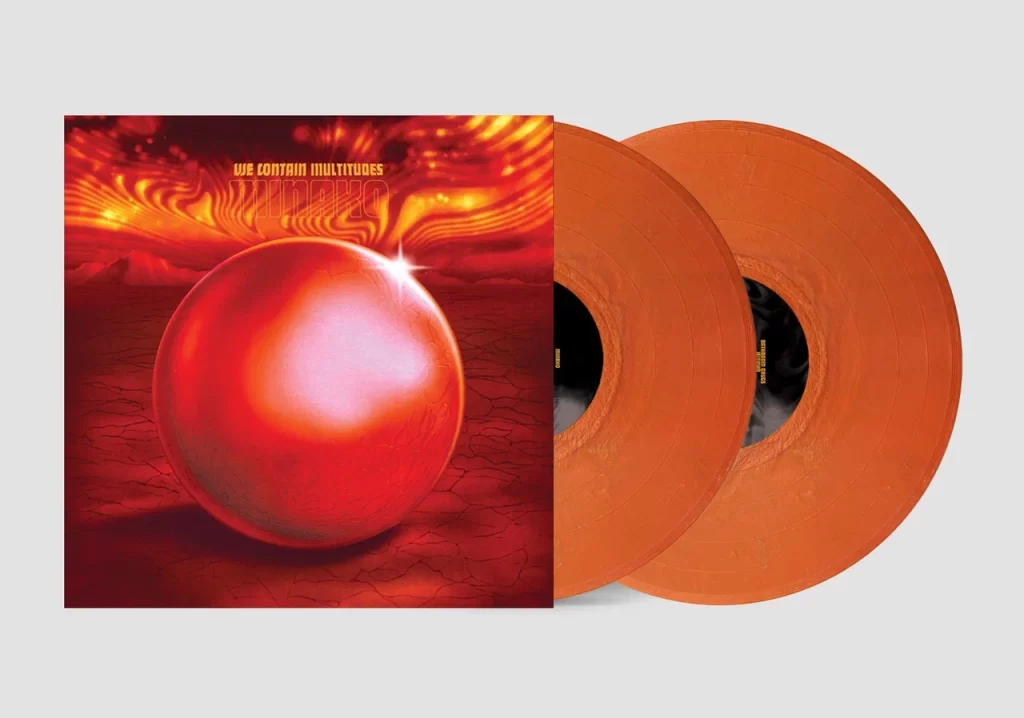
You’re putting Minako out as a double LP, with limited-edition vinyl and all. Was the decision about the satisfaction of making something that feels real in the digital haze?
I remain a big believer in physical media and analog experiences. Also—forgive the cornball and super-obvious sentiment—but actual records in actual album covers are awesome.
Further information
Minako was recorded by Abe Seiferth and produced by Seiferth and the band. The double LP is coming out this June 25. It is a limited edition of 300 including 50 on orange vinyl is available from Expert Work Records.