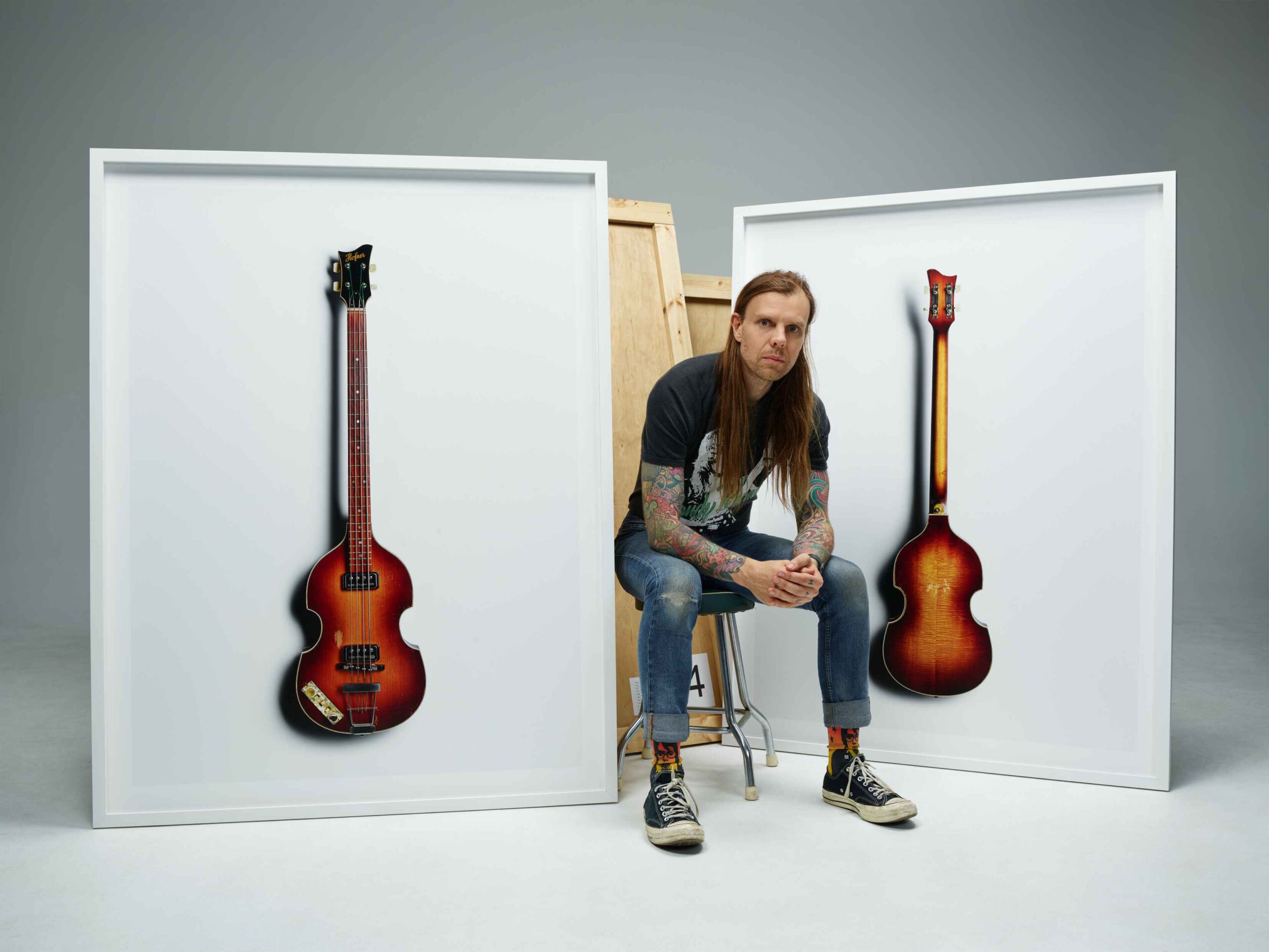
Kane Hibberd with 153 Paul McCartney
“You never own a guitar – you’re just its custodian.” That quote sets the tone for Kane Hibberd’s extraordinary photographic odyssey. Over twelve years, the Australian music photographer criss-crossed continents, knocking on greenroom doors and studio side entrances, to capture the most cherished guitars of the world’s most iconic musicians — not in mid-solo, but in still life. The result is Scale, a staggering exhibition of life-sized portraits of 100 instruments, from Paul McCartney’s Hofner bass to Chrissie Hynde’s well-worn Telecaster.
What elevates Scale beyond a museum of rock relics is its intimacy. Each guitar is presented as both artefact and autobiography, brought vividly to life by audio stories from the artists themselves — some hilarious, some poignant, some truly wild. In this conversation, Hibberd discusses the emotional weight of instruments, the joy of being alone with Kirk Hammett’s guitar at Metallica HQ, and why a battered SG may have saved Captain Sensible’s life.
Where did the original spark for Scale come from? Did it arrive in a moment or evolve gradually over time?
Scale was originally inspired by Chris Cheney’s Gretsch from The Living End. I was touring with them in 2011 and talking to drummer Andy, about how cool Chris’s beat up guitars were. Up close to the guitar, the detail you could see like the hardware rusting from sweat and the dents and scratches from years of playing to me looked really cool. Andy made an off the cuff comment, “You should do a book on guitars.” I guess the sentiment kind of stuck because over the next few years I kept on coming back to the question of how I could show the detail that you could only see if you could get close enough to the guitar.
Sometime during those next few years at some point, I came up with the concept of shooting the guitars and printing them life size and in early 2014, I literally woke up one day and started. After telling so many people about this idea I had, it was time to either shut up about it or begin.
Why guitars? What made you focus on a single instrument rather than a broader musical collection?
The guitar was the initial catalyst for starting the project, to show the detail that most people would never get to see and then keeping it to just guitars shows the contrast of how each artist inadvertently turns their guitar into a unique piece of art over a period of time. How they play it, what sort of music they play and their individual relationship with the instrument changes it so that no two instruments, even if they are the exact same make and model, will ever look the same.
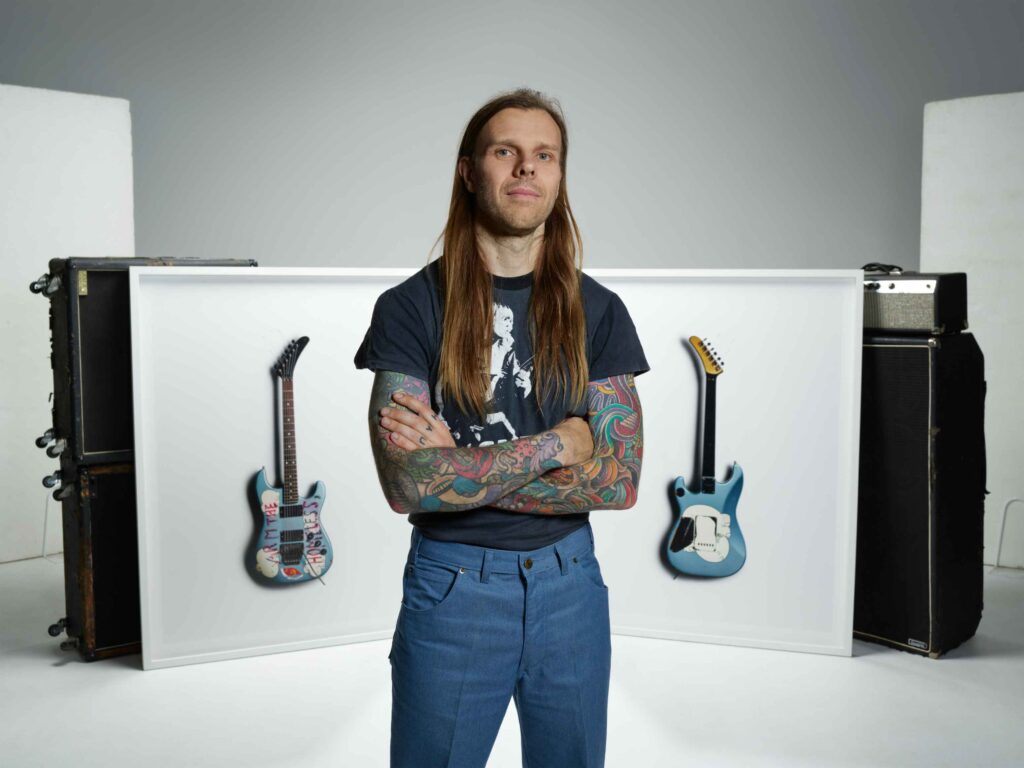
With the lighting and background being constant as well as the size of the print, this allows the viewer to become even more focused on the instrument itself. The interviews I did with each artist then give the visual state of the instrument further context in why it looks the way it does.
When you walk into the Scale Exhibition, it’s almost overwhelming with not only the size of the prints but the number of them and the breadth of artists covered. I think if I’d focused on a diverse range of musical instruments, it wouldn’t have this impact, it would be more a story of the relationship different musicians have with different instruments. That would still make for a compelling exhibition but it wouldn’t have had the same visual impact of walking into a room filled with just images of guitars. Plus, I’m sure you’ll agree that a beaten-up old guitar just looks amazing!
How does Scale challenge how we think about instruments — not just as tools, but as vessels for memory and emotion?
People who play an instrument have a fundamental understanding of the relationship each person has with their instrument that develops over time. It’s the people who don’t play an instrument that I think will learn something about that relationship that they’ve most likely never considered when they visit Scale.
It’s said you never own a guitar, you’re just the custodian of it. The guardian and protector. A guitar can’t stand up by itself, it needs to be held or carefully placed so it won’t fall down or be damaged. It’s not like a piano or a drum set that you sit at, often in the same location and then leave when you’re finished. You have to be constantly aware of the guitar at all times, it’s a very personal relationship. There is a physicality in the presence of holding the guitar or feeling its weight around your neck. The sensory reaction to your hands meeting machine and becoming a conduit of the human spirit is almost mystical in nature.
Unlike larger stationary instruments, a guitar can go anywhere and be always within arm’s reach. It’s a constant companion which only increases the intimacy of the relationship. The change in location often influences your playing too. Johnny Marr talks about the guitar being both a sociable instrument, “Where you can literally find new friends, form a band, hang out and jam. But at the same time, you can just disappear for a few hours, shut everybody else out and be on your own, like a diarist, with it.”
Matty Healy talks his Mustang guitar being the only guitar he has an “Overwhelmingly strong emotional attachment to” because he just doesn’t have the time to build another relationship like it with the sizeable guitar collection he now owns.
Without the gifted hands and imaginations of the artist playing the instrument, a guitar is just an inanimate object. With the passing of time though the object morphs and moulds to the visceral guided graces of the human hand. Hours upon hours of intimate connection, the search for the perfect chord progression or a just a single note bring the object and the player closer to being one.
Many artists that I’ve spoken to often talk about the feeling of a guitar. One that’s been played so much that it’s irreplaceable not because of the monetary value but because of the time they’ve physically spent with it. Jim Moginie (Midnight Oil) talks about his Gretsch being like an old friend that’s been to every gig, sharing the special moments. Richard Hawley describes picking up his favourite Gretsch as giving him a sense of being whole. Lzzy Hale (Halestorm) describes her Gibson Explorer as feeling like home.
Even an artist like Kevin Parker (Tame Impala) who views his instruments as tools admits that it’s inevitable to become emotionally sentimental about a guitar when you’re using it to create music “That’s really heartfelt and takes you to an emotional place.”
How did you gain the trust of these musicians to let you photograph their most personal instruments?
I think it’s a testament to the strength of the Scale that so many people that I had never worked with before accepted my invitation to be a part of it. The idea was simple, I photograph one guitar and it was up to each artist how far they wanted to delve into that relationship which again all forms part of their relationship with the instrument.
I think that relationship is something that hasn’t really been explored before, many artists found it interesting to be talking about their guitar outside the usual technical talk. Many artists starting putting me touch with their artists friends directly after I had photographed their guitar. That personal recommendation between artist to artist really helped legitimise the project. As an example, Ian MacKaye put me in touch with Steve Albini. Steve put me in touch with Terrie Hessels. Terrie put me in touch with Thurston Moore.
I also think the breadth of artists I spoke to for the project demonstrates that this wasn’t just about fame. I wasn’t just interested in talking to highly celebrated artists, I was interested in the relationship that every artist has with their instrument. It doesn’t matter if an artist plays stadiums and has sold a million records or they play clubs to three hundred people, they both have a relationship with their instrument that was worth exploring.
Was there a shoot that was especially emotional or technically challenging?
Being from Australia, the journey of creating Scale over a decade in the making was literally a life changing experience. During that time, I got to travel to so many places that I hadn’t been to before such as Iceland as well as returning to places many times over, like Nashville. It was also a continuous thrill to lock in an artist that I had tried for many years and only through perseverance and some good timing that it happened.
Being a lifelong Metallica fan, shooting Kirk Hammett’s guitar at Metallica HQ was a dream come true. For a few years I had tried to get in touch with Kirk through different contacts with zero responses. On a trip to the US in 2019 when I arrived into LAX while awaiting a connection to Nashville I had a random memory of talking to a guitar tech years and years before who said he was good friends with Justin (Kirks tech). Even though it had literally been 4 years, I emailed the contact and by the time I arrived in Nashville I had a positive response and within 48hrs I had confirmation that Kirk was in! I had the opportunity to shoot in in LA or at Metallica HQ and there was no way I was missing out on that opportunity. The MET Jam room is like a museum.
I was in LA at the time so I drove up to San Raphael along the tourist route one which was a great way to start the trip. Luckily I wasn’t on too much of a hard schedule with back to back shoots so I could enjoy the trip. I stayed in a super cheap motel 5 minutes from where I would be shooting it so I wouldn’t have far to travel the next day. I was always paranoid that something would happen like I would get a flat tire or the car wouldn’t start on the days I would travel for shoots even though it never happened.
It takes around 2hrs to photograph a guitar and so I really remember trying to take it all in while shooting the guitar. Trying to be present during the experience even though I was shooting one of the biggest guitarists. The process for shooting each guitar was relatively the same though I still would get a bit nervous and would just want it to be done so I could relax.
Kirk wasn’t around for the shoot, I was with the manager of the studio who was super nice, a huge King Gizz fan. I was alone in the room for most of the shoot which I had to try and stop myself from zoning out and looking at all the memorabilia around. I got a little tour afterwards which was amazing. All in all, one of the best days I had while shooting Scale.
Do any of the guitars carry an unexpected history — a surprise gift, a life saved, or a twist of fate?
The stories attached to some of the guitars are amazing and something I wanted to document. Some of them are well known and some of them aren’t but they are all intrinsically linked to the guitar.
There are many stories of guitars being stolen but later, in some case years later, being returned to their rightful owners. Kelley Deal, Peter Buck, John Reis and Peter Frampton, the latter being returned over 30 years later after surviving a plane crash before being looted.
I love that Mark Bowen from Idles still plays a guitar that he got from his Dad, David who himself played in Belfast in the late 70’s. David has some fascinating stories of gigging during the height of The Troubles, from rubber bullet holes in clubs, being bottled on stage through to trying to pick up band equipment from a gig the night before and being arrested and giving out band badges to prove they were indeed a band!
Keith Urban owns Waylon Jennings 1950 Broadcaster, a surprise gift from his wife Nicole who bought it at auction, an auction she had to prevent Keith from registering with.
One of my favourites though is Captain Sensible. Captain Sensible fell off stage one night playing his trusty SG which he dubs as a “survivor” due to the number of guitars that were broken and went out into the audience never to be seen again. He fell off stage and fell painfully on his ribs. After the show he was taken to hospital for some scans. When they were done, the doctor came in and said ‘I’ve got two things to tell you. Firstly, you’ve broken a rib, and secondly, you’ve got cancer.’ From the scans, they picked up a spot on his liver, which was a completely random accident as they would never have found it unless they were specifically looking for it. Because they picked it up so early it was later successfully removed so you could conclude that falling off stage that night inadvertently saved his life.
Paul McCartney, Johnny Marr, Chrissie Hynde, Noel Gallagher… Did any of them surprise you in how they talked about their instrument?
The stories that came from the conversations I had about the guitars involved a lot of nostalgia about a life lived playing the guitar which is often described as a friend. On the question of “If the guitar could talk to you after all these years”, Paul McCartney responded with, “I think it may well say, ‘I’ll tell you what, mate, we’ve seen some stuff, haven’t we!’
Johnny Marr responded to that question in regards to his Rickenbacker, ‘We’re still doing it Johnny boy’ even though he admits he’s pathologically anti-nostalgia and tries to not get too sentimental about it.
These days Johnny’s more likely to be playing a Fender Jaguar, but still ends up using the Rickenbacker for something on each album. It’s like an old friend that’s been with me through all kinds of stuff. If there’s a certain job that I think needs doing, I’ll reach for it and know it’s going to deliver. And that’s a really nice, familiar feeling. However, I think it’s always good to remember that a guitar is also a tool. A tool for work.
Even artists such as Noel Gallagher who do view their instruments as straight up tools couldn’t help but develop more of an emotional attachment to the Strat he bought off Johnny Marr that he recorded some of his biggest tunes on such as ‘Wonderwall’ and ‘Don’t Look Back In Anger.’
What role does physical scale play in an age where music is increasingly digital and intangible?
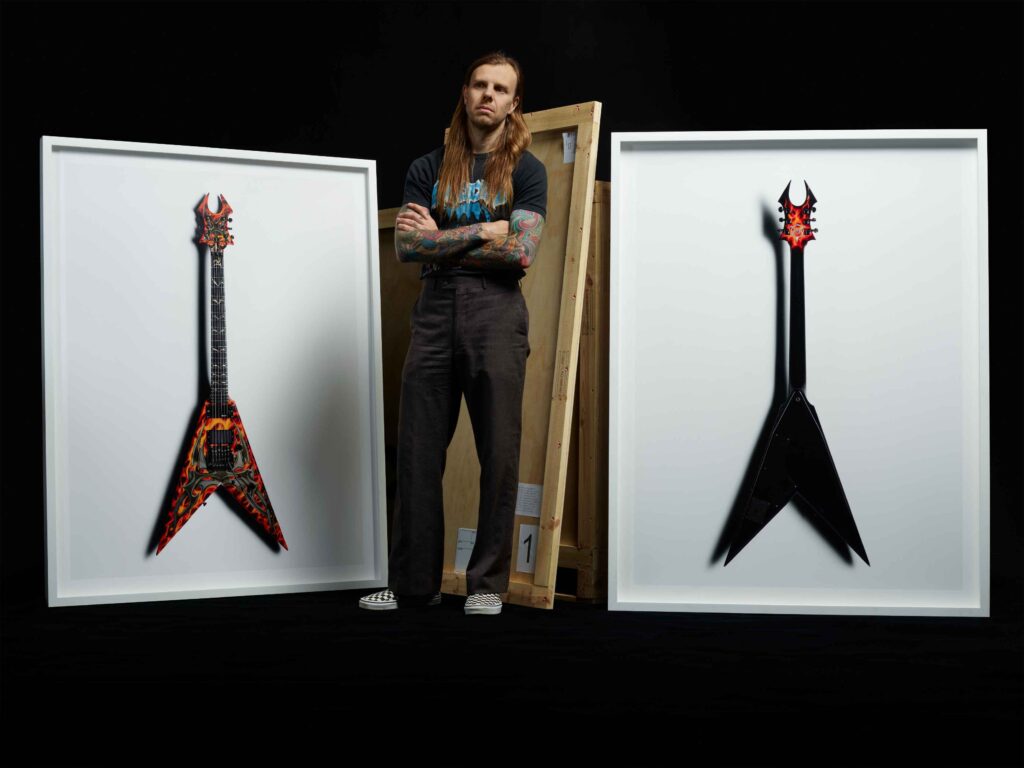
Before I had even shot a single frame for Scale I knew it had to be a physical exhibition. The camera that I shot the project on, Phase One, was chosen for its resolution and detail that it’s capable of reproducing. Other than the forth coming book, I only ever want Scale to be viewed as the full-size prints. I don’t want it to be viewed on a screen or in any alternate print sizes. I want people to physically come and see what a print can look like when the process for it’s creation has been designed specificially it’s intended output.
There is a real physicality to the prints, they almost seem larger than life. There is something about getting lost in viewing the instrument when it’s presented in such stark surroundings. There is nothing to distract you and you can get lost in the detail. The prints capture the guitar in such a life like way that you can really get up close and see the detail in the smallest wood grain. Even after having looked at these guitars for hours upon hours, I can still look at it with fresh eyes and discover something I had noticed before.
After spending over a decade on this, do you still feel close to it — or does it belong to the public now?
It’s strange, after walking around the exhibition as it was being built in London I was struggling to figure out what I was feeling. Launching the exhibition was something that I had thought about for over a decade and honestly, I started to feel a little removed from it seeing it in an exhibition format because of the scale of it. It almost seemed too big, like it was the work of other people, not just one individual.
A few hours before doors on the opening night though, I finally figured it out. After being alone with Scale for so long what I was really looking forward to was sharing it and having someone else in the room to experience their reactions to what I’d been living with for so long.
It’s been so great to share what I’ve created and even though some of the stories are known in guitar afficianardo circles, its been fantastic to see them move further out into the world. I’ve found myself describing the exhibition as, come for the images, leave with the stories. Because when you leave and tell someone about what your saw, it’s the stories you’re going to recount.
What’s next? Are there plans to tour Scale beyond London, or to expand into other instruments or artists?
London is Scale‘s debut exhibition which, coming from Australia is a crazy thing to say. The plan is to have London be the first stop on a world tour of which hopefully I’ll have some information regarding the next stop soon.
Guitars is in the DNA of Scale so I can’t see myself adding trumpets anytime soon but a banjo? You never know. As for additional artists, there are a few prized guitars I would still love to have in final collection from Angus Young, Joni Mitchell, Dolly Parton, Tony Iommi, Willie Nelson, Jimmy Page and Bonnie Raitt. I never thought I would have Paul McCartney in the project, but here we are so I’m still hopeful for the remaining few.
Further information
Scale: A Photographic Exhibition by Kane Hibberd: Until 31 August | Unlocked Shoreditch | 118 Curtain Rd, LONDON, EC2A 3AY
Website and booking: www.scale-exhibition.com
Photos used with permission courtesy of Scale