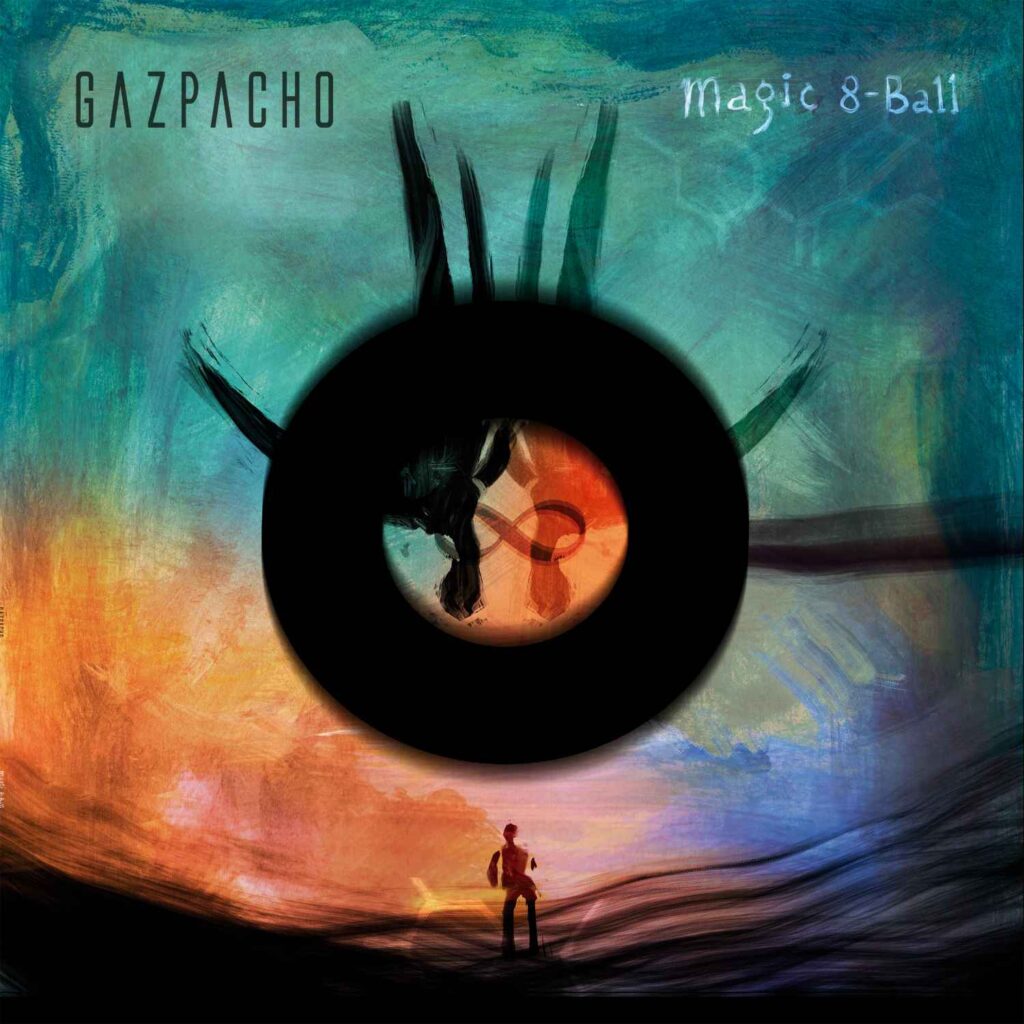
Magic 8 Ball finds Gazpacho at their most focused, yet still chasing the unknowable. Where past albums drifted into long-form hypnosis, this new album turns its gaze towards the point where fate and free collide. Speaking with Thomas Andersen, you hear a mind equally distrustful of certainty. He talks about scrapping an album the moment it became lifeless and following the music until it reveals what story it wants to tell.
What felt like the clearest starting point for Magic 8 Ball, and how did the image of the toy oracle come to feel like the right metaphor for an album about fate?
Hi and thank you for having me. This is a great question and a difficult one to answer without sounding like a dork, but here you go. The actual answer.
The scientific worldview, despite its mechanical precision starts to resemble mysticism the deeper you go. I mean, the Big Bang? Come on man. A sudden explosion from absolute nothing, birthing time, space, and matter? That’s absurdly hard to grasp. And in that light, stories like Jesus walking on water or the Buddha embodying cosmic truth don’t sound as crazy anymore do they? Maybe they’re just different languages trying to say the same impossible thing.
I’ve always felt, perhaps without much reason, that the earliest religions might be the closest we’ll get to “the real one”. Think of the Neanderthals, worshipping the sun, their ancestors, or some unknowable force. That kind of raw, primal reverence makes sense to me. Because if there is a God, it would have to be something so fundamentally alien and mysterious that we’d never begin to comprehend it. The idea that the universe could be reduced to math and that us little apes could understand it all? That feels more childish than the most fantastic myth.
But as rationalism gained ground, especially in the West, we threw out God. And with God, we also tossed out tradition, meaning, and any deeply rooted sense of right and wrong. We also threw out hope while we were at it. In doing so, we crowned ourselves the new masters of truth and morality.
Except we aren’t masters, are we? We’re basically overgrown children riddled with doubt and as I’m sure you’ve noticed, no one has any idea what they’re doing. We have an amazing technological world, hell, we have the internet, and we use it to argue over dumb stuff on Twitter (yes I know it’s X) or watch cat videos. I love cats as much as the next guy but surely this is not the master race that’s cracked the code of the universe.
No throne stays empty and with our need to believe in something, it might as well be a plastic toy like an 8 ball spitting out random answers. That’s as good as it’s gonna get.
The album is organised as a series of short stories. When you write a song that is also a miniature narrative, do you begin with a musical idea or with a voice and a situation? Can you talk through one example where the words came first and another where the music set the scene?
All of them start as music. A lot of the time we use any text lying around as placeholder lyrics to help build the melody. Once that’s done, we sit down, listen to the song and try to figure out what it’s about. And the song usually tells us. That sounds annoyingly like hippie talk but it’s true.
Often, we’ll write the instrumental with a concept in mind, and sometimes that idea sticks. Most of the time the song veers off somewhere else, and we follow. ‘Sky King’ is one that stayed true to the original idea. It was written about Richard “Beebo” Russell, the ground service agent who stole a plane on a whim and crashed it to his own great surprise. We wrote that instrumental to make the verses feel as quiet as his regular day at work would be and the chorus as soaring and sudden as what he did. The lyrics wrote themselves. It was one of the few times where the song did exactly what we asked it to.
‘The Ship of Theseus’ is an explicit reference point for the record. In practical terms, how do you translate that philosophical question about identity into songwriting choices: melody, arrangement, recurring motifs or lyrical refrains?
It’s in everything. The guys making this album, are they at all connected to the people who made Gazpacho albums 20 years ago? We all make compromises and go through so many changes, thanks to whatever fate throws at us, that I’d say it’s impossible to consider the “self” the same one we had last week.
This only gets translated by telling different stories. I don’t think Mr. Russell the baggage handler at twelve, would ever dream of stealing and crashing a plane as an adult. So which of those is the real Richard? Same idea in ‘The Unrisen,’ about those who’ve passed away. Who’s the real version of a person? We’ve all been dead for billions of years and only lived for a blink. Statistically we’re more dead than alive by a huge margin. So which one is you? The rare living Jason or the eternal dead one? Sorry if that was too much my man.
Magic 8 Ball is described as more focused than some of your previous work. How did you decide what to leave out, and what does the band mean by clarity and tension in a Gazpacho track?
On past albums we maybe got a little too into the long hypnotic stuff. We thought it worked then because those albums were introspective and built for it. But on this one we tried not to take that too far. We didn’t pack in too many instruments, (Night had over 200 tracks in some sections which is insane) and we trimmed the fat as much as possible.
There is an idea at the album’s core that the same patterns return in different forms. Did you purposely write musical Easter eggs that echo across the eight songs so that listeners might feel that repetition? If so, where should we listen most carefully?
We’ve got a running theme that’s on several albums. The melody during the moog solo in the middle of ‘The Unrisen’ is on almost every Gazpacho album starting with ‘Prisoner’ from Firebird. It just shows up now and then, and we love it. No idea why. I remember thinking it sounded too Disneyesque, but it also had this longing that sets a mood.
Your records have often favoured extended forms and cinematic textures. On this album you’ve kept things tighter. Did the five year gap since Fireworker change the way you approached structure and discipline as a group?
Yes. We actually started writing a concept album about an imminent comet strike and how it wouldn’t really change anything. The idea was to show how we manage to disregard and forget death to stay sane. It was a very long and hypnotic piece but we had trouble keeping it interesting. Mostly because we couldn’t find the right tempo. Too slow and it dragged, too fast and the mood was gone.
Thankfully we were saved by the bell when the film Don’t Look Up dropped with the exact same story. After a few tears we scrapped it. That process probably pushed us into something more immediate and energetic. There’s something freeing about ditching a project that’s fighting you, even if it hurts. Sunken cost fallacy and all that. I think that’s the real reason this album is what it is.
The band has a long relationship with concept and story, from Night and beyond. Has your appetite for narrative evolved over the years, and do you ever feel constrained by a concept that must fit a single story arc?
It’s the source of inspiration. Why create anything if you’ve got nothing to say? Being in Gazpacho keeps me hunting for ideas and trying to put those random shower thoughts into music. I always loved what Steve Rothery (of Marillion fame), said about concept albums: you can go too far and make one about the life cycle of the tsetse fly. Damn that one makes me laugh! Concepts are great when you’ve got a good one. We always try to have a larger idea that lets us write about all sorts of stuff.
Night was going to be this dreamlike train of thought thing about the state between sleep and awake. That time when the ghosts come out for coffee. That gave us freedom to write anything and make it work. Same with Magic 8 Ball. Everyone’s story has something worth exploring.
A recurring theme on your albums is the tension between agency and inevitability. At what point in the writing did you realise whether the album would be asking questions rather than offering answers, and was that conscious from the start?
We’ve never claimed to have the answers. Like that scene with the supercomputer in Hitchhiker’s Guide, the real magic is asking the right question. All our albums are meant to be a space for listeners to get into their own heads and let the music take them wherever they want. I don’t think anyone really cares what we feel about stuff. The real juice is giving people a chance to see things from other angles. Through other stories.
Gazpacho have often spoken about listening habits and being influenced by unexpected music. Were there contemporary records or non-rock influences that quietly reshaped the sound of Magic 8 Ball during its creation?
I’ve heard people compare it to all kinds of stuff. Latest one was Depeche Mode, which we love. I know the melody on ‘The Unrisen’ was originally inspired by a Russian Orthodox Easter hymn. That song came during Easter where I got to thinking about how many folks don’t rise from the dead and how they’re further from us than someone on the furthest planet. The finality of death. That’s the core of Magic 8 Ball. Even if we’re modern and enlightened, we think magical thoughts all the time. I still feel like my dead parents are watching over me and helping me. It sounds crazy, but I believe it.
Live performance has been central to your reputation. How do you imagine these short-story songs translating on stage, and will the live versions emphasise different aspects of the arrangements?
We’re working on that now. Rehearsing and figuring out what sounds to use and how to make the songs stronger live. I think we’re a good live band and the songs usually improve after rehearsing them. Live versions tend to shift the dynamics more. The quiet parts get quieter and the loud parts louder. It’s like the songs are on speed.
In a world that often demands certainty, what would you like a listener to take away from this record about chance, choice and the slow work of becoming who we are?
I’d love if anyone listening to this felt like they could take something useful from it. Lightning can hit anytime and being mentally ready is a good thing. It is another way of “prepping”. There’s a quote I heard from an actress I recorded in my studio once who was recently diagnosed with cancer. She said she used to think “why me?” but then thought “why not me?” since it happens to so many people. Good and bad.
That gave her peace.
Thanks for having me Jason and thank you for the great questions.