They were always the most eccentric of the psychedelic folk travellers, and now, three decades since their last full-length dispatch, Dr. Strangely Strange return with an album that’s as playfully surreal and gently subversive as ever. In his typically allusive, erudite style, reviewer Brian R. Banks traces the whimsical path of these Irish countercultural cult figures from their 1960s commune days to the quietly magical Anti-Inflammatory. Brian celebrates a band whose refusal to modernise is their greatest strength. Anti-Inflammatory, he suggests, may not cure aging, as the band mischievously claim, but it certainly soothes the soul.
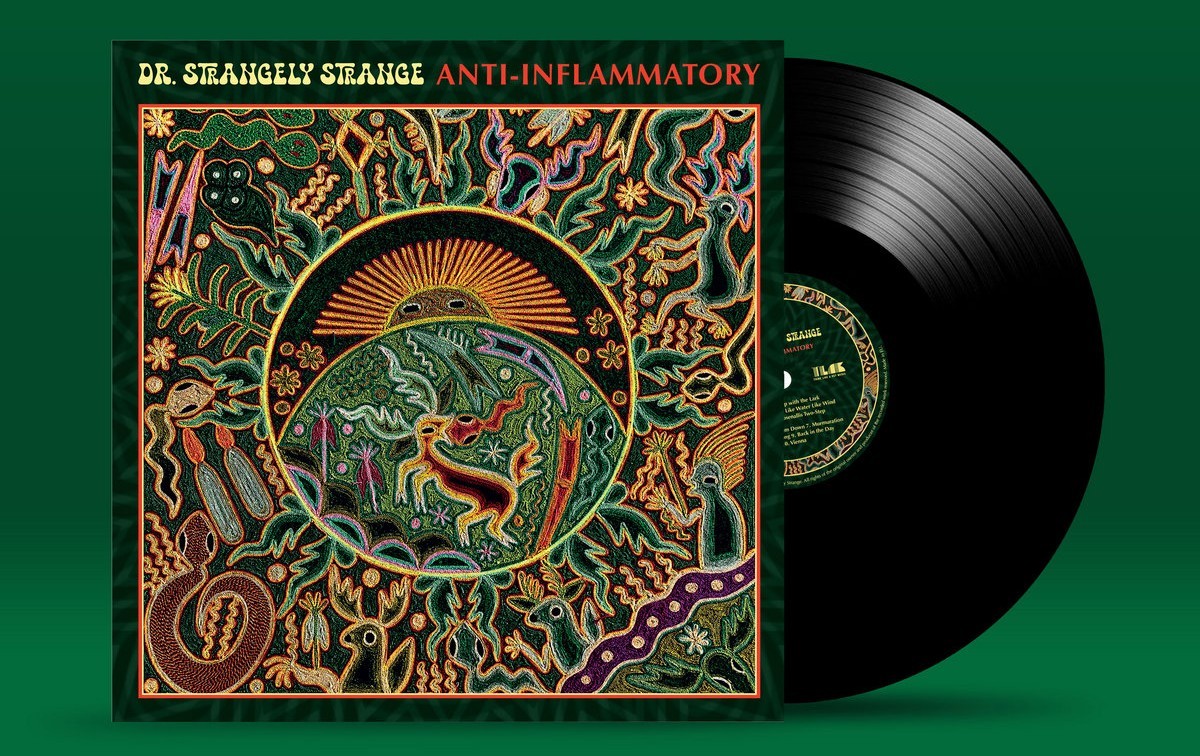
Dr. Strangely Strange Anti-Inflammatory (Think Like A Key TLAK 1197)
Sprinting furiously, or at least curiously, out of the traps from a timeslip of 28 years—if you’re counting properly—this is the psych folk first-wavers’ first new album since the 1990s. After pioneers Incredible String Band and Pearls Before Swine, both of whom have threads here, the Strangelies’ brew of whimsical merriment surfaces again with the original trio who recorded a debut in 1969.
The band was formed in 1967 by now-septuagenarians Tim Booth from County Kildare (vocals, guitar, mandolin, saxophone, percussion), Ivan Pawle from the more eastern Anglia where Romans once landed (vocals, bass, keyboards, guitar, whistle, melodica) and, briefly, Brian Trench who left then replaced by Dubliner Tim Goulding (harmonium, vocals, recorder, glockenspiel, stylaphone): in truth, multi-instrumentalists of whom two were and remain visual artists too.
In their early commune-living days (still today songwriting remains equally shared) they were chums with Phil Lynott, Gary Moore, and Robin Williamson of Incredible String Band, recommending them to his label owner Joe Boyd at Island. Seeing them support Skid Row he hesitated, until hearing that the stateside label sporting Pearls Before Swine was interested, took the plunge and booked a couple of days studio time in London to produce the beguiling Kip Of The Serenes in 1969, with a track on the classic compilation Nice Enough To Eat. (I’ve an original cassette of Kip…that eludes reference anywhere; the product not me). In spite of a now legendary status, besides coinciding with Nick Drake’s debut and the kudos of putting James Joyce to unforgettable melody, it was grumpily reviewed (“creeping ennui sets in with numbing effect” Melody Maker) or studiously ignored (John Peel gave his unbought copy to a kindergarten).
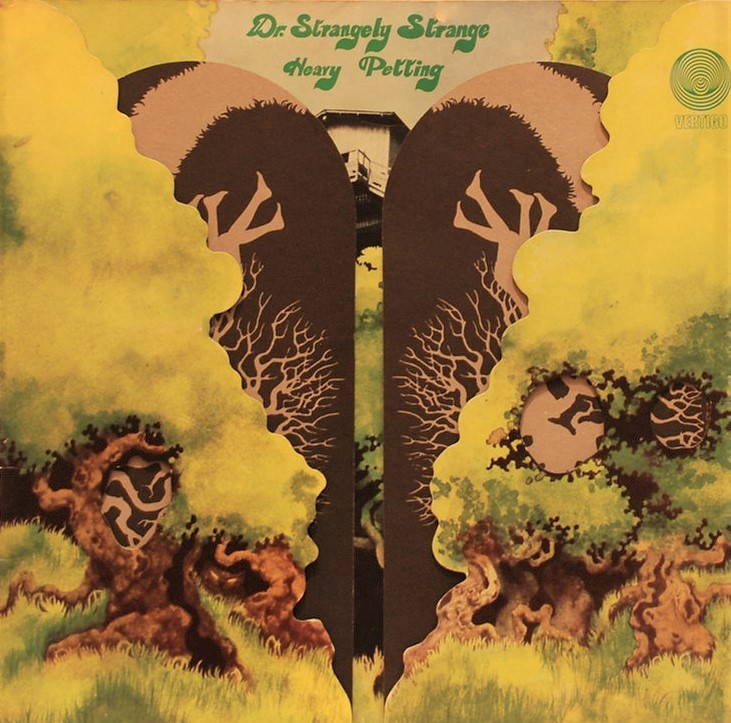
Gigs increased but presumably Boyd didn’t take up an option and Vertigo released Heavy Petting in 1970, with a rockier (of sorts) feel abetted by Fairport Convention’s drummer plus Gary Moore with some wizard licks. They were on the Vertigo Annual too. Peel changed tack after seeing them at a festival in mid-1970 and taped three tracks once for Top Gear (but inexplicably not on Night Ride) and a Sunday In Concert supporting James Taylor later that year, two of the five songs unrecorded. No LP tracks featured on his show, but a Les Cousins bootleg circulated that year, I may have heard it at fan Genesis P. Orridge’s or above the great bookshop by the bridge that started Camden’s hippydom.
Some Dutch and Danish broadcasts (and a rehearsal with Gary Moore) were released on the sadly quiescent Hux Records who expanded the early work. Briefly sporting a drummer for a tour band including Gay and Terry Woods, who were perplexed by the ensemble getting looser rather than tighter (in music terms), the melody medics took a sabbatical though never broke up, guesting with the Incredible String Band amongst others. Booth produced two animated films, The Prisoner 1984 inspired by the poet W.B. Yeats, and Ulys in 1998 returning to Joyce, with Dr. Strangely Strange music.
In 1997 appeared the new and lovely, always-amusing Alternative Medicine via Big Beat (have you noticed how label like band names have deteriorated since that time and today’s doesn’t buck the trend), then the fine Halcyon Days (Hux) eight years later. The trio were augmented by fiddle/mandolin virtuoso Joe Thomsa in the 1980s for mostly local gigs, and that is the core quartet for Anti-Inflammatory plus guests including producer Brian Casey, recorded in his studio near Booth’s home in Clonakilty, County Cork.
Up With The Lark has a quivering Ivan Pawle vocal intro over piano that leads (almost) into an Irish madrigal with Thoma on fiddle and Casey on ‘tin’ whistle. Some reviewers see it a weak kick off (like football’s rule change going ‘the wrong way’?) because not the LP’s mood, reviving what one calls (oddly) a “renaissance dance”. The songwriter says it’s about their batty horse inspired by a popular Irish radio theme tune. Of the single Baby Bunting, Tim Booth enigmatically calls it “Deep stuff at the shallow end”, an octet combo romping into an electric-acoustic potion with a distant hint of a Bo Diddley rhythm.
Goulding’s Like Water Like Wind, inspired by the Persian Rubaiyat Of Omar Khayyam (also echoes compatriot poet Rumi) nods to their 90s magic. Rosenallis Two-Step, one of only two songs passing four minutes, by Tim Booth who says that historic Irish hill village sounds like a wild west gunfighter town, a motif throughout their career (the debut’s Roy Rodgers; James Gang on Alternative Medicine; Halcyon Days’ Invisible Kid). It’s a full ensemble sounding almost like a jugband, while Drive ‘Em Down (Pawle’s “wobbly whisper” for what the label dubs “a cattle-herding romance” whatever that is) is a finger-picked country (side) musing on school and life in typical humor that fades too soon (a pity the producer couldn’t extend songs with ideas/observations, but at least never ebbs into this century’s pervasive la-la’s!). Murmuration is about a music dream involving Terry Woods, “old fashioned, old timely” (Booth) echoing the “summer breeze” of that period’s LP track, aided by two low C whistles, fiddle etc. Back In The Day (with mellotron?) is typical Pawle, not ”twee” however as one scribe opines but factual bridging of the chasmic span between periods.
There are three instrumentals (by Thoma and/or Goulding), reflective for life and where we are or seem: Sulan, named after the meandering river in Cork sounding like a visual accompaniment, the melancholy but actually wedding celebrating Morning Song, with almost school assembly piano in a sweeping melody, and Vienna (named after Tim Goulding’s grandchild in this age of odd but not boring names) has classical tropes that offshoot into ragtime on a family grand piano once played by Louis Armstrong.
In the important time of Rome’s expanding civilization it became standard for its historians to exaggerate by a factor of ten: as conquerors the enemy was ten times larger, if they lost they saved face by the same artifice (probably the first propaganda, a word later coined by the Vatican from the Latin). Historians know this, history T.V. doesn’t, even exaggerating to more than entire populations at that time comparable to today! Equivalent absurd exaggeration permeates the history of music nowadays (“treasure”, “royalty” etc.) There’s no such hype with this band, unlike other survivors (copied by tribute bands and media soap-opera, shades of Orpheus and Eurydice!!) even if the high-water era seems as bygone as Rome and Constantinople, each a zenith in their own very different ways.
We live in an age of invention, hype; less developed countries even treat it is always positive! In music, Zeppelin or Stones have never been unique nor stand-alone, Dylan’s 1960s novels were ridiculed not given a prize by an organization laughing at its own origins and genuine laureates. Safety in numbers, like the charts. But some, not a few, contemporaries were original, unlike anyone else, not like those happy to mimic and avoid personal creativity. It’s good to support originality in these last days, if we don’t want to devolve. The past can’t be recaptured of course, or replicated, but enjoyed at least for what it was.
Some reviewers call it the first new album after 38 years, no, some say hippy, better to see them as they actually were i.e. counterculture, though eschewing politics or current events still, unlike Neil Young. The website says these “musical medics have found the cure for aging itself”, which of course they haven’t though their earlier albums do administer tonic to alleviate the times while living life and creativity. You might prefer a ‘des-res with all mod cons’, Dr Strangely Strange are endearingly quaint, almost ramshackle, more of a cabin by the lake left alone in its own right than a ’condominium’ (?!) of more bathrooms than living rooms. At times not a band, especially live, as a motley cast of ex-sailors sharing yarns
Alas the booklet (after a beautiful Tim Booth cover) has no history, context (another sign of the times?) nor lyrics (which for this group are rich) or times but some awful internet images of God knows what jarring with the art elsewhere by someone without sympathetic background. The album is too short as if the different formats (CD/vinyl) have the same length, absurdly, but I wouldn’t excise anything for the sake of a cassette mixtape, put it that way. Qualms because the album is endearing, a bit more “oddly normal” than “strangely strange”, but compared to what’s often served up by others, welcome from those who always beguile as a fitting accompaniment to dream. A boxset’s overdue, isn’t it?
Brian R. Banks
Further information
Dr. Strangely Strange Anti-Inflammatory (Think Like A Key TLAK 1197)