
Sam Cooke - adapted from public domain photo from ad for single When A Boy Falls In Love / The Piper, released 1965.
By Scott Shea
As we enter into the 61st anniversary of Sam Cooke’s death, I wanted to commemorate him through his music. The story of Sam is all too brief. We lost him at the age of 33 in a brutal homicide that took away not only a great singer, but a husband, a father, an employer, a boss, an entrepreneur, and an innovator. The details of that whole event are sordid and have always been pushed aside in favor of preserving Sam’s positive image, and there’s a Netflix documentary that tells the entire story. Here, I decided that we’d look at Sam’s musical development and progressions through the man’s own music.
Like many young, black singers of the 1950s, Sam Cooke entered the music business through the gospel world. The son of Baptist minister Rev. Charles Cook and Annie May Cook, he first sang in his father’s Christ Holiness Church choir in Chicago Heights as a young boy. At age 14, he formed his own gospel group, the Highway Q.C.’s, which, at times, featured Lou Rawls, and left it six years later to join the renowned Soul Stirrers. The veteran gospel quartet was formed in 1926 by Silas Roy Crain in Trinity, Texas, and, by the late 1940s, was the premier traveling black gospel group in the country. Crain bolstered the lineup in the early 1930s when he drafted Rebert Harris and the Friendly Gospel Singers of Houston to join him as his new Soul Stirrers. It was an incredible blend of Crain’s jubilee-style gospel and Harris’ slower, more soulful delivery, which would influence Sam Cooke profoundly. In fact, he acquired his trademark transitional flutter (woah-oh-oh, and oh-oh-woah-oh) after attempting to duplicate Harris’ style. 19-year-old Sam was brought in as his replacement in late 1950, which was a real testament to his talent.
He officially left the gospel group in 1957, as rock and roll was taking the world by storm, and joined tiny Keen Records in Los Angeles, which was run by songwriter/producer Robert “Bumps” Blackwell. He very quickly left his mark on that era with his #1 original “You Send Me,” which was followed by “Only Sixteen,” “For Sentimental Reasons,” “Wonderful World,” and many others. He jumped to RCA Victor in 1960, and, in the four years before his death, led the soul revolution that culminated with the rise of Motown and Stax Records, and can be heard in songs like “Sad Mood,” “Bring It on Home to Me,” “Nothing Can Change This Love,” and “Good Times.” Sam was even incorporating the red-hot Civil Rights Movement into his original, “A Change is Gonna Come,” released 11 days after his death. But the story of Sam’s life isn’t limited to just his hits. His deeper cuts were just as brilliant and accurately portrayed the direction his career was going, and, at the Strange Brew, we like deep cuts. Here are six that tell the story of Sam Cooke that you may not be too familiar with that possess his deeply familiar and delightful sound.
1. The Last Mile of the Way (1955)
This was recorded as Sam’s tenure with the Soul Stirrers was winding down, before he added an “e” to the end of his last name and went on to conquer secular music. It’s a pleasant blend of the pure black gospel, which the Soul Stirrers were known for, and the pop sentiments and soul harmony that highlighted Sam’s early hits with Keen Records, turning it into a contemporary gospel number. It also showcases the advantages of Specialty Records’ modern recording equipment, which added the big-budget polish normally heard on Frank Sinatra and Nat “King” Cole records. It features a nice duet between Sam and baritone singer Paul Foster, as well as a gospel choir and a rhythm section that lifts William Edie Marks’ turn-of-the-century gospel standard to the heavens. The tragedy of it all was that “The Last Mile of the Way” languished in the vaults for 15 years until finally seeing release on a Specialty 45 in 1970. More recently, it was featured in the final scene of the Bruce Springsteen biopic, “Springsteen: Deliver Me from Nowhere,” which introduced Sam Cooke & the Soul Stirrers to a whole new audience.
2. That’s Heaven to Me (1957/1960)
This song was recorded two different times; the first by Sam with the Soul Stirrers at his final group session in 1957, which wouldn’t see release until 1972, and the second as a solo effort on the Keen 1960 gospel compilation, “I Thank God.” And you can’t go wrong with either one. In the late 1950s, the U.S. was much more religious than it is today, but there were still a fair number of people who were put off by gospel music. It was very popular, particularly in the South and in black communities across the country, but still far from the mainstream. Even today, its purveyors are always looking to make it more publicly acceptable, and it was no different then. In this soulful number, there was no mention of Jesus by name or scripture verses. Rather, it was just an expression of gratitude for seeing his beauty in many of his earthly creations set to a contemporary R&B melody. A lot had happened in the year leading up to this recording. Sam’s popularity had transcended that of Crain’s and everybody else in the Soul Stirrers. In fact, in February 1956, both singers had signed separate contracts with Specialty to get bigger cuts of the pie, and it was clear as day that Sam was outgrowing the group and would soon be leaving. Exactly one year later, Specialty released his first solo record, “Lovable,” a reworking of the Soul Stirrers’ “Wonderful” from 1956, under the pseudonym Dale Cook. In April 1957, Sam officially left the group, and “That’s Heaven to Me” was a parting gift. It went on to become one of their most popular songs, but remains very much off the radar for casual Sam Cooke fans. Two singers very close to Sam would go on to record covers of this beauty, Lou Rawls with the Pilgrim Travelers in 1962, and his former protégé, Bobby Womack, at the height of his fame for his 1973 album, “Facts of Life.”
3. Desire Me (1957)
One of the oldest tricks in the music business back in its earliest days was to fashion the follow-up single of a huge hit to sound like its predecessor. Most of them didn’t hold a candle to their hit cousin, but there were a few exceptions. “This I Swear,” the follow-up to the Skyliners’ classic “Since I Don’t Have You” and “Hats Off to Larry,” Del Shannon’s single after “Runaway,” both come to mind. The Ink Spots, the top black vocal group of the 1940s, and one of the fathers of doo-wop, used a variation of the same guitar intro for nearly every single for years after its original appearance in their 1939 smash hit, “If I Didn’t Care.” Sam Cooke’s “Desire Me” was the sophomore follow-up to his monumental #1 hit “You Send Me,” and it works. Both songs were arranged to appeal to white audiences, but that doesn’t mean they’re bad. Quite the contrary. Sam sprinkled in R&B elements that separated him from his white contemporaries and laid the foundation for Motown, Stax, and other crossover black labels of the 1960s. Much like “You Send Me,” this song was sweet ear candy with understated musical arrangements and the lilting background vocals of Lee Gotch & the Pied Pipers, whose vibrato-rich female vocalists sounded like a woodwind instrument. The biggest difference between these numbers is that “Desire Me” was written by an obscure country music songwriter named Bruce Culver, but Sam’s laid-back vocalese makes it sound like one of his own. Initially paired as the A-side to “(I Love You) For Sentimental Reasons,” disk jockeys turned it over in favor of the decade-old King Cole Trio hit, which reached the Top 20 of the Pop Charts. “Desire Me” barely cracked the Top 50, but it did peak at #17 on the R&B.
4. Soothe Me (1961)
When Sam Cooke died near the end of 1964, Stax Records in Memphis, Tennessee, was still a couple of years away from finding its signature sound that would be heard on records by artists like Otis Redding, Carla Thomas, Booker T. & the MG’s, Sam & Dave and more. This Sam Cooke original was first recorded by the Sims Twins, a brotherly duo from Elba, Louisiana, and was a minor R&B hit on Sam’s own SAR label. It’s heavy and clunky compared to the breezy version done a year later by the master himself, with Lou Rawls serving as his harmony vocalist. In fact, Sam’s version almost serves as a blueprint for the Stax sound, as he lightened up the mood by kicking up the tempo a couple of notches and adding a horn section complemented by a matching xylophone that can’t help but get people on the dancefloor, as Sam’s music is often prone to doing.

The Sims Twins released four more singles on SAR, including another Sam Cooke original, “That’s Where It’s At,” which also possessed prefigurements of the impending Stax sound, but were dropped shortly after its release. Sam formed SAR with Silas Roy Crain and songwriting and business partner James W. Alexander in 1959, which fulfilled his dream of becoming a music industry entrepreneur and producer. His label released 57 singles between 1959 and 1965, but only a few hit the R&B charts, and none crossed over to the Pop side. More importantly, it served as a launching pad for future hitmakers Mel Carter, Bobby Womack, Johnnie Taylor and Billy Preston. “Soothe Me” eventually made its way to Memphis, with Sam & Dave releasing arguably the definitive version of this classic in 1967, which appeared in the 1980 John Belushi and Dan Aykroyd comedy, “The Blues Brothers.” In 1968, James & Bobby Purify recorded their version of the song less than five miles away from Stax at Chips Moman’s American Sound Studios.
5. I’m Gonna Forget About You (1963)
This soulful gem was tucked away on the compilation “3 Great Guys” with RCA Victor labelmates Paul Anka and Neil Sedaka. After his tremendous success at independent Keen Records in Los Angeles, Sam signed a big contract with RCA in January 1960 and hit #2 on the Pop Charts with “Chain Gang” by the end of the year. His first year at his new label marked a significant stylistic shift for the young singer. He went from sanitized crossover appeal heard in songs like “Teenage Sonata” and “You Understand Me” to the much more soulful stylings in originals like “Chain Gang” and “Sad Mood” that dominated the latter part of his career and would influence everybody from Curtis Mayfield and Jerry Butler to Otis Redding, Marvin Gaye and Al Green. The potential of this song was not lost on Georgia native Arthur Conley, who traveled to Fame Studios in Muscle Shoals, Alabama, an outsourcer of the Memphis sound, in 1966 and released it as his final single for the studio’s eponymous label. It didn’t chart, but Arthur would be better served with Sam’s help in very short order. Four years later, Sam’s former protégé Bobby Womack reworked the song’s lyrics and arrangement and recorded it at American Sound in Memphis for his second studio album, “My Prescription.” He left the songwriting credit intact out of love and respect for his beloved mentor.
6. Yeah Man (1964)
In pop music, there’s this fascinating phenomenon that happens occasionally, where a song either inspires or is reconfigured into a bigger hit. Some examples include Johnny Cash’s first hit, “Folsom Prison Blues,” which was inspired greatly by the Gordon Jenkins/Beverly Mahr song “Crescent City Blues,” which was featured in the 1951 Warner Bros. film, “Inside the Walls of Folsom Prison,” and Ricky Nelson’s “Hello Mary Lou,” which was derived from “Merry, Merry Lou” by the Sparks. Sam Cooke wasn’t above this practice either, basing his hit “Bring It on Home to Me” on Charles Brown & Amos Milburn’s “I Want to Go Home.” “Yeah Man” served as the basis for Arthur Conley’s monster hit, “Sweet Soul Music,” which peaked at #2 on both the Pop and R&B charts. While not a carbon copy, it opens with Sam belting out the question, “Do you like good music?”, which elicited a call-and-response from a background chorus. Arthur reworked the song with his mentor Otis Redding and turned Sam’s song about popular dances into a tribute to contemporary soul singers Lou Rawls, Sam & Dave, Wilson Pickett, Otis himself and James Brown. “Yeah Man” appeared on the first posthumous Sam Cooke LP, “Shake,” in January 1965. Following the success of “Sweet Soul Music,” James W. Alexander, Sam’s former business partner who still oversaw his publishing interests, sued Redding and Conley, which resulted in the attachment of Sam’s name to its songwriting credits. Sam wasn’t completely innocent in all this, however. He copped the opening riff from Elmer Bernstein’s main title theme for “The Magnificent Seven,” which Redding and Conley kept intact. Nevertheless, “Sweet Soul Music” has become a bona fide classic, and it seems that, much like “That’s Heaven to Me” was Sam’s parting gift to the Soul Stirrers, “Yeah Man” was his gift to two of his friends and millions of soul music lovers.
A Change Came
When Sam Cooke was killed on December 11, 1964, we lost more than a great singer. We also lost an innovator, a risk-taker and a man who wanted to change the world for the better. It was the height of the Civil Rights Movement, which Sam had been a part of since his time with the Soul Stirrers. He witnessed and was subject to the unfair Jim Crow laws that permeated the U.S. South, and actively sought to change them, which some believe may have cost him his life. In the early morning hours of that fateful day, Sam and a woman of ill repute, named Elisa Boyer, met up at Martoni’s, a posh Los Angeles restaurant, and drove 15 miles to the Hacienda Motel, a sleazy port of call for prostitutes and their johns in the heart of South-Central L.A. As Sam made his way to the bathroom to prepare himself for a romp, Boyer grabbed his clothes and wallet and bolted for the front office. Sam threw on his topcoat and chased after her. Understandably upset, he pressed the motel manager, Bertha Lee Franklin, on where Boyer had gone. Things got heated quickly with Sam accusing her of hiding the girl who made off with his wallet, and within seconds, she pulled a 22-caliber pistol from behind her desk and shot him in the chest. The bullet pierced his heart, and he died quickly. His final words were, “Lady, you shot me!” He was dead before any police or ambulance attendants arrived.
The whole scene was improperly investigated by the Los Angeles Police Department from the get-go. Rock and roll music was still held in disregard by anyone over 30 and, to the police, Sam was just another dead black man at a seedy motel in the ghetto. There was a lot of conflicting evidence that was never properly sorted out, and the Netflix documentary, “ReMastered: The Two Killings of Sam Cooke,” is loaded with conspiracy theories that range from business partner Allen Klein to the mafia to any number of the alphabet agencies for the federal government. Franklin’s gun was a .22 caliber but was registered as a .32, which could’ve been a clerical error. Sam’s body was also heavily bruised, which had been attributed to Franklin hitting him with a broom handle, and there were no witnesses to the crime. Nobody staying at the motel admitted to hearing any gunshots. Of course, if the Hacienda Motel was indeed a haven for prostitution, it’s not out of the realm of possibility that nobody would voluntarily come forward. At the inquest, Boyer testified that she feared Sam was going to rape her and fled out of fear for her life. Franklin also stated she feared for her life and shot in self-defense, and the Los Angeles Police Department marked it as a justifiable homicide.
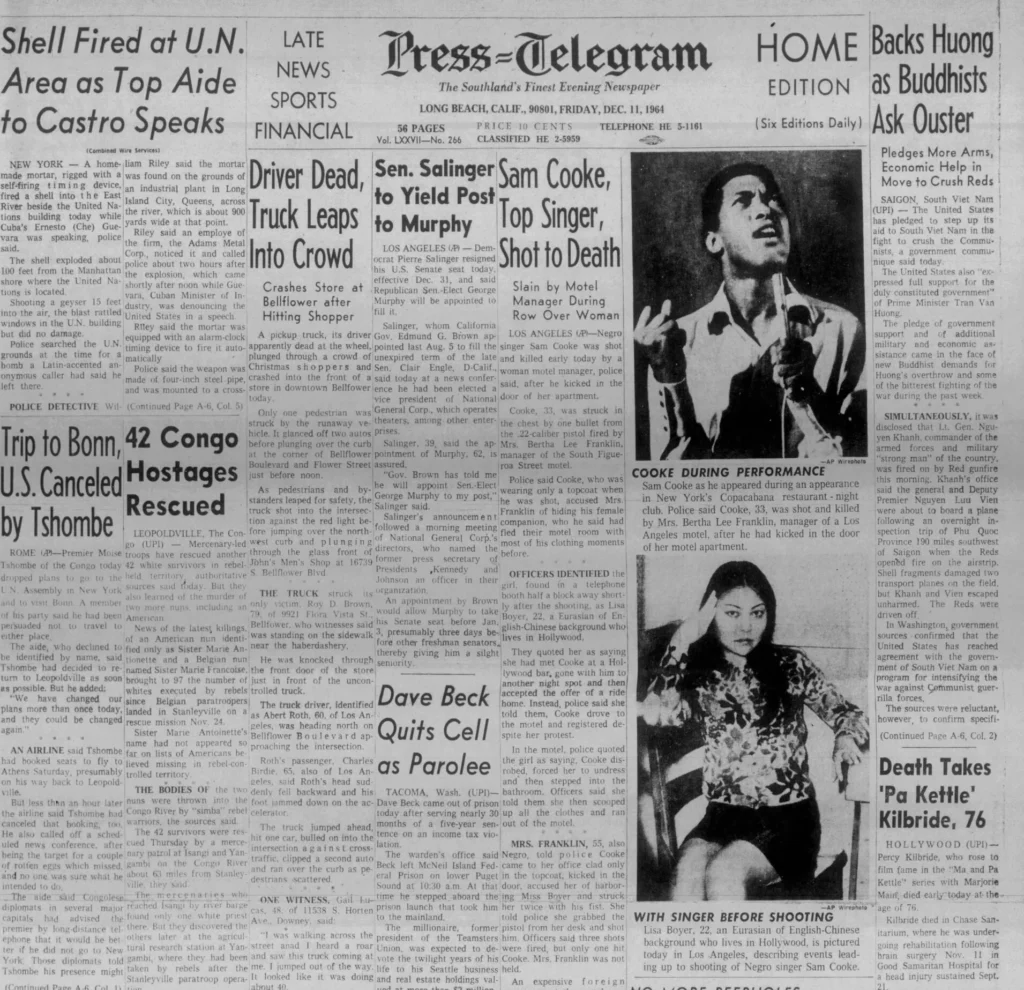
It could’ve happened just that way. Setups like that are as old as prostitution, and they often go unreported out of fear of embarrassment. Sam was habitually unfaithful to his wife Barbara, and there had been considerable tension in their marriage following the drowning death of their youngest child, Vincent, in 1963. And less than three months after Sam’s death, Barbara married his 20-year-old protégé, Bobby Womack, which further paints a picture of marital troubles and amplifies the scandal.
There’s no shortage of sad events surrounding the end of Sam’s life. It’s hard to imagine that someone who presented such a joyous image and seemed like a downright good guy could meet such an ugly end. Also, perhaps because of its nature, his death is never mentioned in the same sentence as that of other musical luminaries, such as Buddy Holly, Otis Redding, Jim Morrison, Janis Joplin, and Jimi Hendrix, who died young. Thankfully, his music never suffered for it. It’s still revered and played regularly, and that is the ultimate testament to his character, not the mistakes he made that cost him his life.




This is a brilliant piece about Sam Cooke, and the tragic and mysterious ending to his life. I like to think of myself as a long-term fan, but must admit that I was blissfully unaware of most of the songs which are expertly analysed here in depth. Thankfully – and somewhat remarkably – his music is alive and well more than 60 years later. I still enjoy listening to his magnificent 1963 (?) interview with Magnificent Montague, surely a unique, revealing, indelible insight into his fundamentally humble, respectful nature.