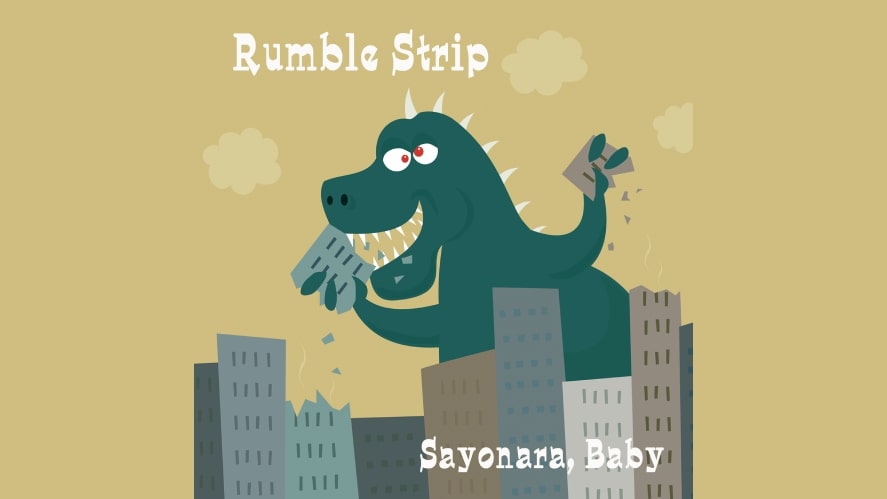
Rumble Strip might just be the most unlikely partnership in Americana. Dave Nachmanoff has played London’s Royal Albert Hall with Al Stewart and shared stages with Alison Krauss and America. Richard Rossi spends his days writing jokes and illustrating children’s books. Yet their new album Sayonara, Baby proves that opposites attract in the best way, its songs are full of stories about love, loss and everyday absurdity. Speaking to Jason Barnard, Dave and Rich discuss the art of writing under pressure, why humour matters in music and how good songs can come from the most surprising places.
Sayonara, Baby sounds like a blend of Americana, folk, and power pop with some rockabilly edges. How intentional was that genre-crossing when you set out to make the record?
Rich: Completely unintentional. We did this on a limited timeline, first word on paper to last word recorded, in under 90 days. We added a couple tracks from a prior EP and voila! An album. My contribution to each song is limited to lyrics. I hand those over to Dave to shape into wherever his imagination takes him.
Which track from the album do you each feel best represents the “soul” of Rumble Strip, and why?
Dave: It’s hard to say. Each song brings something unique to the mix. I hope future Rumble Strip releases are similarly varied.
Rich: I’ve been enamored with storytelling my entire life. Rumble Strip enables me to keep doing that. “Sayonara, Baby” is a perfect example. “Soul” implies a core direction. I just wander.

The title track has a punchy energy. What’s the story behind that song?
Rich: A few years back, my wife and I attended a friend’s wedding. It was held at the famed CBGB just a couple years before it closed its doors. Three weeks later, I picked up the phone and it was my friend on the line. Through his tears, I thought I heard “She wants her old life back”. So I did what any friend would do. I told him to meet me at a local bar and we’d talk.
When I arrived, I noticed he was drinking water. That’s when it hit me. I had invited a recovering alcoholic to a bar on his darkest day. Brilliant. Fortunately, that’s not the end of the story. Folks will have to listen to the song to learn how it ended.
Humour is clearly threaded through many of the lyrics. Do you see humour as central to the band’s identity, or more as seasoning for the storytelling?
Dave: Rumble Strip is a side project, not a band per se’. It’s good fun. In that sense, it’s not unlike Dukes of Stratosphere. When I have some free time, Rich passes along lyrics to me and I go to work – with help from some incredible contributors. Bart van der Zeuuw plays drum on the lion’s share of tracks and is terrific. And then there’s Megan Kleven and her knack for creating great vocal parts.
Rich: I’ve always been compelled to try and make people laugh. I think it’s a defense mechanism.
How do you typically approach writing a song together? Do the words always come first from Rich, or does Dave sometimes spark the process with music?
Rich: Lyrics have always come first. I was the one who originally approached Dave about turning my words into fully realized songs. So the onus is on me to make sure I present him with lyrics that are interesting and fully developed. When that doesn’t happen, it usually becomes apparent as Dave fleshes out the melody. Then I revisit it if necessary
Do you ever clash creatively, and if so, what usually resolves the impasse?
Rich: In the case of “It Could Always Be Worse”, I leaned on the conventional. My vision wasn’t very adventurous. Dave had a different idea. He presented me with two quick demos – one utilizing my idea and one that used a very different approach. Thank goodness we went with Dave’s idea. It turned out to be much more fun.
Given your very different career backgrounds, what have you each learned from the other?
Dave: Songwriting often involves melody before lyrics. In the case of Rumble Strip, songs always start things off with Rich’s words. It’s just a different way of working.
Rich: I am often fixated on what sounds good to others. I’m learning how to listen and understand what works for me.
Dave, you’ve played with artists including Al Stewart, America, and Alison Krauss. How does the intimacy of Rumble Strip compare with those large-scale collaborations?
Dave: I’ve been a full time musician since 1997 and most of that has been on the road. Obviously, in 2020, everything shut down. For the better part of three years, I wasn’t playing live at all. I was functioning primarily as a producer and studio musician. It was all done with people sending me files back and forth from all over the world. Fortunately, technology has made it possible to work remotely and to collaborate over long distances. With Rich on the east coast and me on the west coast, it’s a necessity once again.
Rich, as a professional joke writer and children’s author, how does your sense of timing in humour translate into songwriting?
Rich: Arnie Levin used to tell me that punch lines benefit from the element of surprise. Arnie was a cartoonist for The New Yorker back in the 70’s and 80’s. Anyway, when I wrote jokes and created cartoons for a living, Arnie’s advice proved to be spot on. Each requires brevity – punch lines have to hit quick. Turns out that this discipline can be applied to lyric writing, too. “South of the Border” is a good example.
‘Actuary of Love’ is a pretty unusual title. Where did it come from?
Dave: In “Bean Counter”, Graham Parker talks about the soulless people behind the music business – and society in general. But if nature tends toward equilibrium, then one would imagine there’s a cosmic accountant, an otherworld actuary actively trying to balance the books in our favor. If that’s so, what does that look like?
‘Uber Driver’ feels rooted in the everyday absurd. Do you deliberately seek out the mundane to turn it into art?
Rich: I’ve had some scary experiences in cabs. I’ve heard some really good songs about cabs, too. I thought it was about time we update the theme. Are there any cabs left?
Your 2021 EP Let’s Roll! was well-received. What lessons did you take from that into making a full LP?
Rich: It had been several years since we recorded Let’s Roll!. In 2021, I actively tried to write what I thought people wanted to hear. Sometimes, it worked – but not always. This go ‘round, it was simply a matter of channeling whatever moved me at that moment. It was kind of liberating.
What surprised you most in the making of Sayonara, Baby, either in the studio or in how the songs evolved?
Rich: With Let’s Roll!, I had a lot of prewritten material. I had plenty of time to look it over. There’s comfort in that. In the case of Sayonara, Baby, I called Dave in mid-January and asked him if he had interest in working on an LP. He said he had a couple months until things got really busy. Problem was, I hadn’t written a thing up to that point. I gave myself two weeks to come up with at least a half dozen sets of lyrics – I think we ended up with seven. Then Dave had to get them recorded within the timeframe we had. And in my opinion, they’re better than those on the EP. Turns out the time crunch was a very good thing.
Where do you see Rumble Strip heading next?
Dave & Rich: We’ll start writing again soon and hopefully we’ll find the time for album.