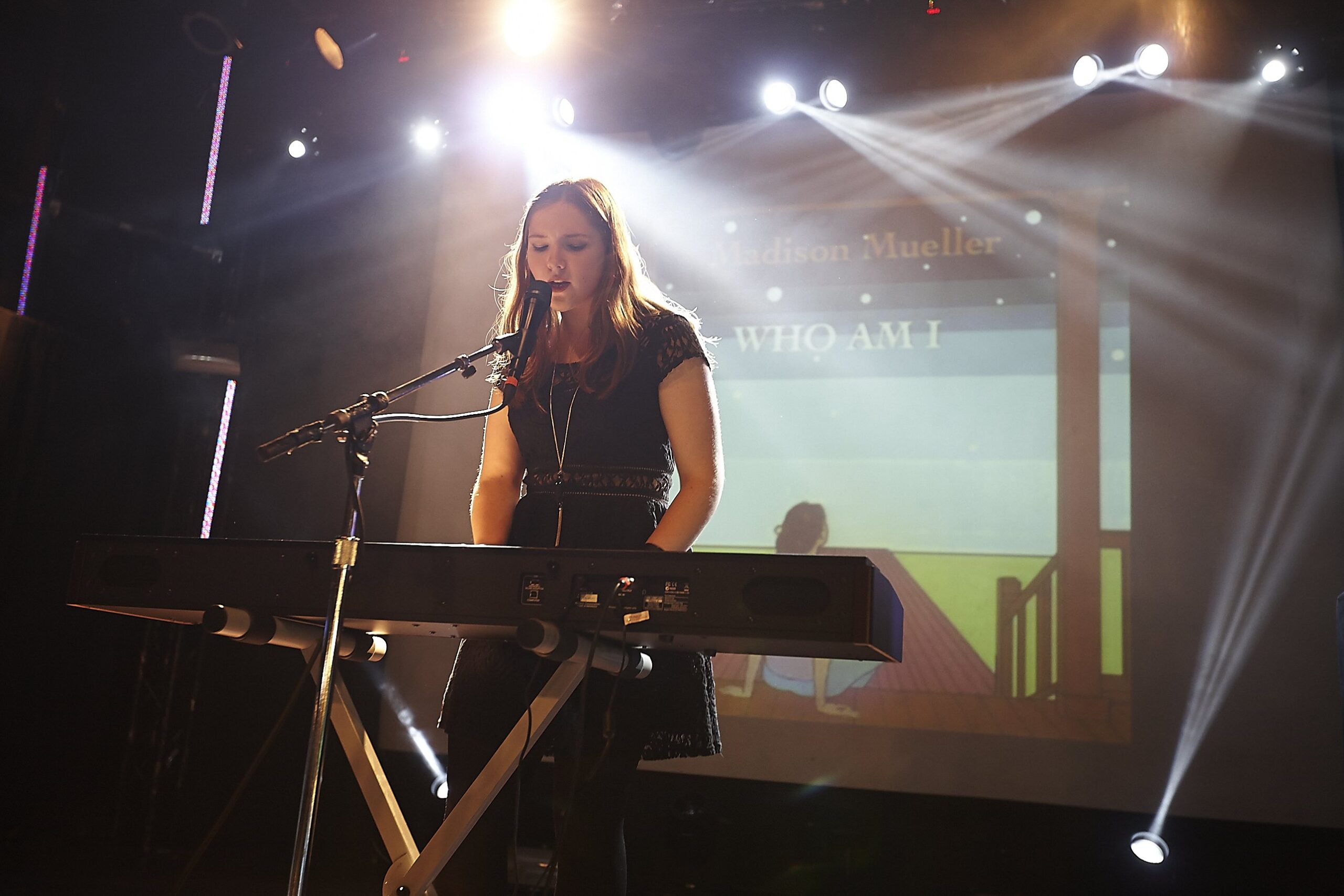
If you want to understand how music survives beyond the machinery of the industry, look to a town like Barrie, Ontario, and to a songwriter like Madison Mueller. She’s part of a generation raised online but grounded in the old rituals of gigging and community work. Her sound draws on the influence of classic rock and the precision of modern pop, but what really sets her apart is her approach. Talking to her, it’s clear that “career” isn’t the word she’d choose. She is rooted in empathy and a refusal to let honesty become a marketing strategy.
You’ve been immersed in music since childhood. What kind of sounds filled your home growing up, and when did you first feel music might become your passion?
Growing up, I was in a household that never shied away from music. Though I didn’t have parents that played instruments themselves, they were music lovers. I grew up with a very solid foundation of classic rock, which has never left me. I’m still finding artists from that era that inspire me. It truly was a time for experimenting with different sounds and processes, and it’s so interesting to watch that unfold through an artist’s discography. There’s too many to name, but to list a few that I have a soft spot for, there’s: Queen, Fleetwood Mac, Genesis, Joni Mitchell, Billy Joel, Supertramp, Simon and Garfunkel etc.
As for recognizing that music was becoming a passion of mine, I think others saw it in me first. My Oma and my Opa started me in piano lessons at the age of 6, and it opened up a whole new world for me. Though I lost my Opa not long after, my Oma would always say that one of his final wishes was to keep me in my music lessons – he saw something special there. She gladly supported this, and it felt like I couldn’t be without music in some form from that point on. I think I realized a deep calling when I started writing music (real music, not just the emotional lyrics written in a journal from a girl before she hit double digits). The first time I wrote a song wherein I created the piano accompaniment and the lyrics for, there was no turning back for me.
How has being part of a smaller, arts-focused community shaped your sense of purpose as both a songwriter and mentor?
The music world is so vast at this stage in time. I feel unbelievably lucky that I have had the opportunity to work in person with other musicians, and exist in spaces that truly support other artists trying to build a name for themselves. It’s very easy to feel as though you might be competing with other people that are reaching for the same goal as you, but I have never felt that way. Being online 24/7 can really make your art feel like a numbers game, and it strips some of that passion for me. Hence the love for live music and collaboration.
I think the most important thing you can learn is that when you support others, they will more than likely support you. And then everyone feels good. When you surround yourself with people that are further along in their journey, the only thing you have to gain is knowledge. It’s good to be the least experienced person in the room, because that’s the room in which you stand to learn the most. I’m lucky enough to have found myself in some of those rooms, and I strive to put myself back in those rooms whenever I get the chance. I always leave feeling the most inspired and motivated after moments like that.
‘Sweet Bitterness’ is a track about longing for childhood wonder. Do you feel adulthood dulls our emotional bandwidth, or is there a kind of deeper clarity that comes with age?
This is the type of question that can change depending on the day you ask. I hardly think that adulthood dulls our emotional bandwidth. In fact, I have a feeling it does the opposite. As kids, the world feels so small. Everything feels exciting, and new. As we begin to fall into habits and routines while we grow, some of that novelty wears off. I think that’s what “Sweet Bitterness” was longing for. The idea that the biggest moments in my childhood were something as simple as a field trip the next morning. Or having a sleepover with a friend for the first time. That excitement becomes harder to find as you get older, and as your world gets larger. The feeling of being “alive” is something we all chase, and the payoff for that as adults is just as rewarding as it was for us when we were kids. It’s just a matter of taking those risks and allowing yourself to expand those horizons – something I think a lot of us struggle to do as we get comfortable in our lives. I do sometimes wish I could be just as lit up by the idea of a sleepover like I was as a child, but I find that light in other ways and do my best at this age to follow that when I see it.
How do you balance honesty and vulnerability in songwriting, particularly in a social media age that demands curated versions of ourselves?
This can be very complicated, and I know I struggle with this. When I look at the current artists that inspire me, it seems like what they are “curating” is stemming from their vulnerability. That has to come first. If you are trying to fit your honesty into a box you have made for yourself, it is never going to fit. If you are willing to be vulnerable within your music, I find a lot of the other things will follow. It shows when you feel rooted in what the music means to you. The passion to promote it, the excitement in expanding on it in other forms of expression (i.e. the artwork, music videos, merch), and the people that feel moved by your honesty will come with that sharing of yourself. It’s far easier said than done, but it allows me to have a more solid foundation to grow from, rather than catering to what I think will do well with an audience online.
You’ve gone from student to teacher. What’s one lesson about the music industry you wish someone had told you earlier, and now pass on to your students?
While I’m not teaching as much as I used to, what I would always try to instill was a willingness to feel slightly uncomfortable. If you want to learn a song but don’t feel like you have the ability yet, make yourself uncomfortable and try. You tend to learn a lot more by making a few mistakes, rather than waiting to have everything figured out. Having a plan and someone to guide you in those moments is a good safety net, but as soon as you stop allowing yourself to jump out of your comfort zone, you will end up going in circles. I could often use that reminder, because when I look back, the bigger the mountain I decided to climb is when I saw the most improvement. This goes for all areas of life, but the music industry can be quite daunting. If I never took the first steps into being on stage, or recording music for the first time (both of which made me quite uncomfortable to start), I never would’ve moved forward in this career. Sometimes you just need a little push.
You’ve spoken about wanting listeners to “see themselves in your songs.” Has there ever been a song you wrote for others, only to realise you’d written it for yourself?
I think the beauty in songwriting is that the meaning can change over time. My first release “Who Am I?” was written at the age of 15. My biggest concern at that time was picking the high school electives that would determine what I wanted to pursue later in life. I didn’t have much of a clue, but I sat down and wrote a song about it, which allowed me to recognize the path I wanted to run down. Ten years later, and I can still see myself in that song at a very different stage in life. I have read countless comments about what that song has meant to others – from other teenagers, all the way up to people in their 80s. While it originally felt like a song for myself, it very quickly became one I had written for others to relate to – I was inspired by just that alone. But little did I know, it would find significance in my life a decade later. I’m still attempting to find the right paths for me to run down, and I still feel like a child trying to figure that out. My own song has refound me, and I have no doubts that my others will resurface in similar ways throughout my life.
You played over 50 shows last year. What does the stage give you that the studio doesn’t, and vice versa?
In many ways, I am much more familiar with a stage. I have been performing in one way or another since I can remember. The stage allows you to witness people exactly where they are at, and they get to see that in me as well. I appreciate being able to interact and create a relationship with myself and who I’m playing to – whether that be 5 people or 500 people! The studio however, allows for creativity and collaboration – to see a song that started out between me and one instrument turn into something entirely different is so gratifying (and challenging). Unless you’re with a band playing off each other, there isn’t as much room for that on stage. When that does happen though, it’s pure magic! I often prefer to listen to the live versions of some of my favourite songs, which somewhat merges the best aspects of both.
What draws you to a song enough to reinterpret it, and do you approach a cover as an homage, a challenge, or something more like a conversation with the original?
Great question! I have a large repertoire of covers, though I often stray away from covering songs I feel deeply attached to for fear of overplaying them. However, the songs I have added that I feel I’m paying an homage to often are my favourites to play. I love to search out a challenge, and usually will do that when I feel uninspired. I can always tell that I’ve been influenced by an artist’s style when looking back at some of my own songs. I’m a mirage of all of those inspirations, and wouldn’t have it any other way.
You’ve worked with producers like Michael Jack and Andrew Chervak, people with very different backgrounds and discographies. What have you learned from those collaborations about shaping a song in the studio, and how do you know when a track is truly finished?
As touched on before, having a song that starts out with just myself and one instrument usually lends itself to a wide array of areas we could jump into. Trying different approaches and techniques is integral to finding your own sound, and I am so happy that I’ve been given the opportunities to test those waters.
Andrew Chervak was a fantastic producer to record with. His ability to pull out emotion from me while in the vocal booth is something I have yet to have had happen again. We recorded “Too Nice” together, which went a more pop route than I was used to and I had such a fun time putting that together. The song called for a bit of “bite” and I appreciated that he brought it to that point. I myself would’ve found it leaning towards more of a ballad otherwise.
Working with Michael Jack was a really incredible experience as well. His history in the industry and musicians he was able to pull on really transformed “Sweet Bitterness”. The song is about an element of nostalgia and I love that he brought that through with some of the early 2000s vibes. I originally wrote the song on the piano and the way it shaped out to be more upbeat was really interesting to see.
They both had a way of really interpreting the song in unique ways, and while I’m getting better at envisioning that myself, having people that can help guide that has been so impactful.
As for a song being finished within the studio… I think if a song feels strong enough with just myself and one instrument, its “essence” is already complete, recording it is just where you get to expand on it! I still listen to those songs listed above and find new things I would change. At some point you just have to know when to stop adding, and for that I usually have to take a step back from it, ask for a few trusted opinions and go from there.
You’ve released a steady stream of singles. Is there a full-length collection on the horizon, or do you feel the single-by-single approach suits the way you create right now?
While I don’t mind the single-by-single approach, and it’s worked well for me, I really am working towards an EP of some sort. I’m more of an album listener – I like to see a story within the collection. I’m very drawn to that, and feel I write in a similar way. Having a complete body of work that’s dedicated to a certain era would be the way I would like to express myself in the future, and I think it’s closer than I think. I want to take listeners on a journey, and I think I will flourish in that way. That’s what I plan to be working towards, and I do hope it comes together in the ways I’m envisioning!




This is an excellent insight into Madison’s musical journey. It helps that she is a very well-spoken lady with an innate ability to succinctly express feelings and scenarios. I suppose that’s part of her songwriting ability; a way with words. Putting feelings into words is a skill and I think she’s one of the best at it.
Maddie you are amazing, a force and it truly comes through in both your music and your life!