Radio-Activity (C) Kraftwerk
By Stephen Dalton
A mesmerising modernist masterpiece from the golden age of wireless technology, Kraftwerk’s Radio-Activity is a darkly beautiful electromagnetic symphony of transistors and transmitters, chain reactions and mutations, sci-fi lullabies and starlight sonatas. Produced and composed by Ralf Hütter and Florian Schneider, it was first released in analogue form in 1975, followed by a pristine digital upgrade in 2009, this seminal suite of electronic chamber music would later help inspire generations of post-punk, synth-pop and art-rock futurists. Now complete with new artwork, it is being reissued in multiple 50th anniversary formats including deluxe vinyl and an expansive Dolby Atmos mix, which brings vivid new shading, forensic detail and richly layered cinematic depth to the most boldly experimental album in the Kraftwerk Kanon.
Radio-Activity was made in the afterglow of Kraftwerk’s international success with Autobahn (1974). Loaded with droll puns and double meanings, the album title and lyrics are playful meditations on wireless communication, but also on the dawning age of nuclear power, atomic weapons and radioactive fall-out. The concept came to Ralf Hütter and Florian Schneider during Kraftwerk’s breakthrough US tour, in early 1975, where they witnessed first-hand the importance of radio in promoting new bands and fresh sounds. Indeed, the roots of electronic music partly grew from adventurous German stations like WDR, while revolutionary composers such as John Cage and Karlheinz Stockhausen even used short-wave radios as musical instruments.
Reflecting a new era of artistic autonomy and creative daring within the band, Radio-Activity was Kraftwerk’s first fully electronic album, and the first to feature both English and German lyrics. Like its predecessor Autobahn, it was recorded at their fabled Kling Klang sound laboratory in central Düsseldorf. Radio-Activity was then mixed by sound engineer Walter Quintus at Rüssl Studio, Hamburg. Assisted by newly recruited percussionists Wolfgang Flür and Karl Bartos, plus lyricist and visual artist Emil Schult, Hütter and Schneider confirmed their growing profile as global figureheads of the emerging electronic music scene, creating an avant-garde symphony from elegant conceptual foundations.
Sonically, Radio-Activity pushed the band’s sonic explorer side to the max, borrowing from musique concrete, audio collage and circuit-bending sound art as much as any contemporary pop influences. Alongside Kraftwerk’s growing studio arsenal of Minimoogs, Farfisas and home-made drum machines, the album also features game-changing instruments like the Sennheiser Vocoder, the Votrax speech synthesizer and the Vako Orchestron, an ornate keyboard-sampler that used pre-recorded optical discs to replicate choral and instrumental effects. This seminal synthesizer was bought, programmed and played by vocalist and composer Ralf Hütter, and later became an instantly recognisable signature sound on all the band’s classic 1970s albums.
There is an undertow of Cold War paranoia running through Radio-Activity, even in its lighter melodic moments. The album was born during a period of heightened superpower tension, nuclear brinkmanship and terrorist violence in Germany. As young bohemian artists who often travelled late at night carrying unusual electronic instruments, Kraftwerk routinely fell under police suspicion, surveillance and even unexpected apartment searches. Intentional or not, Radio-Activity captures the febrile political Zeitgeist of mid 1970s Europe, from the sinister crackle and creeping dread of Uranium to the eerie robotic chant The Voice of Energy, whose heavily distorted German-language vocal sounds like an apocalyptic threat from some power-crazed, god-like energy monster. Even today, both feel like chilling sci-fi horror movies compressed into less than a minute.
A future Kraftwerk classic and enduring live favourite, the album’s signature track Radioactivity is a hypnotically stern rumination on both nuclear energy and wireless connection. Hütter’s deadpan vocal sounds like a Gregorian chant for the atomic age, all embedded in a ghostly background chorus of swirling synthetic voices. On its later digitally rewired version, first heard on The Mix (1991), the song would evolve from detached observational reportage to more focussed protest against the dangers of nuclear power. “Chain reaction and mutation / contaminated population…”
But Radio-Activity is also an album full of spine-tingling magic, haunted beauty and sleek pop melody. Faster, lighter tracks like the swooning, soaring Airwaves and the bouncy, shiny Antenna both sound like blueprints for the synth-pop boom of the 1980s, upbeat and infectious and intoxicated with the innocent joys of transistor technology. Fizzing with high-voltage crackle and atmospheric interference, Radioland is an achingly romantic ballad about surfing the short-wave stratosphere in search of far-away frequencies.
Looking further afield still, to distant pulsars and quasars, Radio Stars is a sublime hymn to the music of the spheres, cryptic sonic signals sent from the outer limits of the galaxy and the dawn of time itself. And Ohm Sweet Ohm, a punning title referring to units of electrical resistance, brings the album to a close on a warm serotonin rush of sweet melody, moving from darkness to light, nocturnal gloom to glowing sunrise, galloping towards some bright horizon.
The longer tracks on Radio-Activity are interwoven with shorter pieces of musique concrete, including the attention-grabbing Geiger Counter, an ominous machine heartbeat that accelerates as the threat of contamination builds. Half a century later, this compact gem sounds like a minimal techno rave in the ruins of a nuclear power station. Later in the album, Intermission offers a gleaming, chiming, elegantly spare tone poem before bleeding into News, an overlapping collage of sampled radio bulletins, a cacophony of voices couched in a fragrant synthesizer melody.
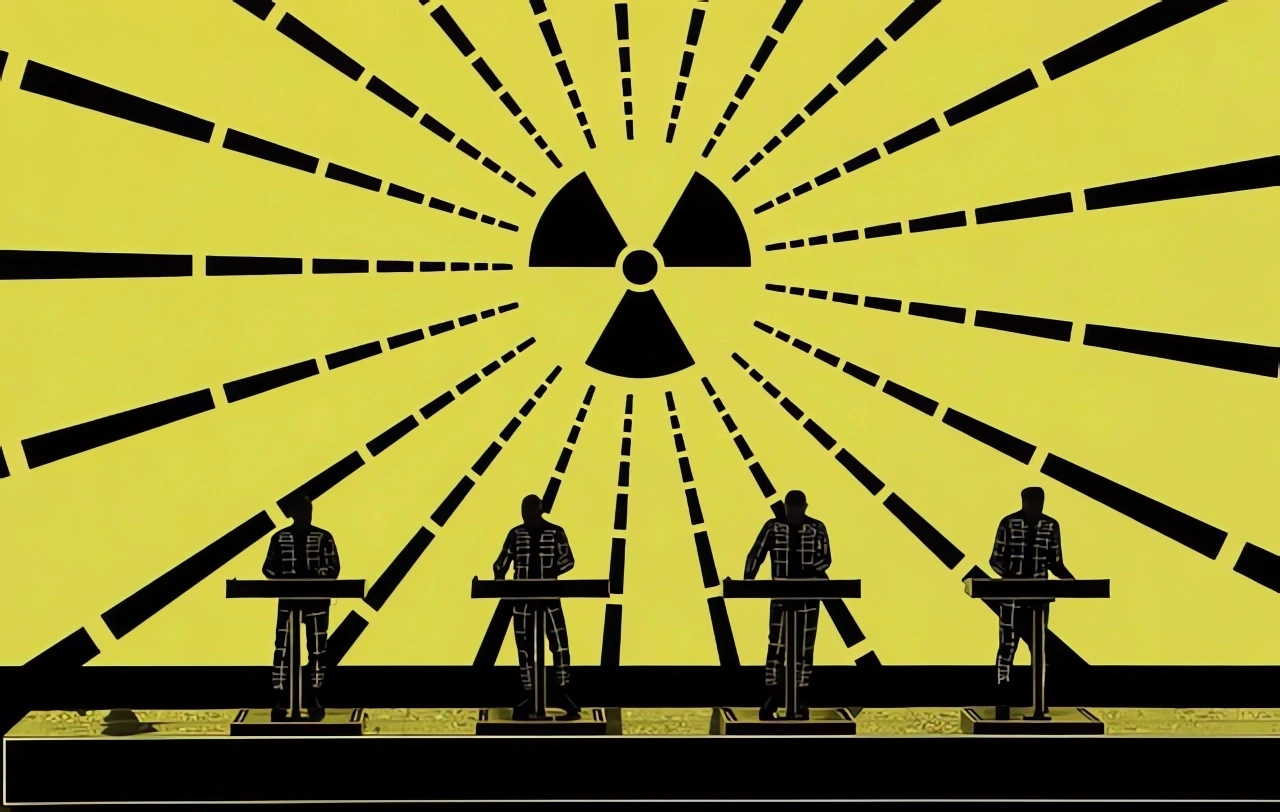
Radio-Activity was initially released in an iconic monochrome cover featuring a vintage radio from the Third Reich era. The new 2026 sleeve artwork is a vivid Pop Art design based on the fluorescent yellow and black nuclear warning sign. Two types of toxic contamination, generations apart.
The legacy of Radio-Activity still radiates across the musical cosmos. Always ahead of their peers, this was the album on which Kraftwerk mapped out the post-punk electro-pop future years before it arrived. Steeped in crepuscular gloom and dystopian disquiet, these techno-gothic tracks would later prove a key influence on artists like David Bowie, Cabaret Voltaire, Ultravox, Joy Division, New Order, the Human League, Yellow Magic Orchestra, OMD and Depeche Mode. Indeed, OMD originally called themselves VCL XI, a reference taken from the album’s original rear sleeve artwork, and penned their 1979 debut single Electricity as a semi-homage to the title track. Famously, New Order later sampled the doomy choral voices of Uranium on their immortal 1982 avant-disco anthem Blue Monday, confirming Kraftwerk’s eternal feedback loop between the laboratory and the dancefloor.
More recently the Chemical Brothers, Aphex Twin, Underworld and other electronic innovators have drawn on Radio-Activity for samples and inspiration. Half a century later, Kraftwerk’s most experimental album remains an unsurpassed masterwork, still vibrating with darkly beautiful power, still broadcasting its mysterious mesmeric messages across the airwaves.
Further information
Kraftwerk: 50th Anniversary of Radio-Activity:
- *Blu-ray audio disc featuring 3 mixes including a stunning Dolby Atmos Mix reconstructed from the original 16-track tapes at Kling Klang Studio by Kraftwerk founder Ralf Hütter and Fritz Hilpert
- *12” vinyl picture disc (2009 Remaster)
- *Full digital release of the Dolby Atmos Mix on Apple Music/Tidal/Amazon
All formats released by Parlophone Records on 15 May 2026: pre-order here