Mark Webber and Jason Barnard. 23 October 2025, The CAT Club, Pontefract
By Jason Barnard
We pick up in the days after Glastonbury. The band walk off the hill and into the Townhouse studio to finish Different Class. Success arrives quickly and awkwardly. There is television, noise and the Brit Awards. There is also the first hint that attention can hollow things out. Russell Senior leaves. This Is Hardcore looks the glare in the eye. We Love Life finds a softer register before the lights go out in 2002. Years pass with silence. Then the group return in 2011 to play the hits, but more fully in 2023 to write and record. Mark Webber looks back with Jason Barnard at The CAT Club through all of it, from the rush after Glastonbury to the maturity of More.
Different Class
The band went back into the studio. “We recorded at The Townhouse near Shepherd’s Bush,” Webber recalls. “Queen had worked there, and people from their fan club would still turn up at reception wanting a look around. Chris Thomas was producing us, music-business royalty. He started at Abbey Road around the Beatles, worked with the Sex Pistols, Roxy Music, John Cale, Elton John, INXS … quite a list.”
For Webber, it was his first major recording session. “There was a bit of pressure, but at the time everything just seemed easy. We were on a roll. Chris would regularly stop everything to tell stories from the old days, drink brandy, and play the mixes phenomenally loud.”
It was around this period that Mark’s role in the group would be clarified. Webber explains “We were in the studio and Geoff Travis and Jeannette Lee, the managers from Rough Trade, came for a meeting. It was announced there would be a band meeting, and that I wasn’t invited. They went upstairs to the games room, which had a pool table and a record player. They were up there for hours until eventually someone asked me to come upstairs. I thought they were probably going to say, ‘This has been great. Thanks for all your help. See ya! We’re about to become incredibly successful and this has all become a bit too familiar,’ or something like that. But what happened was Jarvis said something like ‘We’ve had a talk about it, and we’d like you to join the group.’ I don’t think I answered them at the time but it was just kind of assumed the answer was yes. So then over the next few weeks, I was written into the recording contract, the management and the publishing. From then on, everything was split six ways instead of five. For a short while up until this point, I had become a bit frustrated – not because I felt like I should be in the group, but just because it wasn’t really very clear where I fitted in.”
Different Class became a defining album of the decade. “We were slightly inept musicians that were suddenly making records with this guy who’d worked with everyone. It was amazing. The songs just came quickly – we recorded half the album, realised some weren’t good enough, went away, wrote more, and finished it off. It all felt effortless.”
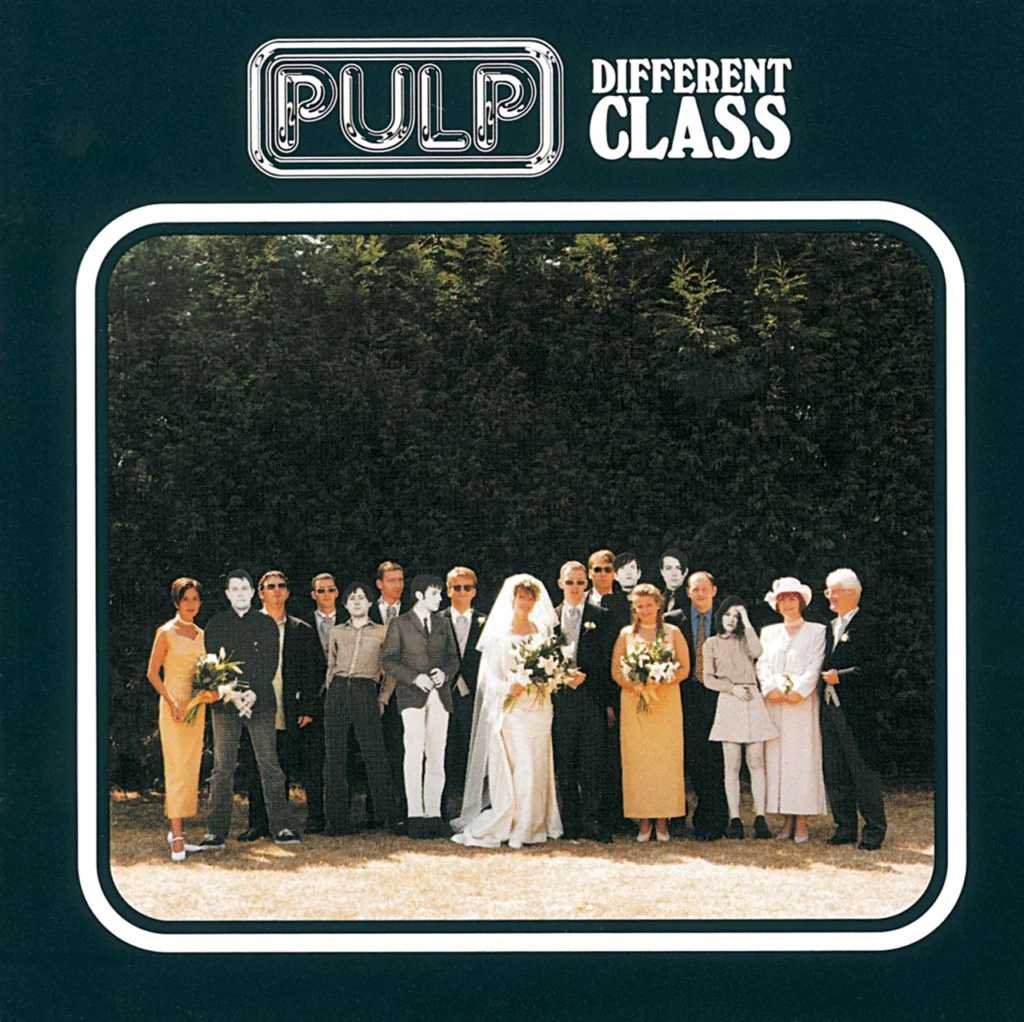
With Different Class the group’s world accelerated beyond recognition. “There was so much happening: radio, TV, concerts, that we didn’t have time to think,” Webber says. “It was just next, next, next.” The contrast to the group’s early days wasn’t lost on him. “Not so many years before this, Pulp played the Co-op Hall in Chesterfield to a dozen people.”
Success also brought intrusion. “Once Jarvis started getting tabloid attention he couldn’t do anything anymore.” One such headline was the “Ban This Sick Stunt” Daily Mirror front page about the ‘Sorted for E’s and Wizz’ artwork. “We were actually out at Top of the Pops that day to record a performance ‘Mis-Shapes’ as it was a double A side.” The record company sent their special tabloid consultant on damage limitation to advise the band how to respond. “He f struck a deal with the Mirror whereby Jarvis would do an interview with them for the next day if they would publish the lyrics to the song. It was just a realistic portrayal, an observational piece, but they made out that it was encouraging people to take drugs so we persuaded them to print the lyrics so that it was clear that wasn’t the case.” The rest of the band were less impacted. “Jarvis did attract most of the attention so the rest of us could pretty much go to the supermarket and lead normal lives.”
Sorted for E’s & Wizz
At the height of their fame came the Brit Awards and the moment that would further put the spotlight on Jarvis Cocker and Pulp. “We were performing at the ceremony and were nominated for a few awards. Didn’t win any of them! We’d seen Michael Jackson rehearse ‘Earth Song’ in the afternoon, and it did seem a little bit over the top.” Webber remembers. “So it comes to the show and it was one of those situations where all the industry people are sat around tables and they have dinner and there’s an endless stream of alcohol. Because we’d been nominated our table was next to the stage. Michael Jackson was performing and Jarvis was annoyed. I didn’t hear this, as I was sitting practically opposite on a big round table, but Candida just said to Jarvis, ‘If you’re not happy, why don’t you do something about it?’ Pete Mansell was also there, he was Pulp’s former bass player who was dancing, playing a scally, during our performance. So Jarvis and Pete stood up and just walked onto the stage. The amazing thing was there was no security between the floor and the stage. There was just a little ramp that they walked over, and they were on the stage. Didn’t have any plans as to what to do when they got there, so they just scurried back and forth and Jarvis did this wafting gesture, and then they came back and sat down. Richard, who was the tour manager after me, got the vibe that this wasn’t cool and said ‘Let’s all go back to the dressing room.’ Soon after that, we were told that Jarvis had been taken for questioning, so the rest of us just went to the after show party. He was kept in the police station overnight, and obviously the record company lawyers got involved. The next day, we were starting a tour in Brighton. We went down there, did the sound check and we didn’t know until the last minute if Jarvis was going to be there. But then he was released and the show went on. That tour was a bit crazy, with photographers following us everywhere.”
It marked the moment Pulp moved from pop success to cultural phenomenon and to exhaustion. “We’d been on a treadmill since His ’n’ Hers,” Webber says. “It was all new and exciting for a while, but after Different Class and all the touring we wanted to hibernate a bit.”
By the end of 1996, Pulp had sold millions of records and were being hailed as the most articulate band of their generation. Yet inside, the fatigue was obvious. “We did a lot more than we probably wanted to,” Webber says. “After going round the world with Different Class, we’d had enough for a while.”
Separations
When the glitter of Different Class began to fade, Pulp found themselves confronting the realities of the kind of fame they had once mocked. The whirlwind of chart success, the tabloid fascination following the Brit Awards incident, and two years of near-constant touring left them adrift.
“We did have a break after the last concerts of that tour,” says Webber, “it felt like a long time but it was maybe only a couple of months. We’d already written ‘Help The Aged’ by then because we first performed it in the summer of ’96.”
Russell Senior, Pulp’s violinist and key force behind the group for a decade, had become detached. “When we were recording Different Class, Russell wasn’t that interested in the process like some of us were,” Webber recalls. “He spent a lot of time in a lounge at the back of the studio developing a board game that he thought was going to make his fortune. It was called The Housing Market, about buying and selling houses.” Webber also highlighted other issues, “The violin is so loud in that BBC Glastonbury broadcast … That was done by someone who didn’t know what the balance should have been, but the violin was often quite painful for the rest of us. The rest of us just started to go in a slightly different musical direction.”
Senior’s attention drifted, and his domestic life made touring harder. “Russell was the first in the band to have children so was not wanting to go away so much. Somehow, it was decided that he was leaving. I remember the business meeting about the divorce, but not really the discussions up to that. He sort of lost interest after a while. We were doing other stuff and didn’t seem like he was that interested in contributing to those new songs.”
His departure marked a change in the group’s balance. “Russell had been the one who brought me in, he was the organiser back then.” Webber says. “With Russell having left the group, there was more space for my guitar. Things became more guitar-led. The songs maybe became a bit more conventional, but there was a chance for me to be more myself in the parts I was playing.”
Tomorrow Never Lies
In 1997, during the sessions that would eventually become This Is Hardcore, Pulp were briefly recruited into the glamorous orbit of James Bond. “Word came through that there was a new film and they were looking for a theme tune,” Webber remembers. “We were in the middle of making an album, but we dropped everything, a bit like when we had to rehearse for Glastonbury in 1995, and wrote them a song.”
That film was Tomorrow Never Dies, its working title being Tomorrow Never Lies. “It was, for me, the most exciting day of recording we ever did,” he says. “We basically wrote and recorded it on the spot, and documented a lot of the mutations of the song as we went through the day. We were playing together really well.”
The result was a sharp, menacing track that married Cocker’s dark wit to Bond-like orchestral drama. But Eon Productions chose a safer pair of hands. “We sent it to the James Bond people, but they were not interested at all,” Webber says. “It seemed like they already had Sheryl Crow in their back pocket. Maybe they were just putting the word out to see what alternatives were around. I don’t think we ever really had a look-in, but we wrote a good song out of it.”
Although rejected, ‘Tomorrow Never Lies’ later surfaced as a sought-after rarity, proof that Pulp could translate their cinematic instincts into widescreen pop.
Composer David Arnold, then the Bond series’ musical director, also invited Pulp to record a track for his Shaken and Stirred: The David Arnold James Bond Project album. “We did a version of ‘All Time High,’ the Rita Coolidge one from Octopussy,” Webber says. “I only remember me, Jarvis and Steve in the studio for that.” The session took place at Air Studios, George Martin’s old headquarters in Hampstead. “Oasis were recording one of their later, more overblown albums in another room,” Webber laughs. “Liam came in, because I guess he must’ve met Jarvis or Steve at a celebrity event, and he was mouthing off for about ten minutes, non-stop. When he left, I realised I hadn’t understood a single word he’d said!”
This Is Hardcore
If Different Class had been a burst of colour, its successor would be the hangover. “All of the Pulp albums sound different from the one before, so it wasn’t a surprise that the next one turned darker,” Webber says. “It wasn’t as though we sat down and said, let’s become unpopular. But Jarvis had achieved his goal of being a pop star, something he’d dreamed of since school, and then realised it maybe wasn’t all it was cracked up to be.”
The result was This Is Hardcore, released in 1998, an album steeped in exhaustion, disillusionment, and ageing glamour. “It drew on all these problems of being followed around all the time by the press, or not being able to walk down the street without people talking about Michael Jackson,” Webber says. “That’s why it got a bit darker, I guess.”
Even when they tried to reach for light, the tone was uneasy. “There was a song that began as ‘Northern Souls,’ became ‘Cocaine Socialism,’ and then ‘Glory Days,’” he recalls. “We thought about rush-releasing ‘Cocaine Socialism’ around the time of the general election as a critique of New Labour. But it sounded a bit like ‘Common People’ musically, and maybe people would think we were trying to cash in or spoil the mood. So we passed on it.”
This Is Hardcore remains one of Pulp’s most striking records, an unflinching examination of fame’s aftermath and the search for meaning in its shadow. “Despite its darkness, it still did pretty well,” Webber says. “We toured a fair bit again, but after that we hit a point where we wanted to do something different.” Webber’s guitar work helped shape the band’s sound during this period. “’The Fear’ was always my favourite of the album,” he says.
Webber said that although both the two albums recorded with producer Chris Thomas were great, the recording process was arduous. “He took apart every little bit. He had his team of people moving every hi-hat tap around in the computer, stuff like that. So it’s fundamentally live music, but then it was heavily edited digitally. With This Is Hardcore, we also had a lot of technical problems in the studio. Again, we recorded half the album, went off, came back with more songs, and then recorded the other half. It took nearly a year to do that.”
We Love Life
The group looked like they were going to follow-up This Is Hardcore quickly and commenced their collective writing sessions “When we were songwriting for the album, there was one day when Jarvis had the idea that each of us bring in two records that we liked so we could use them as a springboard to try and write a song. That day I took a Fleetwood Mac song, ‘Sunny Side of Heaven,’ an instrumental from Bare Trees, and ‘Fearless’ by Pink Floyd. If you can find out how that influenced We Love Life, come back to me later! [laughs]”
In August and September 1999 Pulp played three low key dates to test out their new material. “We were asked to play a party organised by the British Council for the artist Gary Hume, who was representing the UK at the Venice Biennale. We’d been writing new songs, and we thought we’d try out some of this new stuff.” Webber continues “Jarvis, being brilliant, thought, ‘It’s in Venice, so let’s have a massive Venetian blind between us and the audience …’ We played six new songs behind the blind as it slowly opened out. Then the blind was raised, and we played a few more songs that people actually recognised.” They repeated use of the blinds at a fan club gig in Edinburgh followed by the Liss Ard Festival in Ireland.
Those concerts hinted at a band still capable of invention but uncertain of where to channel it. Although they didn’t want to repeat the same recording process they commenced the sessions with Chris Thomas. “We talked about finding a nice sounding room and trying to do it live, with us all playing at the same time. He was up for it and we looked at some places.” Through Chris, they ended up at Roger Taylor of Queen’s garden studio “The control room was in an old mill at the bottom of a hill, and overlooking a lake there was a boathouse where we played. It was beautiful, there was even a swan. But it became apparent we weren’t good enough musicians to record live in that way. And Chris wasn’t able to stick to his word, he soon started pulling things apart again. We recorded maybe five, six songs there in a few weeks. Then we took what seemed like quite a harsh decision of dumping that and telling Chris that we wanted to do it with someone else.”
Webber recalls “‘After You’ was a song I really loved at the time. ‘Got To Have Love’ was also pretty much written, apart from the vocal melody, in the same period. Maybe if those had been on We Love Life then things might have turned out differently.”
Eventually, Pulp turned to one of Jarvis Cocker’s heroes: Scott Walker. “It was a strange concept, because I don’t think anyone ever imagined at that point that Scott would produce someone else’s record. But he was asked and he was into it, and he was a nice guy. He was a germaphobe, so he would have his glass of water sat on the end of the mixing desk, but it would always have a tissue over the top, so no germs fell into it. And there was one day when Geoff Travis, our manager, came into the studio, and was asked how he was doing. Geoff said ‘I’m just getting over a cold.’ Well, Scott went out of the other door of the control room, and we never saw him again for the rest of the day! He had some interesting ideas for the music, and he was mainly concerned with bass. He had been the bass player in the Walker Brothers, so he did things like an arrangement for eight cellos rather than a conventional string section on ‘I Love Life.’ That was never a very popular song, but it’s one that I love.”
Notwithstanding, Mark’s interests were also shifting “By the time we started to really re-record the album with Scott, I was losing interest in the group, which I realise is kind of terrible. So I went and did my guitar parts, but I didn’t hang around like I used to through the whole process. I got very interested in avant-garde film, and that just seemed more interesting to me at that point.”
Released in 2001, We Love Life marked a quieter, more organic return for Pulp but one that still contained some of their best material – whether that be the anthemic ‘Sunrise’ or the expansive ‘Wickerman.’ However, the music scene’s spotlight had moved and to Webber “We’d moved on too. We didn’t want to be sitting around in TV studios all day just for five minutes on the telly. We’d been very popular for a relatively short time and we became a bit disillusioned.”
By late 2002, Pulp knew they were approaching an end. “We Love Life came out and didn’t set the charts alight, but we played some really good concerts off the back of it,” Webber says. “By the end of that year we were tired and feeling like maybe we should give it a rest.”
The Hits compilation followed, with little fanfare. “It was kind of a contractual fulfilment,” he says. “They didn’t promote it, we didn’t promote it. We recorded one new track for it, ‘The Last Days of the Miner’s Strike,’ a great song but not hit single material.”
The end was marked by a show at the Magna Centre in Rotherham around Christmas 2002. “The concert was good but we knew it would be our last. At the end there was no group hug or anything like that. We got into separate taxis and went off in different directions.”
Webber walked away completely. “I didn’t have a guitar in my house for most of those eight or ten years,” he says. “I didn’t even listen to music the first few years, I was so disenchanted with it all.”
More
In 2011, the band returned. “The first time we got back together, we made a pact not to do any new music,” Webber says. “The idea was just to celebrate what we’d done. Russell came back for the first few shows, and as soon as we played a song together, it was obvious there was still something good there.” The shows were met with warmth and nostalgia. “The reaction was amazing,” he says. “We played in most parts of the world over two years, and then we stopped, because you can’t just keep going around playing your old records forever. It stops being special.”
Then, in 2022, came another call from Jarvis. “He got in touch and said he wanted to come round and talk about something,” Webber says. “I think he’d only ever been in my house once before, so that seemed quite significant. He said, maybe we should do some more concerts. I was up for it, we all were. The idea was to do 14 concerts in June 2023, a UK tour and that’s it. But since then, we basically haven’t stopped.”
The reunion gathered momentum quickly. “The reaction was overwhelming,” Webber says. New material was soon instigated by Jarvis, “During those first 14 dates we did ‘Hymn of the North’ in a couple of concerts. Then we started to talk about whether we should consider recording that song and give it away, or should we see if we can write some others and make an album. We didn’t have a record label at the time, but we had written some songs that were not bad so we thought, well maybe we should have a go, so long as it’s not long and torturous like the others had been.”
For what ultimately became their number 1 album More, Pulp returned to recording as if starting again, without the weight of past success behind them.“Rough Trade wanted to release it, but they didn’t have a huge budget so we had to do it cheaply, which was a blessing. In the end, the album was basically recorded in three weeks at the end of 2024.” When it was released this June, the response was amazing. It had been so long since we’d made a record, and the business had changed so much that we didn’t even know how to measure success anymore, except by people’s reactions.”
One new track, ‘Slow Jam,’ stands out for Webber. “A lot of the songs were already in good shape before Jarvis brought them to us, but then we all helped with arrangements. ‘Slow Jam’ is my favourite in the record. Maybe it’s the strangest one musically, which is probably why I like it. People always go on about Jarvis’s lyrics and I never really paid much attention to them, but this one is particularly good.”
For Webber, now in his fifties, he finds the return both affirming and grounding. “My daughter was born about a month after our last engagement in 2012,” he says. “I thought she’d never get to see us play. Now she has. That means a lot.”
Further information
Part 1 of the Mark Webber interview