Ian Gillan (adapted from photo by Stefan Brending, Creative Commons CC-BY-SA-3.0 de)
By Jason Barnard
Ian Gillan’s journey from a council estate in Hounslow to the pantheon of rock gods is a story of perseverance, talent, and the transformative power of music. Speaking at a recent u3a event, to kick start a month-long celebration of positive ageing, the 80-year-old vocalist opened up about his remarkable career, sharing intimate details about his upbringing and the moments that defined one of rock’s most distinctive voices.
Working Class Identity
Gillan’s upbringing was marked by the fascinating political divide between his parents – his Scottish Labour-voting father and English Conservative mother. The nightly dinner table debates would prove formative for the future rock star, offering him early lessons in perspective and compromise.
“They would argue the toss about politics in the evenings, and they had pretty fixed views,” Gillan recalls with obvious affection. “And mum would say to dad, ‘You know, Bill, we are lower middle class, and we have aspirations. Why don’t you think about getting a job in the office, and then you get a salary with a monthly, discrete payment into your bank, this is the sort of thing you do when you’re lower middle class.'”
His father’s response revealed a working-class pride that would influence Ian’s own worldview: “And dad said, ‘well, you know, Pet, I love my job in the factory, I really enjoy it. And I quite fancy the cash in hand on a Friday. And as for the aspirations, why on earth would I want to be lower middle class when already I’m upper working class.'”
This class consciousness was further complicated by his mother’s sacrifice to send him to private school. “I crossed what was left of the farmland to Henley’s roundabout every morning, wearing my uniform that was blue with bright blue stripes, a pale blue stripes and a cap similarly marked that you could see from the moon on a good day. And the kids didn’t like it. Obviously, I felt I stuck out like a sore thumb.”
The social isolation worked both ways: “And then I went to the private school and I was the only kid in school that lived on the reservation as they called it. So it was, I didn’t really fit in either one. And I had to learn to handle myself in my early teens.”
Musical DNA
Music was in Gillan’s blood from the beginning, with a family tree rich in musical talent. “My granddad sang opera, and he had a fantastic bass baritone voice that used to shake the walls in the house. My uncle, Ivor was a beach photographer and jazz pianist, played boogie boogie and stride. I was a boy soprano in the church choir.”
This diverse musical foundation – from opera to jazz to church music – would later inform his unique vocal approach. But it was a single record that changed everything.
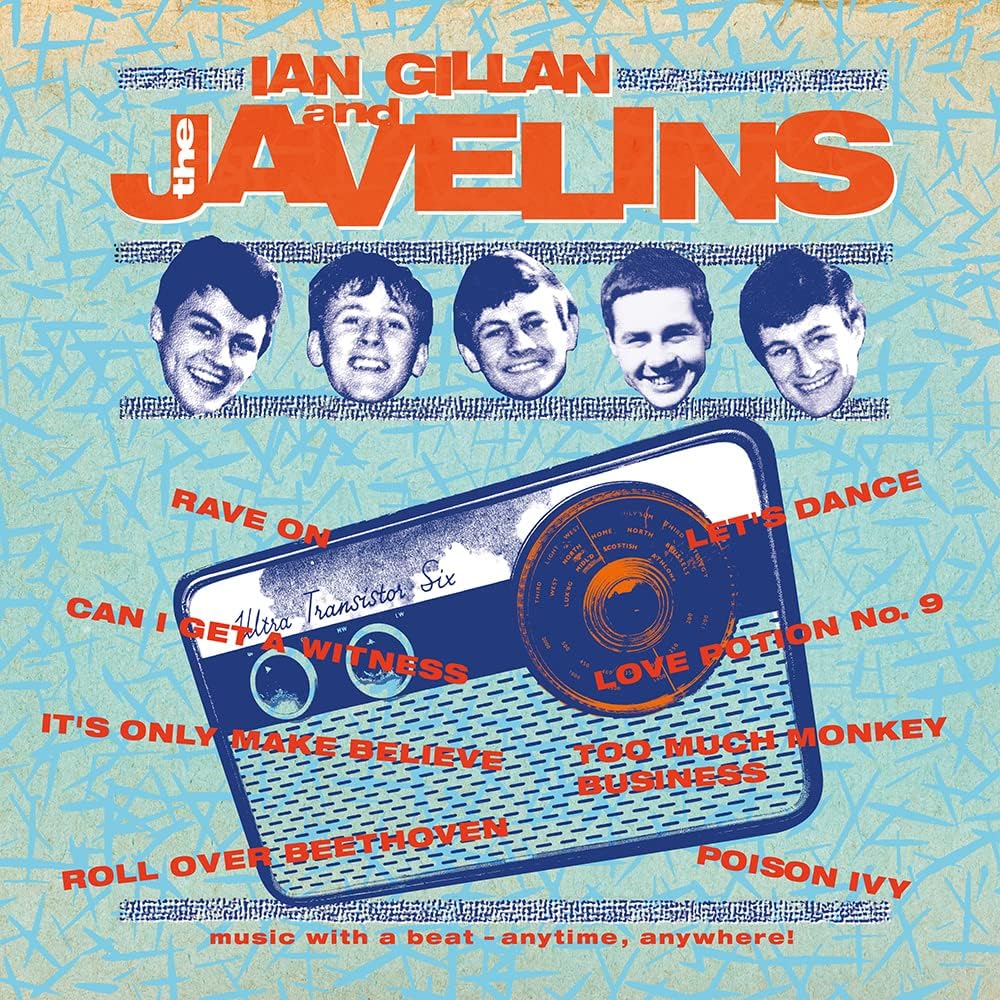
The Elvis Revelation
Everything changed when Gillan heard ‘Heartbreak Hotel.’ “Elvis kind of changed my life. There was something magic about that record. And it still is to me, those early Elvis records were a great inspiration.”
This revelation led to the formation of his first band, a charmingly amateur affair that showcased the resourcefulness of working-class teenagers in 1960s Britain. “So I’m going home one day and stopped this guy, his name was Andy. ‘Do you know anyone who can play the guitar?’ He said, ‘Well, I do.’ I said, ‘Well, bring some friends along. We’re having rehearsals at my house on Saturday morning.'”
The reality was endearingly makeshift: “Four or five of them turned out and no one had six strings on their guitar. It was all beaten up stuff and homemade instruments. I was playing drums on a biscuit tin with a pair of knitting deals. And there was a tea chest bass and a couple of kazoos, but we couldn’t afford kazoos. So we were using comb and paper.”
When his father invested a week’s wages – eight pounds – in a drum kit, it was a mixture of love and comedy: “It consisted of a Salvation Army bass drum, which is one of those big ones you hold in front of you and beat from either side. It’s not the kind of thing you stand on a stage because it didn’t have any pegs to hold it in place. And the moment the vibration started, it just rolled across the stage and disappeared onto the floor.”
The Progression
Each step up the musical ladder came through those fateful encounters Gillan learned to recognize: “This is a lesson to be learned for the rest of my life, weird looking guys standing in doorways. And I got recruited into another band.”
His time with Episode Six marked his professional debut and first taste of international touring. The band’s trip to Germany in 1965 – just twenty years after the war – shocked his parents. “Now you’ve got to put yourself back and think this is just 20 years after the end of the Second World War. There were still bomb sites all around the place which eventually became NCP car parks. And they were shocked that I would be going to work in Germany.”
His mother’s advice proved prophetic: “But I always remember my mum coming up and saying, try and make some friends, which was on reflection an amazing thing to do and say.” Those friendships endure to this day: “In fact, I’ve seen a couple from Munich and a couple from Stuttgart this summer who come to stay with me in Portugal.”
The grueling schedule of five shows a night, eight on weekends, in clubs across Germany and later Beirut, hardened the young musician. “We worked in the Casino du Liban, which is a bit of a hike out of Beirut through Maameltein, a little village we stayed in overlooking the Levant, the eastern Mediterranean. It was pretty spectacular. And the house we stayed in was a derelict farmhouse with no plumbing.”
The Deep Purple Years
By 1969, Episode Six had lost momentum. “We were a pop group, pretty much, and searching for an identity, we’d been through the flower power period. And the harmonies were good, but we didn’t have our own material, pretty much, although Roger Glover, the bass player, was trying to introduce it.”
Then came another doorway encounter: “And so we were playing a show. And then in the background, there’s a bunch of weird looking people with funny haircuts standing in the doorway. And there was Richie [Blackmore], Ian Paice and Jon Lord, who came to recruit me into Deep Purple.”
The decision was obvious: “And it was, it was a no brainer, really, because I think our band had lost momentum. And I don’t think we were going any further. Fantastic group of people. I’ve got lovely memories. But it was time to move on.”
Early Purple Chaos
The band’s first bonding experience was characteristically chaotic. Gillan’s account of the infamous Thames boating holiday with Ian Paice reads like a comedy sketch: “We rented a boat called the Gay Joker from Burt Bushnell’s boatyard in Maidenhead, just downstream of Boulters Lock.”
While Gillan listened to the safety briefing, Paice had other priorities: “Whilst I was listening to all this, Pace was carrying on board all his equipment. He bought the most sophisticated and powerful sound system you could imagine. At that time, it was barely portable, but he lugged it from the car and set it up on the boat.”
The chaos began immediately: “And so if we go into Boulters Lock and Burt, the owner of the boatyard and the boat, he’s standing. He said, okay, he stepped off as the boat rose through the water, filled the lock and we rose to the next level. And as he stepped onto the side of the lock, Paice got his sound system going. And at 100 watts, Vanilla Fudge’s ‘Shotgun’ came blasting out.”
The mayhem escalated: “The man on the deck of the boat behind us fell off into the river. It was a comedy and Burt was just holding his head as we cruised off that river. We later got champagne bottles thrown at us from the bank because Richie Blackmore joined us and he had a white boat that was going so fast that he would go in circles around us as we went upstream.”
The punchline came at Henley: “We’d missed the signs and the warnings and all the glaxons and everything else. We ploughed our way through the Henley Regatta backwards, and we got in a lot of trouble for that.”
Classical Aspirations
Their first major project was ambitious and meaningful. “Strangely enough, the first thing we did was the Concerto for Group and Orchestra, which Jon Lord wrote, which is a magnificent piece of inspiration, where the story behind it is in the first movement, a young brash rock band, challenges an old established concert orchestra, which happened to be the Royal Philharmonic Orchestra.”
The symbolic nature of the piece wasn’t lost on Gillan: “And it’s a mighty clash of titans in the first movement. The second movement is a pause for breath where everyone’s standing back and showing a bit of respect to the other side. And the third movement is moving on in unison and harmony.”
The Royal Albert Hall performance was a career-defining moment, especially for his grandfather: “During the rehearsal in the afternoon, I took my grandfather along and walked him through from the dressing rooms through what they call the bull run, outside to the stage where you come out with this magnificent pipe organ, which fills the stage from behind. And he saw all the red seating in the galleries and the boxes and the stalls of the Royal Albert Hall. And he suddenly, I think, approved of what I was doing because we’d made it to the Royal Albert Hall rather than playing in the soul club down the road.”
Solo
After the famous 1973 breakup, Gillan faced the challenge of building a solo career: “It was very difficult because some of you don’t really know where you stand if you’ve been in a band and then suddenly you’re on your own again, you can’t use the credibility or the kudos of the band to use as a springboard. Of course, you’re known, but in reality, you’ve got to build a new fan base. And so you’ve got to start again.”
The humbling came from promoter Jack Barrie: “I remember talking to Jack Barrie, the famous booker and promoter when I was doing the marquee, a few nights at the Marquee and said, ‘I wouldn’t mind doing the Reading Festival.’ And he said, ‘Yeah, you’re about ready for it. I’ll put you on. You can open for Rory Gallagher on a Friday.’ That was a reality check, but my God, it was fantastic.”
Soviet Adventures
Some of Gillan’s most memorable touring experiences came during extensive Soviet Union tours. The logistics were primitive but the experiences profound: “Yes, we’re very primitive, very basic. I took two trucks. One of them had our equipment in. The back line equipment, which is basically the stuff that goes on the stage, the promoters provide the sound systems and the lights for these larger venues.”
The second truck was equipped for survival: “In our van, in one van was the equipment, the other van contained some mattresses. 10 cases of whisky, 10 boxes of Levi jeans, 10 boxes of Marlboro cigarettes, a pool table, TV, video player as it was in those days, washing machine, dryer, pretty much everything we might need for three months tour outdoors, most of it was.”
Meditation
Throughout his career, Gillan has maintained equilibrium through meditation and contemplation, practices he began in his youth after guidance from Father Stubbs during confirmation classes. “During these confirmation classes, Father Stubbs would talk to me about things in the Bible, and I got to the point when I had to keep asking questions about the miracles. He would say, ‘Well, you’ve got to have faith, my son. You’ve got to have faith.'”
This puzzled the young Gillan: “And this puzzled me because I thought, ‘Really, surely if you’ve got faith, you should understand what you’re being faithful to or faithful about.’ I thought they were trying to separate my brain from my spirit.”
His approach to meditation was characteristically methodical: “So I started this technique of just studying what was going on in my body, and I would literally concentrate on my toes until I could relate to one toe or another. And then every part of my body, then the blood flows inside and the sinews and the muscles and joints and the rest of it.”
The goal was integration: “The point was I wanted to get to the point where I didn’t have to do meditation sessions, I didn’t want to have to wake up in the morning. Oh, it’s time for my meditation or this, that and the other. I wanted it to be automatic. So I was in a constant state and that I was through. Ridiculously long hours of practice, I was able to achieve that.”
Jesus Christ Superstar
Between his Deep Purple commitments, Gillan’s three-hour recording session for Jesus Christ Superstar became legendary. The opportunity came through Tim Rice’s appreciation of Deep Purple’s music: “Tim Rice, again, had heard ‘Child in Time’ and various other songs on Deep Purple in Rock and asked me if I would consider singing a song on their project.”
The recording process was remarkably informal: “And I went around to their flat, Andrew was at the piano and Tim gave me a sheet of lyrics for ‘Garden of Gethsemane’ and said, ‘Andrew will sort of guide you through the tune on the piano and just follow that. But what we’d like in the studio is for you to sort of use your own natural style and perhaps the improvisation in a style of what you do with Deep Purple.'”
Lloyd Webber’s caution proved wise: “So Andrew looked over his shoulder and he said, ‘Yes, improvisation, but not too much.’ Which was it worked out and he was right, because you have to hang on to the lyric to the tune.”
The Sabbath Detour
His year-long stint with Black Sabbath proved to be “the longest party I’ve ever been to.” One incident perfectly captures the era’s excess and misunderstanding. During recording at Richard Branson’s Manor Studios, Gillan encountered an unexpected visitor: “One afternoon during the record, I was in, all the guys used to sleep in day and work at night. And I was the other way around. I slept in a tent because I didn’t, it was too dangerous in the house. And I was warbling away and I looked up into the control room and there was a vicar standing there in full regalia.”
The vicar’s complaint was reasonable: “The thing is, we have choir practice on a Thursday afternoon and I mean, everyone quite naturally has their doors open in the summer, but your beautiful music is invading our church and we can’t hear ourselves sing.”
The friendly resolution led to unintended consequences: “So we went to the pub and we had a lovely chat. And the next day I wrote a song called ‘Disturbing the Priest.'”
Years later, the song’s innocent origins were misinterpreted: “And two, three years later, I got a call at home from Al Dutton, who is my tour manager and friend for many years, who is now working for Black Sabbath. And he said, ‘You’re not going to believe this. We’ve been run out of town. I’m looking down the road. There’s thousands of people. And they’re all marching and making all kinds of accusations.'”
The irony was complete: “The archbishop quotes ‘Disturbing the Priest’ as a classic antichrist type of song. I said, ‘Did he know it was about the noise at choir practice?’ He said ‘They don’t know these things.’ So they actually got run out of town because of a chance meeting with a vicar in the studios.”
Vocal Evolution
Now unable to reach the soaring heights of ‘Child in Time’ since age 38, Gillan has adapted with characteristic pragmatism. “No, I’ve not been able to do that since I was 38 years old. When I was in the church choir, I had a soprano voice and then my voice changed. And I had a young man’s voice that lasted until I was in my late 20s. And then I changed again.”
His forward-thinking approach served him well: “I also said to myself when I was in my 20s and 30s, the last thing I want to do is be screaming when I’m 60. I didn’t think I’d be going on this long, but I am.”
The evolution extends beyond technique to content: “And also lyrically, I mean, when you’re young, you sing about fast cars and all that kind of things and exciting stuff. But that all seems a bit daft when you’re early, middle age and you still have to write about something and it still has to be exciting and interesting. So you look in other places.”
Band Dynamics and Philosophy
His philosophical approach extends to his view of Deep Purple’s unique dynamics: “If there was a planet that had five polar regions, it would be called Deep Purple. We’re also different, socially and politically. I think the reason we love each other so much when we’re working is because we all make way and compromise for the greater good, just to make the music.”
The reality of band relationships is more complex than fans might imagine: “So it’s a very happy band on the road, but I have to be quite honest, last year I packed my bag in May, and we finished the tour in November. But when you go home, no one sends emails or makes phone calls. We get on with a different life. I won’t see those guys until we get back on the road again or do rehearsals.”
Looking Forward
At nearly 80, Gillan shows no signs of slowing down, with Deep Purple’s touring schedule remaining ambitious. His advice on positive aging is characteristically straightforward: “I wish I could give you more medical advice on positive aging, but I think an awful lot of it is in your mind. I used to play football and cricket and swim and dive and all those sort of things and I strangely can’t do that anymore, but I can enjoy talking about it and reminiscing and encouraging others. I think a positive outlook is very important.”
When asked about his favourite Deep Purple track, Gillan’s mischievous side emerges with perfect timing: “I say this for one reason only, and I say this only to annoy Ian Paice. My favourite Deep Purple track is ‘Razzle Dazzle.'”
The Enduring Power of Music
From boy soprano to rock legend, Ian Gillan’s story is one of music’s enduring power to transcend boundaries, build bridges, and change lives. His journey through the social strata of British society, filtered through the prism of rock and roll, creates a story that’s both personal and universally resonant. As he continues touring well into his eighth decade, his voice may have changed, but his passion for music and life remains as powerful as ever. The kid who didn’t fit in anywhere has found his place in rock history, proving that sometimes the greatest journeys begin with not belonging anywhere at all.
Further information
Many thanks to Ian Gillan for his assistance.
Further information can be found at gillan.com and deeppurple.com
u3a is one of the largest membership organisations in the UK for those no longer working full-time. Members connect together to develop their interests, make new friends and have fun. There are more than 1,000 u3as spread right across the UK, with interest groups run and chosen by the members. Whether it’s running, recorder or rock music, members can either join existing groups or start their own. For a modest annual fee, members join their local u3a giving them access to national and local activities.
To read more go to the u3a website