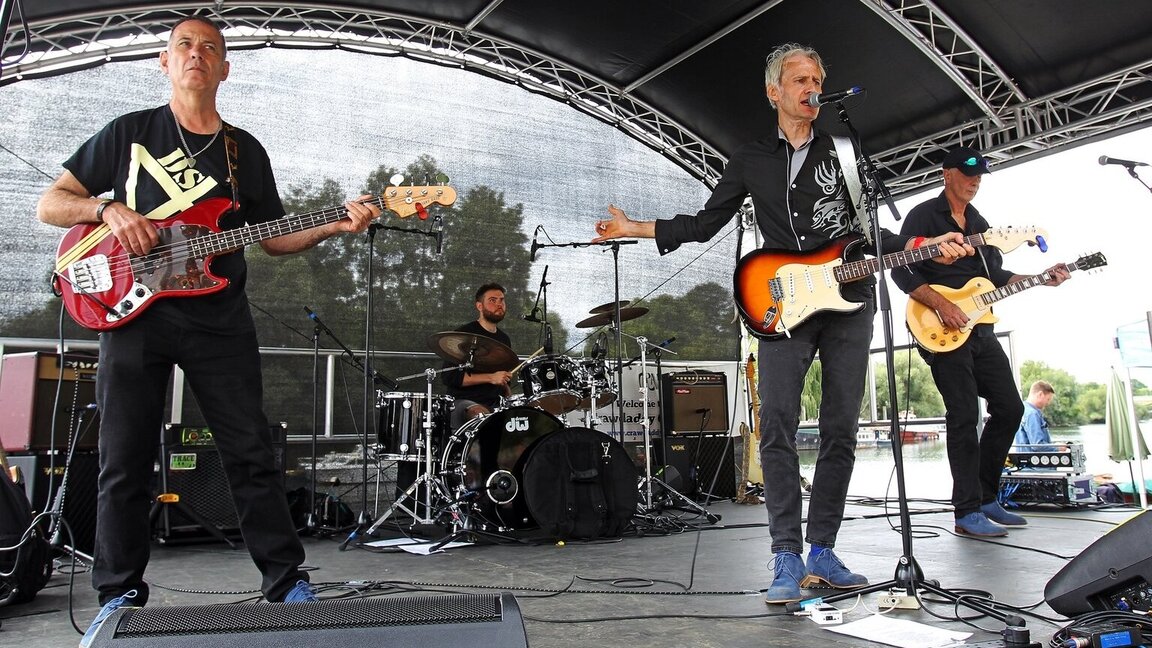
David Sinclair Four (promo picture, used with permission)
David Sinclair has spent decades documenting rock royalty, but somewhere between the interviews, he picked up a guitar and started writing his own story. Now, leading the David Sinclair Four, he’s discovered that credibility as a music journalist buys you precisely nothing when you’re gigging the circuit from scratch. His new single ‘Then… Good Night‘ transforms a children’s bedtime poem into something tender, while the band prepares to headline London’s legendary 100 Club in May. Jason Barnard caught up with him to talk about what it’s really like when the notebook gets put down and the spotlight turns your way.
You’ve spent decades interviewing some of the biggest names in music, from Mick Jagger to Billy Gibbons. How does that experience influence the way you approach your own songwriting and the stories you want to tell?
Well, you can always hope a bit of their genius rubs off – ha ha. And I guess on some level you absorb how they see the world, how they talk about what they do… There’s also a lot of listening involved. As you know yourself, interviewing musicians and reviewing shows and records means you spend years really paying attention — not just to the hits, but to the deep cuts, the patterns, the timing, the decisions that make something endure. You’re constantly asking what gives a song its power. Songwriting is a lot like writing anything else. To write, you have to have read. To make music, you have to listen. All of that seeps into your own work. Not consciously, necessarily, but it shapes your instincts when you sit down with a guitar and try to tell your own version of the story.
‘Then… Good Night’ draws from a Ruth Ainsworth poem you used to read to your children. What was it about that particular poem that stayed with you, and when did you realise it could become a song?
I’d always loved the optimism of it — and the sense of closure. “Ended is the lovely day…” is such a simple line, but it carries so much warmth and reassurance – as if it’s gently putting the world back in its box for the night. Years later, I came up with that descending chord sequence and immediately realised those words would sit perfectly against it. It wasn’t forced — they just seemed to belong there. Once the chorus was in place, the verses followed quite naturally. Sadly, after the song was recorded, my niece Kat died of cancer at the age of 41. She and her own young children had become part of those family trips to the reservoir and in that context the song took on a more poignant meaning than I’d originally intended.
There is a tradition of songwriters writing about children and parenthood, from Lennon to Loudon Wainwright, which can give the risk of being over-sentimental. Were you consciously thinking about how to avoid that territory?
I’m always delighted to be lumped in with Lennon & Loudon. My band doesn’t do sentimental to be perfectly honest – the guitars tend to intervene!
Your son Jack has gone from being the band’s drummer to your producer. How has that relationship evolved in the studio, and what does he bring to the David Sinclair Four sound that you might not have found elsewhere?
Jack is a seriously skilled musician and fully-trained sound engineer. He worked at Trevor Horn’s Sarm Studios before becoming a professional poker player. He has fantastic ears and technical judgement, and he knows more about my music and the band’s abilities than just about anyone else. I’ve been very lucky to have him in my corner.
In ‘[I Got] One Pair of Hands’ you sang about the limits of what one person can achieve alone and the power of collaboration. Does ‘Then… Good Night’ build on or relate to those themes?
Not sure, really. I’m not in the business of themes, as such. I’m just trying to get each song right on its own terms.
The David Sinclair Four is headlining the 100 Club on 19 May. After all your years covering the music industry, what does it feel like to be on the other side of that equation, building an audience and putting yourself up in front of the press?
This is the $64,000 question. There’s a kind of purgatory you have to pass through when you make that crossing. You go from being backstage at the very top end of the business to playing the least glamorous rooms imaginable — and you quickly learn that access and credibility as a writer buy you nothing as a musician and songwriter. You’re starting again, right at the bottom. It’s taken me a long time to earn my way back to this point, so headlining the 100 Club feels like a marker. Not a destination, but a moment that matters. It’s a room with history, a room where things happen, and we’re putting everything into making it a great night — a real band show, a few surprises, and a sense of occasion. I’m proud to be doing the gig – it’s on May 19 – and I’m genuinely looking forward to sharing the night with people who want to be there.
The group has been described as British Americana with roots-rock storytelling. How conscious are you of that blend when you’re writing, or does it just emerge naturally from the influences you and Geoff Peel have?
It’s mostly natural. We’re not sitting there thinking about categories — we’re trying to get better at the craft of songwriting. Geoff is an incredible guitarist and musician who has guided and shaped my raw creative instincts into something more focused. The one thing I’m very conscious of in our songwriting is that the words and music are telling the same story at the same time. The technical term for it is “prosody” and I believe it’s an underrated element of songwriting. I nearly always write so that the words and music evolve together, sometimes beginning with a title that appears early on.
‘Living Like a Yo-Yo’ became your most streamed track and was produced by Robin Trower, yet it sits stylistically closer to blues rock than your more recent, reflective songwriting. Looking back, what does that song say about where you were then, and what you were still trying to work out?
Well, yes, it is my most streamed track – so far! Working with Robin Trower was a game-changer for me and the band. We went in to the studio thinking we had a strong, well-developed demo. What Robin did was systematically re-engineer it: drum part, groove, guitar feel, overall sound. He turned the song into something turbo-charged. At a deep level, he taught us how to arrange and build a track in the studio rather than just record one. That song was when I realised I could be a serious contender. It’s loosely autobiographical, and probably the most fully realised thing I did with my original trio. It became a springboard: materially, creatively, and psychologically. It raised everyone’s expectations of what was possible. That song opened doors and shaped my ambition. Robin was a great mentor, and I learned a huge amount from that experience. Everything that followed — the records, the collaborators, the confidence to push further — grew out of that moment.
You’ve mentioned that writing about your own group is harder than profiling the Spice Girls or anyone else you’ve covered. Why do you think it’s so difficult to find the right words when it’s your own work?
Did I say that? I think it’s much harder to come up with good questions than to answer them. The journalist has to keep everything on track, work out what matters, and impose some kind of shape on the story. The artist just has to respond with whatever’s in their head at that moment. I know which job I prefer!
Finally, what do you hope a listener with no knowledge of your journalism would understand about you from the songs alone?
I don’t know what a listener might work out about me. The songs tend to mind their own business.