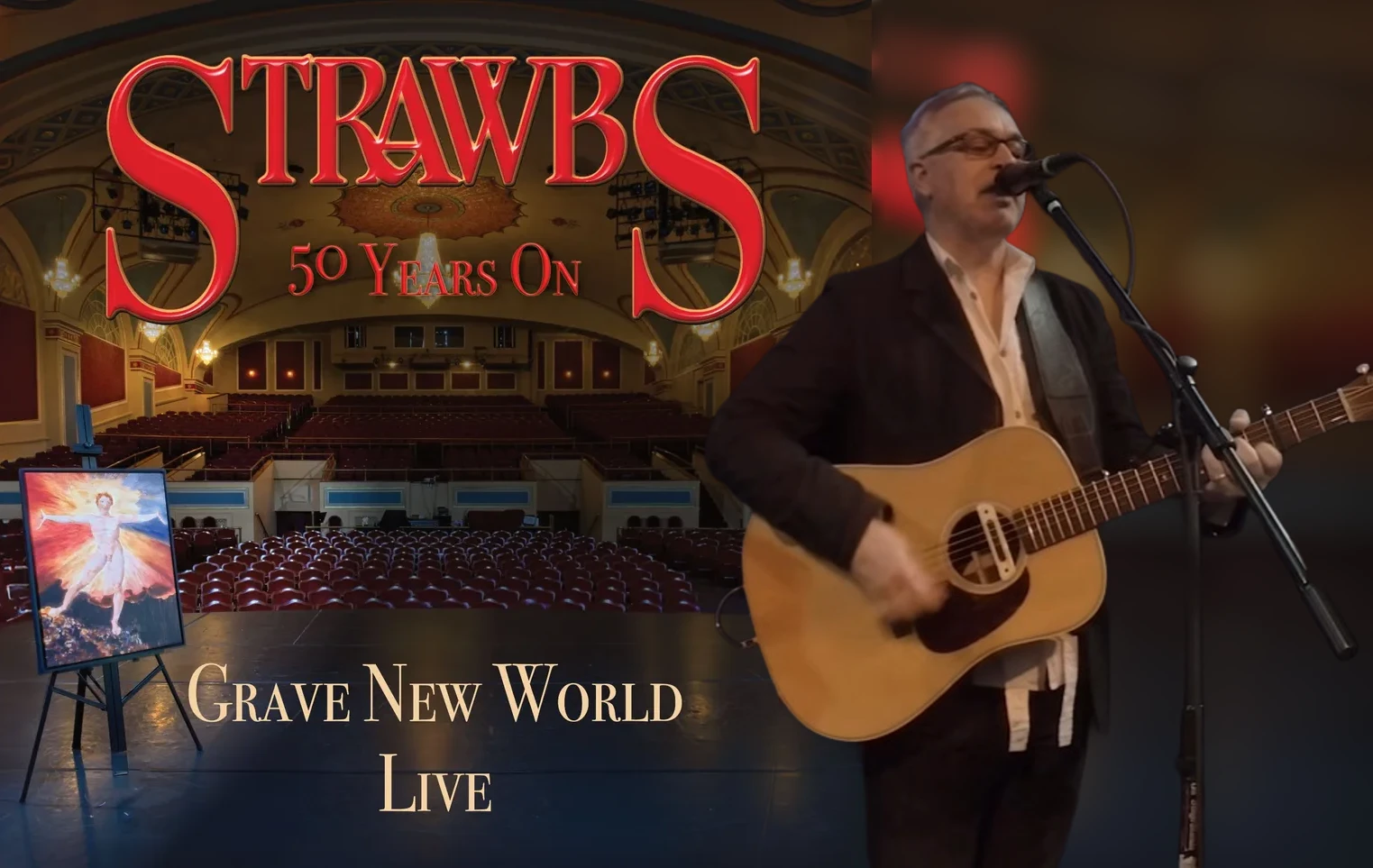
“This is a military exercise.” That was David Cousins’ reply when Wesley Stace asked how preparations were going for Strawbs’ 50th anniversary weekend. The undertaking in question was a full performance of Grave New World, the album Cousins was proudest of, staged whole for the first and only time, with Stace narrating between songs from a script the two of them built together over email: Cousins sending ideas and a running order, Stace writing it up, Cousins correcting the drafts before either would let it go out. It happened once, at the Strand Theater in Lakewood in 2019, and never again. A year on from Cousins’ death, that night is finally getting a release as Grave New World Live.
Stace’s own next record is also imminent. One Last Heist, made with longtime collaborator David Nagler, comes out on 2 September on Pravda Records. Here Stace talks through both: the correspondence and work behind narrating Grave New World, and the sessions, songs and citizenship that shaped One Last Heist.
The Grave New World Live album’s notes describe the narration as something you and David Cousins collaborated on, though the original 2019 concert credited it as written by David and performed by you. How much input did you actually have in influencing the text?
Well, inspired by your questions, I’ve been looking through my emails to refresh my memory for accuracy’s sake and here’s what I found.
David – that’s what he liked to be called – and I been friends a few years when the idea first popped up in April 2018, a full year before the anniversary: “I have several ideas for the show [Strawbs 50th Anniversary] in my head, one being to recreate ‘Grave New World’ and I would love you to be part of that. It would also be great if Eric [Bazilian, of The Hooters] would join us for the same project. It was ‘Benedictus’ that made me think of it.” (Eric and I had recorded a version of Benedictus which ended up on an album of mine called Greatest Other People’s Hits and David loved it, so he wanted Eric to be involved as well.)
By June he was emailing: “I want to do the whole of ‘Grave New World’ album for the first and only time. You would sing lead on ‘The Flower and the Young Man’, harmonies on ‘On Growing Older’ etc… It’s all in my head at the moment but will come together. I can come over in the New Year to run through the songs with you. What do you think?” I thought: YES!
When I heard he was coming over, I hastily invited him to be on my Cabinet of Wonders show at City Winery, which was a great night, with Freedy Johnston, Teddy Thompson, Sophie B Hawkins and so forth, and also the reason why Sophie sang at the Strawbs 50th! Among other songs, David did Benedictus with my band and Eric at that show.
On that trip, we got together and first discussed the idea of me collaborating with him on the narration for this “concept album” (if you like, and he did!) version of Grave New World. He basically gave me a bunch of ideas to work with, and told me how the songs first together, in order, in his head. I wanted to keep the final thing simple, to honour the feel of the record, the context of its creation, and certainly not to write anything anachronistic or anything that got in the way of the flow. I probably added very little that he didn’t suggest, but I did try to make it coherent and also of course poetic, so it would be a pleasure to read. I loved the way David announced songs and told stories at gigs, so that was the inspiration for the feel of the narration.
I must have sent a version to him by email because in January, he replied: “I got your script but didn’t get time to go through it thoroughly. I have cut and pasted the narration into the song list to see how it works. It’s now easier to see the idea in context. On a couple of occasions, the narration appears to be looking back rather than forward. I have made a couple of amendments as a suggestion. I won’t send it out until we are satisfied.”
And that’s precisely how it got written. I don’t know why he asked me to do it, rather than do it himself, except that we were friends and he trusted me and he knew how much I loved the record. So I guess the short answer is: he suggested the kind of themes I pick up on; I wrote it; he corrected it; I read it at the show.
What was David like to work with on it?
A great pleasure and entirely appreciative of whatever I was doing. I’d gone on tour as their opening act, and he’d done my Cabinet of Wonders in both London and in New York City, plus I’d been to see that band quite a few times over the years. He also wrote right before the 50th: “You introduce the players and then you hand over to me and I will explain that this is a theatrical performance and we would rather the audience did not applaud during the show as they will miss the story.” He really wanted its to seem theatrical, the centerpiece of the 50th celebrations, and it was theatrical, in the old style. If we’d have had the chance to do it more, I think it may have developed further in this direction.
Now that the performance is coming out as an album marking the anniversary of his passing, what does it feel like to hear it back, knowing it turned out to be the only time Grave New World was ever staged in full?
Sensational. I am so happy it got done. It was an incredible weekend in Lakewood at the Strand Theater, all thanks to Ray Coles, who knows how to make things happen, and all those wonderful musicians. We did a mini-Cabinet of Strawbs covers which was also killer. It’s sad that his idea of performing it on tour and so forth never happened (though I note he refers to it above as “the first and only time” it would be performed – the idea must have grown on him because of the excitement of this first performance!), but the fact that it happened once, or at all, is a miracle in itself, given the various health situation which continued right up to the final live performance at Cropredy. I have a funny email where I asked him how the set up for the 50th was going, and he replied only: “This is a military exercise.”
By David’s own account, Grave New World was the album he was proudest of, and ‘Benedictus’ the favourite of all his songs. Working that closely with him on the piece, did you get any sense of why that record mattered to him more than the others?
That’s a great question and I think the answer is: it’s the band’s greatest album, some of his greatest songwriting – I think he knew that. I’m quite a compulsive question-asker when hanging out with someone whose work I admire, and David was always into the questions, and loved to chat about it. I definitely asked him about the “concept album” aspect of the record. And he explained about his use of the I Ching at the time etc. We discussed all that and I tried to get it in there in the simplest of ways.
David had hoped the Lakewood show would lead to further performances of Grave New World, but it never happened again. Does that change how you think about your part in it, being the only person who has ever spoken those words live?
David described that weekend as “the undoubted highlight of my musical career” and it was quite incredible. He was a husk by the grand finale: he’d played so many songs and he’d completely exhausted himself. In answer to your question, I think those words are for anyone to speak now. I feel very little ownership of them. It’s just great being a fan and a friend and getting to collaborate in that way.
You’ve talked before about how much progressive rock you listen to. Where do the Strawbs sit in that for you?
Oddly, I’ve always thought of Strawbs more as complicated folk-rock rather than prog, because unlike say Peter Gabriel or Jon Anderson etc etc, David is a straightforward, exceptional, folkie singer-songwriter, a wandering minstrel from the middle ages going from place to place telling the latest stories and news. Obviously, progressive ideas were in the air, and when you hear the dawning of them – and Wakeman’s keyboard – in From the Witchwood, and then the band’s steady movement deeper into complicated structures and suites, it’s evidently prog. And I’d say they harnessed those ideas as well as anyone. But to me, it’s always David’s songs at the forefront: just a guy with an acoustic guitar, dulcimer, or, as he started out and occasionally live later, banjo.
When we spoke in late March 2024, you and David Nagler had just booked your first recording date for the follow-up to Late Style, set for that June, hoping to get three or four songs down live in Philadelphia. Is One Last Heist that record, and how much moved between that first session and the finished album?
It is that record! David and I wanted to make another record together where everything was played live in the room as nature intended. We’d wanted Late Style to be the most elegant record imaginable, but COVID was a scruffy time and much of it was recorded in isolation in far-flung locations. It was great but we just couldn’t get it done how we wanted. So the prime motive here was to go one better, to arrange the songs first, then record them as a band, playing live in the studio, to let it be a ‘players’ record, allowing for expressive solos, room to relax a little. David’s arrangements were all so lovely going in; and the players used them as springboards (or copied them entirely in certain cases).
Studio 1935 is open plan, very welcoming, not lots of isolated booths, so we were all able to congregate, interact, and improvise. We worked quickly, laid down the back tracks in two days (unbelievably, when you hear them!), and then recorded this and that here and there; I did the vocals in San Francisco under the watchful eye of Chris von Sneidern and then we mixed and did horns back in Philly where we’d recorded. It was a lovely record to make. Getting it released? That’s a whole different thing these days. And I’m very glad Pravda Records stepped up.
I understand that ‘Thoughts and Prayers’ and ‘I Say Lots of Things’ are protest songs. We discussed ‘There’s a Starbucks Where the Starbucks Used to Be’ coming out of the fight over the Barclays Center in Brooklyn. Is your relationship to writing that kind of song the same now as it was then?
It is. But there are different ways to handle protest. With those two you mention: one (I Say Lots of Things) is about something so ludicrous and gaslight-y and frightening that it’s almost as if one can only deal with it with comedy, and the other (Thoughts and Prayers) is about something so dreadful and horrific that one can only be deadly serious about it. I learned all these lessons from Phil Ochs, among others.
‘Hello Dead Horse’ is about a band reforming for one last payday. Given how often you’ve gone back to reconvene people, the Decemberists, the Jayhawks, the Minus 5, is there any of your own history in that song?
In that song, no, because I’ve never been in that situation. But I can imagine it (enviously)! Meanwhile “One Last Heist” itself, the title track, is in that sweet spot where it’s either a literal heist – the aging criminal reeled back in for one last payday – or a metaphor – I make one more album, a veteran, ever hopeful that it will all work out. It doesn’t matter which of these it is. I’t’s written that way by design. And the phrase “one last heist” pops up in “Hello Dead Horse” – coincidentally – and that makes the link explicit.
You’ve said you like your music sweet and your lyrics tart. Does that hold across the whole of One Last Heist, or is there a song on it that breaks the rule?
Interesting question. I noticed there were a couple of reviews of Late Style that seemed muddled that the lyrics were full-on, sometimes harshly satirical etc, whereas the music referenced jazz, easy listening and so forth. I mean, that doesn’t honestly seem very muddling to me, but anyway…. And it’s not like I’m the first to do that! Uneasy Listening, would be a good name for it, though that may have been used! The protest songs typify that approach, but then so do the love songs; have a listen to “A Funny One”, “Not My Speed” and “In Our Own Time” and you be the judge. One thing for sure: the way the music sounds on this record – all tribute to Mr Nagler! – sounds divine to me: expansive, lush, inspired by everyone from Gerry Rafferty and Randy Newman to Joni Mitchell, Bob James, Marcos Valle, Gilbert O’ Sullivan and beyond.
You became a US citizen a year ago, after living in Philadelphia for sixteen years, on a record that leans so heavily into that city’s musical history. As you’ve become a naturalised American, has it changed how you think about writing America into your songs?
I feel I have more license to get involved, to be critical, and in particular to vote. I was rather self-conscious about that before – Americans don’t really want a British person to come over and lecture them – and even went so far as to making things less-US-relevant. No need anymore. I am them! I am us! And you’re right, this is for sure the most Philadelphia record I’ve made, partly through my immersion in the city’s hammond jazz sounds, everyone from Shirley Scott, Jimmy McGriff (former Philly police officer!), Jimmy Smith and Charles Earland – it’s not like there’s hammond organ on everything, it’s the feel of those records.
And finally, do you have any plans to do any shows in the UK over the next year?!
I hope so. We were thinking up some immediate plans but my new role as sometime lead singer of The Smithereens might hinder this slightly; not to mention the fact that America remains a large place. I am very excited for the record to be heard in the UK tho, and I hope to be over soon. If my friend and tour manager Darren has anything to do with it, that’ll be sooner rather than later. I suspect May will be a good time for a little visit. Thank for your questions!
Further information
Wesley Stace – One Last Heist is released on Pravda Records on 2 September 2026
Strawbs – Grave New World Live is released on Witchwood Records on 9 October 2026. It will be released as a limited pressing of 1,000