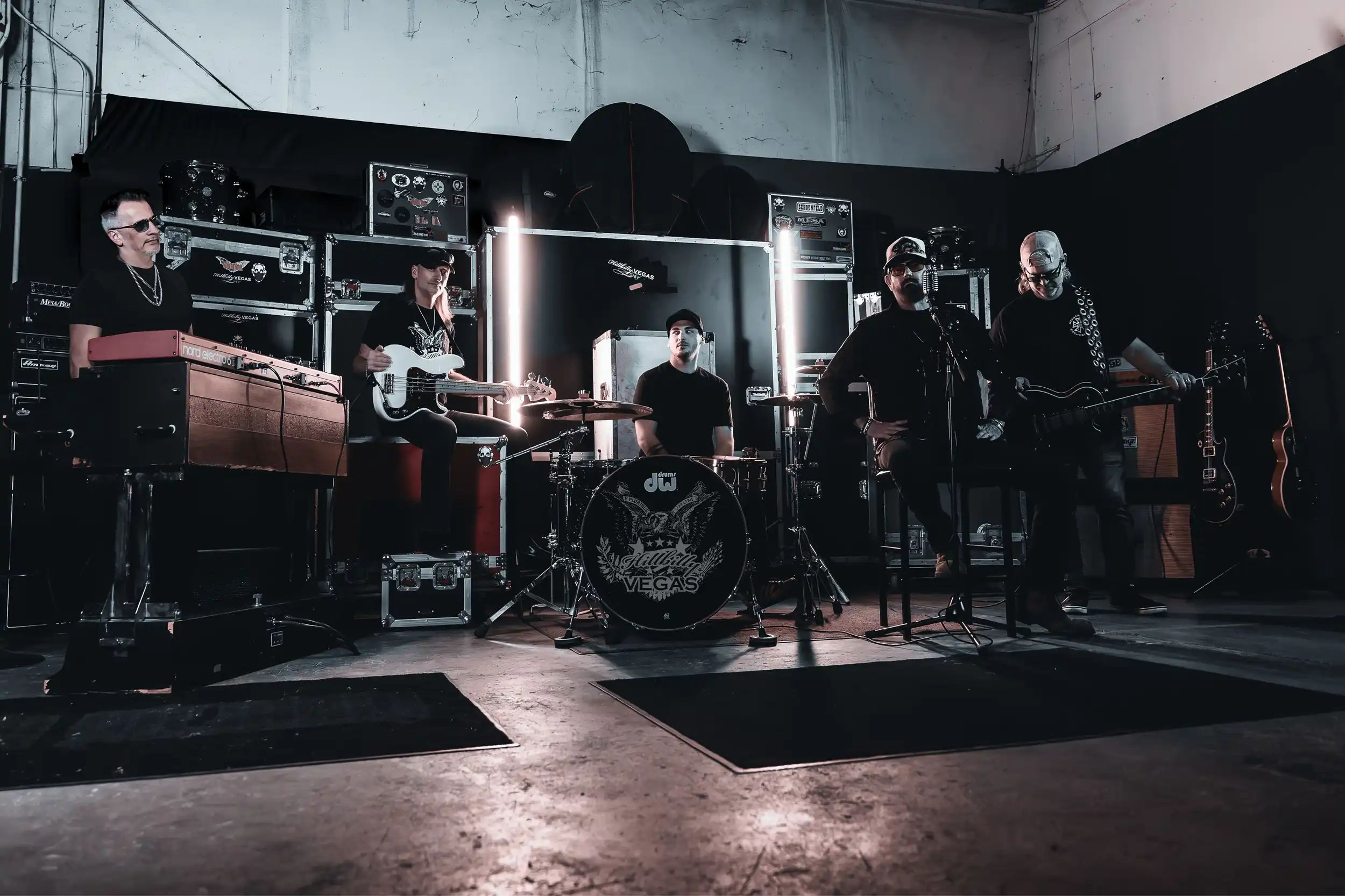
Hillbilly Vegas, 2026, Photo Credit Joe Ward
Hillbilly Vegas started with a funeral and a favour. When Steve Harris lost his grandmother, he gathered some friends to record a gospel song for his mother, and somewhere in that room a band formed around the grief without anyone deciding it should. That was 2011. Harris is now the sole original member, leading an Oklahoma outfit that has built a genuine following in Britain and Europe, and talked Paul Rodgers into singing on their new record. “A La Mode” is out 8 May. Jason Barnard finds out more.
I understand that the origins of Hillbilly Vegas began when your grandmother died and you wanted to record a gospel song. Does it ever feel strange that a song you made as a private gift for your mother is now an origin story?
Not at all. I lost my mother a couple of years ago, and she loved my music. So honestly, the origin story keeps her with me everywhere I go. What started as something personal for my family ended up becoming part of the band’s story too, and I’m grateful for that. I wouldn’t trade that origin story for anything.
You’re now the sole original member. How much of the group’s personality lives in the lineup, and how much travels with you regardless of who’s on stage?
It all started with just me. I had an idea, and I had good friends who wanted to make music. The early days were filled with a lot of fun and absolutely zero expectations, and I’ll always love those days and those guys. We were telling our story then – just like we are now. The truth is, every story has exits and entries. New people come in and they bring new experiences and their own history with them.
But the heart of who Hillbilly Vegas is has never really changed. It’s still about telling our story and hoping people can find pieces of their own story somewhere inside it.
“I Hope You Know” came from a friendship and professional relationship that fell apart because of substance abuse. How did you decide it was ready to be a song?
I don’t think I made a conscious decision to write that song. I was just writing, and feelings started coming out of me. Honestly, I was kind of unconscious to the whole process while it was happening. When the song was finished, I realized I was obviously dealing with some things that had been sitting there for a long time, and they finally found their way out. At that point I was at a crossroads, because I don’t usually put really personal things out into the world. This time I decided maybe it was time to face it instead of carrying it around. And hopefully maybe those words give a little encouragement not just to me, but to somebody else out there too.
Todd Ronning played on Paul Rodgers’ original demo for “Mr. Midnight” while still in Rodgers’ solo band, years before he joined Hillbilly Vegas. When Todd first brought the track to you, did you know whose song it was before you heard it? Also – what did it feel like to then go and sing the song yourself?
Yeah, I knew. Todd isn’t really a “spring things on you” kind of guy. He told me what it was and asked me to listen to it and tell him what I thought about recording it. The moment I heard Paul’s voice on that rehearsal recording, even though it was basically a phone recording, I just thought, “Wow… that sounds like every Bad Company record ever.” Paul is just amazing, his voice is timeless. I loved the song immediately, so we decided to go for it. We don’t just share a bass player history with Bad Company through Todd, we also share a manager in David Spero. So I asked David if he thought Paul might consider singing on it with us. David reached out, and Paul said yes. The first time we got the track back with Paul’s vocal on it, we must have listened to that section twenty times in a row. Honestly, I still replay his part over and over. It’s one of those moments you never really get used to.
You and Paul Rodgers had never actually met when the record was made. Is that still the case?
Paul and I have exchanged emails. He’s such a lovely guy. He’s been incredibly encouraging, thoughtful and honestly just a really fun person to get to know. What’s been really great is that none of it has felt distant or formal. He’s been very genuine and very supportive of what we’re doing, and that means a lot to all of us.
Geraldo came from Loverboy and the Paul Rodgers band, and Todd came from Bad Company. Do those histories ever come up when you’re writing or rehearsing together?
Not really during writing or rehearsals. It usually comes up more in real-life moments. Like when Mike Reno calls to congratulate us on a single climbing the charts, or when we end up backstage with Loverboy eating cake… and yes, somehow there was actually cake involved! Obviously the Bad Company connection comes up when you suddenly have access to somebody like Paul Rodgers and end up collaborating on a song together. But honestly, Todd and Geraldo are just regular guys. They’re both extremely team-oriented and easy to be around. We have a great time together.
The new album is called “A La Mode.” For a band rooted in Oklahoma outlaw country and southern blues, that’s a curious title. Where did it come from?
When I was a kid my grandmother used to say, “Save your fork, there’s pie.” Well, if that’s not music to a kid’s ears, add ice cream on top of it and now you’re really talking. Honestly, I’d much rather talk about ice cream on pie than spend a lot of time trying to figure out labels like “outlaw.” I’m still not completely sure what that even means. But I absolutely know what “save your fork, there’s pie” means.
So A La Mode just felt perfect to me. It feels warm, real, familiar and a little fun, which honestly describes this band pretty well too.
“Miss America” leads the record. What’s that song about?
It’s about toxic relationships. I’m really not a “deeper meaning” kind of guy. I think if you have to explain something in great detail, then maybe the meaning didn’t land the way it was supposed to. To me, “Miss America” is pretty simple. It’s about being completely infatuated with a fantasy while also knowing deep down you probably need to run from it. The problem is, knowing you should run and actually running are usually two very different things. But most importantly, underneath all that “meaning,” it’s just good rock and roll.
“Let It Ride” spent thirteen weeks on the Billboard Rock chart and reached number ten. Did that change anything practically for the band?
It didn’t really change us, but it maybe changed the way people saw us. The funny thing about all of this is that when you’re in the middle of it, you don’t always realize what’s actually happening around you. You’re still just making music, getting in vans, loading gear and trying to put on the best show you can. Although I will say… sometimes the first sign things are changing is that you go from hoping there is a dressing room and maybe there is some name-brand candy and drinks back there to whole buffet tables and you think, “Okay… maybe something’s happening here.” That’s usually the first clue.
David Spero has managed many great artists. How did that relationship come about, and what has he brought to the group that you couldn’t find before him?
Where do I start? David came to us through Todd, and from the very first meeting all the way to this morning, it’s just been an amazing relationship. David’s been a great manager, a great counselor and he’s become a really good friend to all of us. There’s a reason he’s accomplished everything he has in this business. You can feel this energy around him that’s both infectious and inspiring. And honestly, there’s also a very practical side to it. People tend to pick up the phone when David Spero calls.
You’ve spent your last four tours overseas and built a real UK following. What does a British crowd do differently to an Oklahoma crowd at one of your shows, and does the set change at all?
I honestly think music lovers are pretty much the same all over the world. They want to feel something, they want honesty and they want energy. What we really love about British crowds is how invested they are. They follow you, they support you and they really pay attention to what you’re doing. The passion of the UK fans has been incredible for us. They’ve honestly made us feel completely at home over there.
You’ve also played NASCAR events and the Sturgis rally alongside rock and country festivals. Is there a version of the show you adjust depending on the audience?
Nope. To quote Popeye, “I am what I am and that’s all what I am.” I think you’ve got to be the same version of yourself everywhere you go. Whether we’re playing Sturgis, a NASCAR event or a festival like Steelhouse, we’re still going to be Hillbilly Vegas. People may love us or hate us, but nobody’s ever going to say we acted differently depending on where we were playing.
You make your own jewelry and you’re a member of the Cherokee Nation. Are either of those things connected to the music in your mind?
I’m also a committed Stetson rescuer. I just like having my own stuff and surrounding myself with things that feel like me. Whether it’s jewelry, hats or music, I like personality. I think people should represent themselves honestly. As far as being a member of the Cherokee Nation, I’m extremely proud to be Cherokee. I owe a lot to the Cherokee Nation. They provide healthcare, schooling and housing assistance to good people all over Oklahoma, and I think a lot of people outside the tribes don’t always realize how much good is being done every day. I’ll always be a champion for the Cherokee Nation and for tribes everywhere.
Operation Vet NOW works with military veterans. How did you get involved, and how do you support them?
My brother-in-law, Garret Spencer, is a recently retired Command Sergeant Major, and he’s actually the one who brought Operation Vet NOW to my attention. Since he’s the greatest soldier I’ve ever known, I figured anybody he was associated with was probably made up of pretty great people too. We try to do anything we can to support them. The sacrifices our veterans and their families have made for all of us can never truly be repaid, but that doesn’t mean we shouldn’t try to show our appreciation however we can.
You’ve been clear about what comparisons to other groups you don’t find useful. Which ones do you think actually hold up?
I don’t really find those comparisons useful for us, to make ourselves. The last thing anybody wants to hear from a band is, “If you like so-and-so, you’ll love us.” I’ve always hated that kind of thing.
What I do like is when listeners decide for themselves where you fit in their collection. That’s the honest version of it. Music is personal, and people are going to connect the dots however they connect them. That part belongs to the fans, not the band.