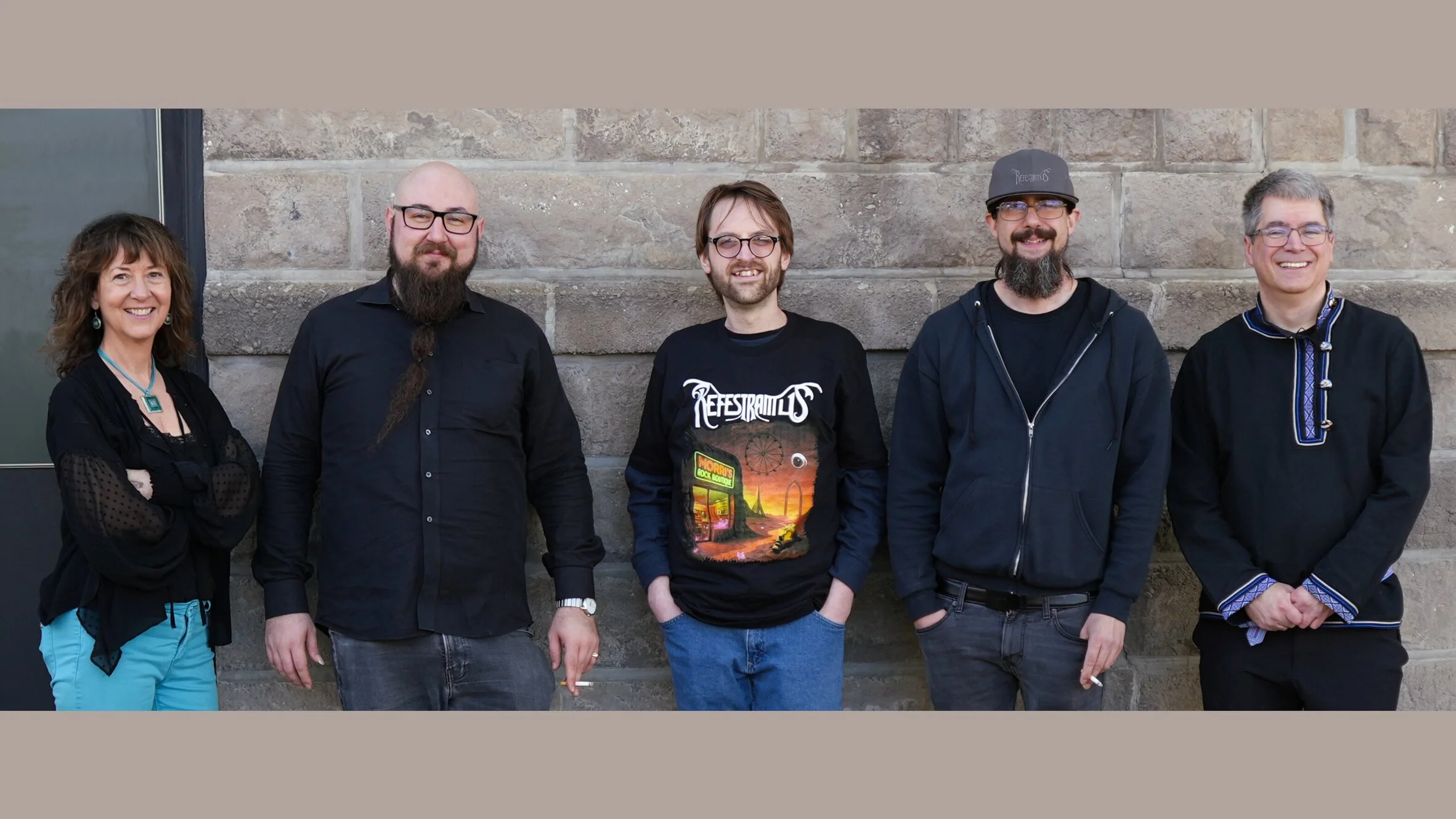
Derek Ferguson has spent twenty-five years watching America and feeling like something has taken hold of it, a mastermind making things worse every year regardless of who’s nominally in charge. That feeling became “Deathless,” the three-part suite anchoring Refestramus’s new album, built around Kashchey the Deathless, the villain of Russian folklore who hid his own death outside his body to make himself unkillable. Ferguson’s shorthand for the trick: “these are horcruxes, several centuries early.”
Refestramus is the Chicago progressive hard rock project Ferguson has led since 2020. Morri’s Rock Boutique, its desert-western third album, came out in March 2026 on Melodic Revolution Records. Ferguson answered the following questions posed by Jason Barnard.
What does the name Refestramus mean, and how did your mother end up coining it?
She didn’t coin it, that’s the thing — she inherited it. Refestramus meant re-arrange yourself. Pull it together, sort yourself out, become presentable. My mother said it to me my entire life, and she’d gotten it from her grandmother.
We assumed it was a real word. Why wouldn’t we? It was in constant household use for decades. I was in my twenties before somebody pointed out that it isn’t in any dictionary, in any language. That’s a strange thing to learn about a word you’ve been hearing since before you could read.
My working theory now: my great-grandmother was raised in a Catholic industrial school in Thurles, in 1904. Latin all around her, none of it explained. I think what she was hearing was revestiamus — “let us re-vest,” what the nuns would say when it was time to change for Mass. A child hears it, doesn’t know the grammar, keeps the meaning, hands the sound down the line slightly worn. Three generations later it comes out of my mother’s mouth as Refestramus and means exactly what it originally meant. The instruction survived; only the spelling got lost.
It seemed like the right name for a band I started in my forties, after a quarter century away. And there’s a practical upside — because the word doesn’t exist, every search result for it is us. No disambiguation page, no band from Sheffield with the same name. We are the entire corpus.
You spent years writing technology books and working in data strategy before this project existed. What pulled you back into music during lockdown?
It’s less that I came back and more that the excuse finally ran out. I played the Chicago scene in the early nineties — that was real, that was a decade of my life. Then a career happened.
You write Mobile .NET, you write Broadband Internet Access for Dummies, you end up running engineering organizations, and somewhere in there you trade an 88-key keyboard for a 104-key one and tell yourself it’s a promotion. The 88 stays in the corner of the room, making you feel vaguely guilty.
What lockdown removed was the commute, the travel, the whole scaffolding of reasons to not do it. May 2020, everybody’s home, and I had a backlog of material that had been accumulating for twenty-five years with nowhere to go. The odd thing is the pandemic also made it possible — every musician on earth was suddenly at home with a decent interface and time on their hands. A band like this couldn’t have been assembled in 2019.
Ian Beabout came in initially just for mixing and mastering. At what point did you realise he was going to become a creative partner rather than an engineer?
I found Ian through his radio show, Prog Rock Deep Cuts — I was a listener before I was a client. So I already knew his taste was better than mine in a few important directions.
The turn came when he stopped sending back mixes and started sending back questions. An engineer asks whether you want the vocal louder. Ian was asking why the section existed. At some point I noticed I was composing toward him — writing with the assumption that he’d push back.
When the second album was finished I told him that as far as I was concerned he’d produced the record. He said it was more like co-production, so that’s how we credited it. Going into the third album we made the arrangement explicit from the start.
How did bringing in Ian’s Colouratura bandmates change the sound of the group between Decoupage and Intouríst?
Decoupage was assembled the way the title suggests — cut and pasted. I recruited players internationally, a lot of them through Fiverr, sent out parts, got performances back, and glued them together. Some wonderful playing on it, but the seams are visible if you know where to look, and the album is essentially me plus a rotating cast.
It was really one person: Derek Pavlic, Colouratura’s guitarist. And the change he made wasn’t a change of style so much as a change of consistency — he’s a phenomenal player, and he’s on every track. That turns out to matter enormously. A record with one guitarist has a center of gravity. A record with six has six.
That was the governing idea for Intouríst generally: keep the same musicians wherever we possibly could. Decoupage is me plus a rotating cast; Intouríst is much closer to a band playing an album.
What are your biggest influences on the sound of your group?
Van der Graaf Generator above all — that combination of genuine menace and moral seriousness, which almost nobody else in the genre attempted. Then the American melodic side: Kansas, Styx, Crack the Sky. Procol Harum for the way a hymn and a rock song can be the same object.
Kansas is worth pausing on, because they’re an object lesson. They were at their best when Kerry Livgren was writing about questioning and searching and doubt. It went downhill fast once it turned into evangelizing and certainty. That’s a line I think about a lot.
I describe what we do as Heartland Prog. Modern prog with a classic feel — I want the complexity, but I want it in service of a tune you can carry out of the room. The compliment I like best is that fans call us the Punks of Prog, which I take to mean we haven’t sanded the edges off in pursuit of respectability.
Your lyrics draw on Russian literature, anime and Orthodox iconography, among other things. How do those interests make their way into a song without it turning into a history lecture?
By refusing to explain anything. The moment you start providing footnotes in a lyric you’ve admitted the reference is doing the work instead of the song.
The test I use: if you strip out every proper noun, is there still a person in there wanting something? Bulgakov isn’t in the lyrics because I want you to know I read Bulgakov — he’s there because The Master and Margarita understands something about how cowardice actually operates, and I need that understood in three minutes.
Morri’s Rock Boutique brings in guests like David Jackson, Joe Deninzon and Rick Witkowski. How do those collaborations usually start, and do you write with a specific guest in mind or build the song first?
The song first, almost always — but there’s a moment mid-arrangement where you hear an absence. Something is supposed to be in that hole and it isn’t a keyboard.
With David Jackson it was the plainest case imaginable: you write something and realize the only correct answer is saxophone played the way exactly one person on earth plays it. That’s not a session hire, that’s a specific voice. Same with Joe’s violin, same with Rick.
How they start is less romantic — you ask. Politely, with the track attached, having done the work first so you’re not asking someone to rescue a sketch. The prog world is small and generous, and Ian’s connections opened doors I couldn’t have knocked on myself. Nobody said no, which still surprises me.
The new album ends up making the case that right and wrong still exist and we’re accountable to them, after a lot of collapse and illusion along the way. Was that idea there from the start, or did it emerge as you wrote it?
Neither, really — because I’ve never sat down to write an album about anything. All three records so far are collections of songs, and the songs are always about whatever I happen to be dealing with at the time. Or sometimes just something I’ve seen that struck me as very funny. There’s a track on Intouríst called “Agent M vs. the Sex Lizard,” which came straight out of the televangelist Sharon Gilbert claiming — out loud, in public, to an audience — that a lizard demon had impersonated her husband in bed one night. You don’t build that into a thesis. You just write it down in between the giggles before the record company can freak out about it.
So, if the album argues that right and wrong are real and we answer for them, it’s because writing it coincided with my arriving at that conclusion myself. Specifically: that evil is real, and that I’m no more and no less evil than anybody else. I’d spent most of my life under the comfortable impression that I was great and everyone else was the problem. Turns out that’s not the arrangement. What a bummer.
“Deathless” draws on the Kashchey folklore to talk about power without accountability. What drew you to that myth?
What’s remarkable about Kashchey isn’t that he can’t die — it’s the mechanism. He takes his own death out of his body and hides it: a needle inside an egg, inside a duck, inside a hare, in a chest, under an oak, on an island. He’s made himself unkillable by externalizing the one thing that made him accountable. Readers who came up on Harry Potter will recognize the arrangement — these are horcruxes, several centuries early.
What drew me to it is that I’ve spent the last twenty-five years watching America and feeling like something has us. Like there’s a mastermind who ensnared us a while back and has been making us incrementally worse every single year since — and it doesn’t matter who’s in charge. The party changes, the direction doesn’t. That’s not a claim I can prove. It’s a feeling, and Kashchey is the shape that feeling has.
So, in the song he finally overreaches: he provokes the Third World War in the Donbas, and the island where he’s stashed his immortality goes up with everything else. Except the folklore is very specific about this — the needle has to be snapped. Vaporizing it doesn’t count. So, he survives, and he spends eternity on a desolate rock in space, having won.
Which I suspect is roughly how it ends for the people making these decisions. Not a reckoning — just the rest of their lives in a bunker somewhere, never seeing the sky again.
HRH Prog 15 was your first show in Britain. What was it like sharing a bill with groups like Focus and Curved Air?
Amazing, honestly. These are records I wore out as a kid in the Midwest, and then you’re all standing around the same catering table.
And I wasn’t walking out there on my own — David Jackson, Alex Hutchings and Gareth Cole were on that stage with us. Doing your first British show flanked by players of that calibre does a great deal for the nerves. David in particular: bringing Van der Graaf Generator’s saxophone player out in front of a British prog audience is not something I ever expected to be doing with my life.
The thing I hadn’t anticipated is how much a British prog audience listens. They’re not waiting for the hits. You can play something in an odd meter that nobody’s heard before and they lean in rather than heading to the bar. For a band whose entire existence to that point had been files moving between countries, walking out and finding a room already willing to meet us halfway was — well, it settled the question of whether the thing was real.
Where do you see the project heading now that Morri’s Rock Boutique is out?
In the immediate term there’s a lot moving. The immersive audio mixes — Atmos and 5.1, mixed by Jonathan Cornell — come out this Friday, August 7th, which for a record with this much going on in the arrangements is genuinely a different listening experience rather than a formality. The vinyl is in production behind that; this is a record that wants two sides and a gatefold you can read while it plays. We should have that vinyl with us when we play the ProgDay festival in Chapel Hill, North Carolina on September 5th.
The bigger news is the lineup. On Morri’s Rock Boutique we were joined by Jan Christiana and Dyanne Potter Voegtlin, both from Octarine Sky, and they’re now officially part of the band. Beyond being tremendous musicians and singers, Jan is one hell of an arranger. If anyone reading this hasn’t heard the Octarine Sky album Close to Nearby, go and fix that — there is playing on that record that is among the most amazing I have ever heard in my life, and I don’t say that as a bandmate. I said it as a listener first.
That changes the shape of album four, because they’re in at the beginning of the cycle rather than arriving partway through. So it’ll carry a lot more of their energy. And we’re hoping to record it together, in the same studio, instead of remotely — which after three albums built out of files crossing borders would be a real shift. That’s the way we keep progressing. Which is what prog is supposed to be about, isn’t it?


