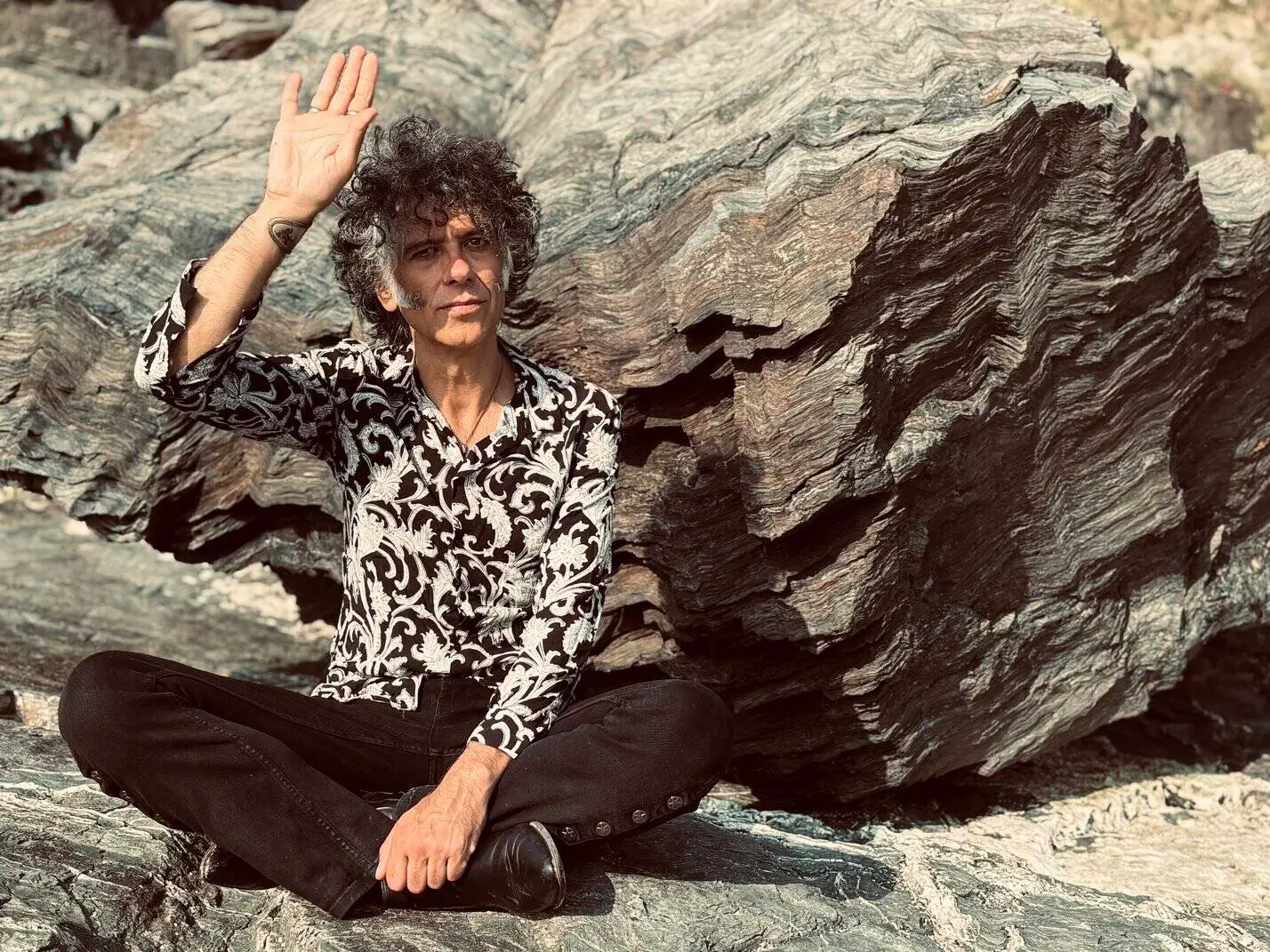
Kavus Torabi - by Layla Sunshine (used with permission)
By Jason Barnard
Kavus Torabi had a dream which inspired the the title of his latest LP ‘October By Name’. He realised only a couple of months before finishing the record that it completes a nine-album cycle: three trilogies running through The Utopia Strong, Gong and his solo work. On this record he has written his first straight love songs, and named a track after a disgraced Persian king who shares his name. He is also clearer about what belongs to Gong and what he keeps for himself. He talks about it here, as well as what a rare year off the road might finally allow him to make.
What was the dream you had, and when did you know the phrase was the album title rather than just an image to write from?
It was a fairly brief but convoluted dream as these things often are. It involved a Cardiacs rehearsal, a van and both Jim Smith and Rhodri Marsden. In the dream I said “October by name….October by nature” which was, in the context of dream logic, an incredibly funny and timely comment. Once I stopped laughing at my own comedic brilliance, I followed it with “That’s an album title!” after which I quickly awoke with the dream still fresh.
Fortunately for me, I needed an album title. My feeling is that if you can’t trust your subconscious, who can you trust? I shortened it to October By Name and it’s become the ideal title for the start of my ‘Autumnal Phase’ which it certainly heralds in.
Hip To The Jag, The Banishing and October By Name make one trilogy, the same way Universe Also Collapses, Unending Ascending and Bright Spirit did with Gong. Is that a method you set out to repeat, or something you only notice once you’re in it?
I noticed that October By Name completes a nine album cycle; Three trilogies from The Utopia Strong, Gong and solo. In that order. It hit me about two or three months before its completion and, as these things tend to, I started building a personal mythology around it from there. The Utopia Strong debut in 2019 really started this recent cycle. I had not seen any of these projects coming, I could never have conceived The Utopia Strong, would never have expected fronting and writing for Gong and never planned a solo career yet here we are. All three seem to work around one another and feed into each other too. It’s been a symbiotic process, really. It wasn’t until this album was completed that, for the first time, I looked back on my last decade of work and marvelled at where it had taken me. There were quite a few albums I did outside of this cycle too but this particular ‘nine panel grid’ has been most instructive. I think I’m a very different artist and musician to who I was when I went in.
You told me ‘Fragrance Of Paradise’ was your first ever love song. Now ‘Signals Shine’ and ‘In Her Radiance’ are being described as new ground too. What’s different about writing a love song solo versus inside Gong?
Although they were all inspired by the same person, I attempted to make ‘Fragrance Of Paradise’ more general, although it isn’t really. I tried to make it about the divine feminine, the goddess which is all women. I suppose with ‘Signals Shine’ and ‘In Her Radiance’ I was less self-conscious about being specific because I didn’t have to sing on behalf of a band, which is always something I think about in Gong. If I feel things get too autobiographical, particularly in a band with its own mythology, a band in which you are constructing architecture in someone else’s universe, I try to steen things away a little, although all my lyrics are sincere and come from the way I feel and think about things.
Writing a ‘straight’ love song as opposed to writing about unrequited, impossible romantic love or heartbreak is a new thing to me. I’ve been slightly surprised at just how florid the words are but I felt the pull of this lexicon and tried not to over think it. The inner critic can often be the enemy of art. It thinks it knows best but is usually trying to prop up an artifice. I like that these are love songs written by a man of my years. It’s a very different energy to love songs written in the craziness of one’s twenties. Not that I could have written one back then. I think I felt they were too corny or something. Again, that would have been the inner critic talking. So much of my decisions were guided by worrying about what other people thought.
You said whatever you write in Gong mode usually stays in Gong, and it’s rare for something to feel too personal for the band. Did any of these six songs start as Gong ideas before you kept them for your solo project?
For the first time yes. When I write in Gong usually, it’s music I come up with in that moment while we’re all together or ideas that are deliberately undeveloped so that I’m not too attached to them once we start working together.
With Bright Spirit, although we had a couple of songs we’d worked on together already, the bulk of the album was written at home and presented to the band. I’d written ‘Dream Of Mine’ and ‘Fragrance Of Paradise’ for this purpose and also a verse for a song then called ‘Wild Deer’ which I presented to the band. Quite early on I realised I was too precious about it to give it over to the collaborative process of Gong and decided I wanted to keep it for my solo work. ‘Wild Deer’ became ‘Water Into Wine’.
You’ve described becoming more solipsistic on a record you made alone. Gong is built on a shared experience with the audience. Does this album pull against that, or do the two just do different jobs for you?
I don’t think Gong pulls away from that. Gong has a way of working and it must be a good one because we’ve retained the same line up for over a decade and never argue. The dynamic we have seems to work for all of us. As I mentioned before, I didn’t plan on working solo but once I found a way, it then inspired a whole approach, almost like a philosophy. It became an all consuming and holistic way of working, a way of putting all aspects of what I enjoy into one thing, from composing, performing, producing, writing words, illustration, design and lettering. I hit upon this formula on Hip To the Jag, just as a problem solving exercise initially, before realising that the entire process was a blueprint I could use in moving forward. If I keep to the core principles of doing everything myself and by hand then I can watch my development and ultimately my own decline through doing it. I’ve given myself particular ‘rules’ in making these albums and I want to get better, or at least deeper, into all the elements of producing each artefact. In doing so they become a marker of who I was at the time of making. I don’t know if I’d ever want to stop collaborating with other people or doing bands but having this thing that I do where I don’t have to compromise, negotiate or justify my reasons for doing something allows instinct and the subconscious to drive it.
‘Water Into Wine’ questions whether free will exists at all before landing on believing change is possible anyway. That’s close to what you told me about ‘Stars In Heaven’ and wanting to love the world again. Is that the same idea, from two different records?
Kind of, I mean they were both written within the same few months although Water Into Wine is more specific. It was inspired by meeting up with an old acquaintance I hadn’t seen in years. We knew each other in our teens and early twenties and to see him now still carrying grievances, still defensive and rueful about his life really kind of broke my heart. The idea that ‘The world is as you are’ really resonated because he seemed to live in the same unhappy world of betrayals and falling out that he inhabited back in the late eighties. It just seems a desperate place to be although, I suppose, everyone’s where they want to be. And it wasn’t just him, I realised I knew a few people like this. I think it’s an observation that only comes from age. Perhaps they were always locked into this path, this way of being. Perhaps there’s no choice and all of this is inevitable, perhaps the idea of ‘self’ is just us observing this flesh avatar we inhabit playing out consequences but, even if that is the case, I think we have to believe that change is possible or, at least, I do. Another thing I’ve realised is that you can’t change someone’s mind. God knows I’ve tried! It just doesn’t work but we can change our own.
You’ve made every solo record the same way since Hip To The Jag, only the instruments you own, artwork hand lettered yourself. Has your overall process for your solo projects remained unchanged over the years or has it developed?
As I said, I created this process on the first record and realised it was a great model for working. I think I’m going to stick to it. Making Hip To The Jag reawakened my love of drawing in pen and ink, something I hadn’t really done since my teens. When I started up again I realised that my ability was pretty much at the same level as it was when I left it at about nineteen but my taste had improved somewhat! Since then I can see my style improving and get more singular the further I get into it. I must say that one of the most enjoyable and satisfying parts of this whole process has been drawing again. I’m very keen to find a way of integrating the art, writing and music even more from here on in. I see them all as part of there same thing, really.
What’s behind the title ‘My Shameful Namesake’?
Ha! That refers to Kai Kavus, the vainglorious and disastrous king from the Shahnameh, the Persian book of Kings, from which I was named. I always wondered why Kavus was such an unusual name, even among Iranians, but it wasn’t until I read about him I realised why. I saw quite a few parallels with myself in his story. Not least because he was charmed by a Div (demon) in disguise as a minstrel who enchanted him in his court with his music. As someone who took the devil’s music to heart and suffered the consequences, it felt most apt!
‘The Banishing’ was cathartic and intense, this one’s more optimistic. Is that where you are now, or a conscious choice not to repeat yourself?
Not conscious exactly, more that the process has been about making something autobiographical, putting all of who I am at the time of making into the thing, hopefully I too am changing and still growing rather than just growing old. There were a few more technical factors too, I acquired a little analogue synth since making The Banishing. I wrote In Her radiance and Ancestor’s Song using it and it’s all over Doperider, the last Utopia Strong album and Bright Spirit too, especially present on The Wonderment.
What does the rest of 2026 and into 2027 look like – solo touring, The Utopia Strong?
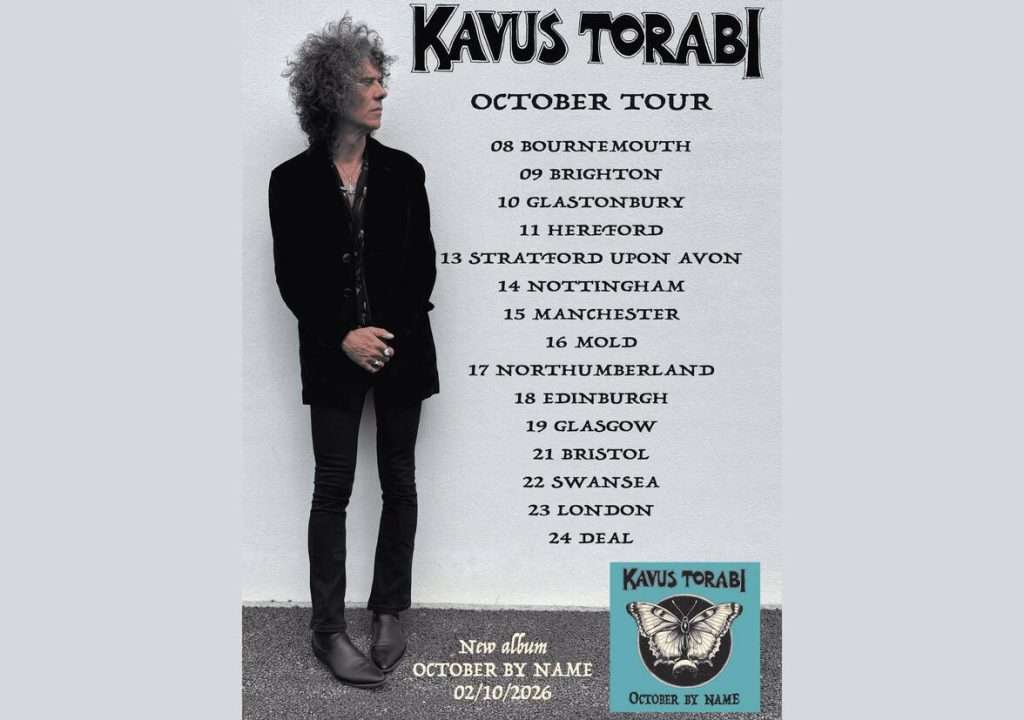
I have a solo tour to go with this album in October and outside of that I’m touring with Gong until December. We’re having a hiatus in 2027 with me wanting to concentrate more of my energies into solo music, art and The Utopia Strong. Gong became so busy recently which began to relegate The Utopia Strong and my solo work to almost ‘side project’ status which I wasn’t especially happy about. I mean I love that Gong has been so busy, but what tends to happen is the entire year gets carpet-bombed with dates and touring and I have to fit everything else into the gaps. I fancied a year where I could actually concentrate on making things rather than the repetition of the same day; hotel, van, soundcheck, gig, hotel.
Further information
October By Name by Kavus Torabi will be released on 2 October 2016 and is available to pre-order: